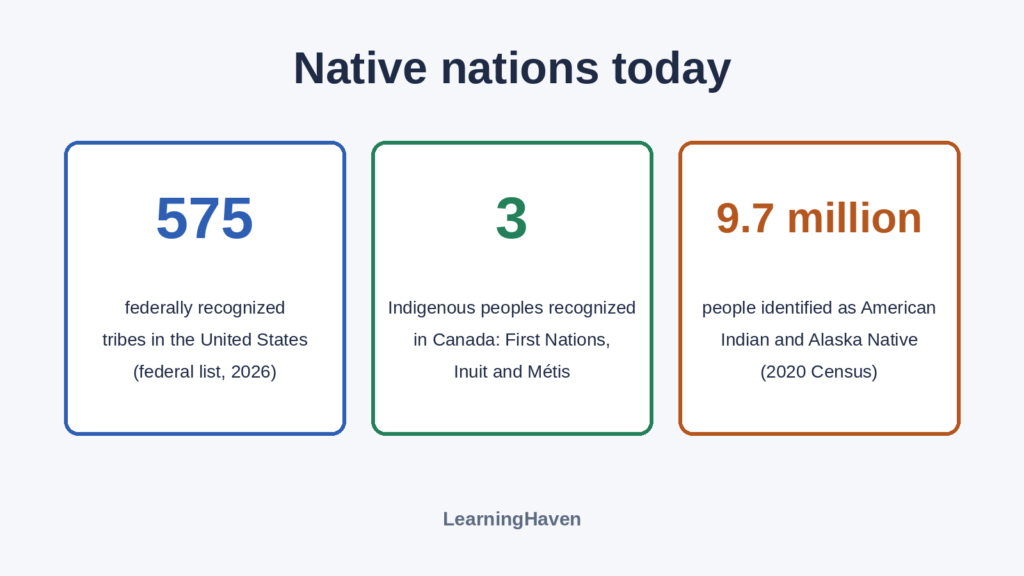
Native Americans are the first peoples of the Americas and their descendants. Today they belong to hundreds of distinct nations, each with its own government, language and homeland. No single culture covers them all. The United States recognizes 575 tribal nations, and the Smithsonian counts more than 2,000 tribal groups across the Americas.
Key facts
- The U.S. list published on January 30, 2026, names 575 federally recognized tribes (Bureau of Indian Affairs).
- The Smithsonian describes more than 2,000 tribal groups across the Americas (National Museum of the American Indian).
- In the 2020 Census, 9.7 million people identified as American Indian and Alaska Native, alone or in combination (U.S. Census Bureau).
- Canada’s Constitution recognizes 3 groups of Indigenous peoples: First Nations, Inuit and Métis (Government of Canada).
- Fossil footprints in New Mexico show people were in North America 23,000 to 21,000 years ago (U.S. Geological Survey).
Why learn about Native nations as distinct peoples?
Each Native nation has its own government, language and history, so treating “Native American” as one culture hides real differences. The Smithsonian’s National Museum of the American Indian states, “There is no single American Indian culture or language” (Native Knowledge 360°). The museum describes “vast cultural diversity among more than 2,000 tribal groups” in the Americas (Native Knowledge 360°).
Ways of life grew from each nation’s homeland. The museum says that for thousands of years, Indigenous people have “studied, managed, honored, and thrived in their homelands” (Native Knowledge 360°).
This section does not attempt a full picture of any nation’s culture. It covers specific topics and several nations, and it points you to the nations’ own websites and museum resources for anything deeper. It is part of LearningHaven’s social studies section.
What should you call Native peoples?
You can use any of the common terms, but the best choice is usually the name of the person’s own nation. The Smithsonian’s museum says of the common terms, “All of these terms are acceptable” (Smithsonian NMAI). It adds that “whenever possible, Native people prefer to be called by their specific tribal name” (Smithsonian NMAI).
- American Indian appears in U.S. government documents, such as the Bureau of Indian Affairs definition of a tribe, and in the Smithsonian museum’s name.
- Native American is common in the United States. The museum notes that it “is falling out of favor with some groups.”
- Indigenous peoples is a collective name for the original peoples of North America and their descendants (Government of Canada).
- First Nations, Inuit and Métis are the 3 groups of Indigenous peoples that Canada’s Constitution recognizes. Canada calls them “3 distinct peoples with unique histories, languages, cultural practices and spiritual beliefs” (Government of Canada).
- A nation’s own name, such as Haudenosaunee or Oceti Sakowin, is the most specific choice.
Older pages, including an earlier version of this one, said the word “Indian” was simply wrong and that “Native American” was the only proper name. That idea comes from older guidance. The Smithsonian’s current teaching guide accepts all the common terms. Use a nation’s own name when you know it, and use a common term when you mean many nations at once.
How many Native nations are there today?
The United States recognizes 575 tribal nations, according to the list the Bureau of Indian Affairs published on January 30, 2026 (Federal Register). Some older Smithsonian and Census pages still say 574. The newest official list says 575.
Each federally recognized tribe has “a government-to-government relationship with the United States,” the Bureau of Indian Affairs explains (Bureau of Indian Affairs). The bureau says tribes possess “certain inherent rights of self-government (i.e., tribal sovereignty)” (Bureau of Indian Affairs). Sovereignty means a nation has the right to govern itself.
The count changes over time as nations gain federal recognition. It does not include nations recognized only by a state, or Native nations in Canada and other countries. It is a floor, not a full count of Native peoples on the continent.
Where did the first peoples of the Americas come from?
Scientists say the first people reached the Americas from Asia during the last Ice Age, but they still debate when and by which routes. During the Ice Age, low seas exposed a land bridge about 1,000 miles wide between present-day Russia and Alaska (National Park Service). The park service says people may have crossed it “at different intervals between 40,000 and 13,000 years ago” (National Park Service).
- By the coast: Some people may have traveled south along the Pacific coast by boat. Sites in Channel Islands National Park suggest people reached the California coast as early as 13,000 years ago (National Park Service).
- Footprints: Fossil footprints at White Sands National Park in New Mexico show people were in North America between 23,000 and 21,000 years ago (U.S. Geological Survey). Scientists dated seeds, pollen and quartz grains from the layers with the footprints.
- A broad range: The Smithsonian says American Indians have lived in the Western Hemisphere for at least 15,000 to 20,000 years (Native Knowledge 360°).
The National Park Service sums up the science: “the date of the first peopling of the Americas remains in question” (National Park Service). An earlier version of this page gave one route and one date range as settled. The evidence does not support that.
Many Native nations also have their own origin histories. The Smithsonian notes that “Many American Indian communities have creation stories that specify their origins in the Western Hemisphere” (Native Knowledge 360°). Those histories belong to each nation to tell. This page does not retell them or rank them against the science.
How do scholars group Native nations by region?
Scholars often sort Native nations of the United States and Canada into 10 culture areas, which are regions where societies shared many traits. Anthropologist Clark Wissler developed the idea in the early 1900s (Britannica). The 10 areas are Arctic, Subarctic, Northeast, Southeast, Plains, Southwest, Great Basin, California, Northwest Coast and Plateau (Britannica).
Culture areas are a model made by outside scholars, not borders that the nations drew. Nations traded and moved across these regions, and their ways of life changed over time. The Shawnee homeland was in the Ohio Valley, for example, and all three federally recognized Shawnee tribes are based in Oklahoma today. Modern state and national borders also cut across the areas.
Our page on the major groups of Native North America goes through the culture areas region by region.
To sum up so far, Native Americans are hundreds of distinct, living nations, not one culture. The safest name for any group is the nation’s own name. Any number about Native nations should come with a date and a source, such as the 575-nation list from January 2026.
What happened when Europeans and the United States took Native lands?
After Europeans began arriving in the late 1400s, Native nations faced new diseases, wars and the loss of their lands. Britannica dates the first European arrivals to the late 1400s (Britannica). When European diseases reached Native communities, “the people suffered terribly,” North Dakota’s state history program explains (North Dakota Studies). Later, the U.S. government used laws and treaties to force nations off their homelands. “Congress passed, and President Andrew Jackson signed, the Indian Removal Act on May 28, 1830,” the National Archives explains (National Archives). The act let the president negotiate removal treaties with nations living east of the Mississippi River (National Archives). The forced removals of the Cherokee, Muscogee (Creek), Choctaw, Chickasaw and Seminole nations that followed are known as the Trail of Tears.
The U.S. government also ran or funded boarding schools for Native children. The Department of the Interior’s Federal Indian Boarding School Initiative lists 417 of these institutions across 37 states or then-territories (U.S. Department of the Interior). Its July 2024 report confirmed that at least 973 American Indian, Alaska Native and Native Hawaiian children died while attending them (U.S. Department of the Interior).
Native nations resisted these policies and survived them, and hundreds govern themselves today. This section is a short summary. It does not cover every war, treaty or removal. Our page on the effects of colonization on Native nations covers this history in more depth.
Where do Native people live today?
Native people live on reservations, in tribal communities and in towns and cities across the United States and Canada. In the 2020 Census, 9.7 million people identified as American Indian and Alaska Native, alone or in combination with another group (U.S. Census Bureau). The Census Bureau counted 324 distinct federally recognized American Indian reservations in 2022 (U.S. Census Bureau).
In Canada, more than 1.8 million people identified as Indigenous in the 2021 Census, about 5 percent of the population (Government of Canada). The Smithsonian puts it plainly: “American Indian cultures and people are fully engaged in the modern world” (Native Knowledge 360°).
Census numbers count how people describe themselves. They are not a count of tribal citizens.
How do you use this section?
Start with the two overview pages above, on major groups and on colonization, then pick a topic or a nation below. Every page in this section treats Native Americans as many distinct, living nations, and each one uses the nation’s own name where a source gives it. Each page also links back here, so you can always find the rest of the section.
This section does not cover every nation. It covers the ones we have researched and written pages for. If a nation is not listed here, that is a gap in the section, not a comment on that nation’s importance.
Which topics cross many nations?
Eight pages look at topics that matter to many nations. Each one explains that meanings belong to specific nations, not to Native peoples as a whole.
- Native American symbols looks at the meanings carried by design and imagery in different traditions, and why one chart cannot explain them all.
- Horses in Native American culture covers how the horse changed life on the Plains after Spanish colonizers brought horses back to the continent, and what horses mean to Native communities today.
- Sacred pipes: beyond the peace pipe label explains why the popular name oversimplifies a ceremonial object, and why it is not a craft project.
- The spirit bear covers the white-furred black bear of British Columbia’s Great Bear Rainforest and what it means to the Coastal First Nations.
- Native American music covers songs, drums, rattles, flutes, and powwow music in specific nations, and how to listen with respect.
- Totem poles covers the poles that Northwest Coast nations carve, what crests and pole types mean, the potlatch ban, and poles that have come home.
- Native American clothing covers the materials nations used by region, Pueblo and Diné weaving, beadwork, and why regalia is not a costume.
- Native American pottery explains how potters build pots by hand, which nations are known for pottery, and potters working today.
Two more pages cover shared history and a yearly observance.
- The Trail of Tears covers the forced removal of five nations from the Southeast after the Indian Removal Act of 1830, the routes they traveled, and where those nations govern themselves today.
- National Native American Heritage Month explains how November became a national observance in 1990 and how you can take part respectfully.
Which nations does LearningHaven cover?
LearningHaven has pages on nine nations or confederacies so far. Each page carries its own sources, including the nations’ own websites where they exist.
The Haudenosaunee (Iroquois) Confederacy
The nations of the Confederacy call themselves Haudenosaunee, a name from their own language that means “They made the house” (Haudenosaunee Confederacy). The Confederacy began with five nations, and the Tuscarora later joined as the sixth.
- The Haudenosaunee Confederacy hub introduces the Six Nations and explains why we lead with the name the nations use for themselves.
- The Mohawk Nation (Kanien’kehá:ka) and the Seneca each have their own page.
- Iroquois art covers culture in more depth.
- Iroquois false face masks carries a caution from the Confederacy about how the masks should and should not be taught.
This section covers two of the six member nations, Mohawk and Seneca, along with the shared Confederacy history and art.
The Ohlone peoples of the San Francisco Bay Area
- The Ohlone section is a hub of its own, covering the Ohlone peoples whose homeland is the San Francisco Bay Area.
- San Francisco before European settlement looks at the Bay Area before colonization.
- An education page on Ohlone life and history includes a record of a 2003 tule reed canoe event at Lake Merced.
This section does not cover every California nation. It covers the Ohlone specifically.
The Wampanoag
The Wampanoag are the Native people of present-day southeastern Massachusetts, including Cape Cod and the islands. Two Wampanoag communities, the Mashpee Wampanoag Tribe and the Wampanoag Tribe of Gay Head (Aquinnah), hold federal recognition today. Our page on the Pilgrims and Plymouth Colony covers the 1620s, when English colonists settled in the Wampanoag homeland.
The Oceti Sakowin (Sioux)
“Sioux” is an outside name for the Oceti Sakowin, the Seven Council Fires. The Oceti Sakowin page covers the Lakota, Dakota and Nakota nations, who live today on reservations and in communities across the northern Great Plains and in Canada.
The Shawnee
The Shawnee are an Algonquian-speaking people whose original homeland was the Ohio Valley. Today three federally recognized Shawnee tribes govern themselves from Oklahoma.
The Cherokee
The Cherokee page covers the three federally recognized Cherokee tribes: the Cherokee Nation and the United Keetoowah Band in Oklahoma, and the Eastern Band of Cherokee Indians in North Carolina. It also covers Sequoyah’s syllabary, the Cherokee Phoenix newspaper and how Cherokee people keep their language alive today.
The Pawnee
The Pawnee are a Caddoan-speaking people whose homeland lay along the Platte, Loup and Republican rivers in present-day Nebraska and Kansas. Today the Pawnee Nation of Oklahoma governs itself from the town of Pawnee, Oklahoma.
The Potawatomi
The Potawatomi are an Algonquian-speaking people of the Great Lakes region whose homeland lay around Lake Michigan. Today they belong to seven separate federally recognized nations in Oklahoma, Kansas, Wisconsin, Michigan and Indiana.
The Crow
The Crow, who call themselves Apsáalooke, are a Siouan-speaking nation of the Northern Plains whose homeland lay in the Yellowstone River region. Today the Crow Tribe governs itself from Crow Agency on the Crow Indian Reservation in Montana.
Try this: Who lives here today?
Find out which Native nations have homelands where you live, using sources that the nations and the U.S. government publish.
- Open the official list of federally recognized tribes and look for nations in your state.
- Remember that some nations were forced to move. A nation whose homeland includes your area may be based in another state today, as the Shawnee are.
- Visit each nation’s own website. Write down the name the nation uses for itself, where its government is based today, and one fact it shares about its history.
- Compare your notes. Is the nation based where its homeland was? If not, use the colonization page above to find out why.
Use the nations’ own sources first. Do not make crafts that copy sacred objects such as pipes or masks. Teachers can find more ideas in our social studies lesson plans.
Sources
- Smithsonian National Museum of the American Indian. Native Knowledge 360°: Essential Understandings
- Smithsonian National Museum of the American Indian. Native Knowledge 360°: Teaching and Learning about Native Americans
- Bureau of Indian Affairs. Indian Entities Recognized by and Eligible To Receive Services From the BIA (Federal Register, January 30, 2026)
- Bureau of Indian Affairs. What is a federally recognized tribe?
- U.S. Census Bureau. Facts for Features: American Indian and Alaska Native Heritage Month, November 2023
- Government of Canada, Crown-Indigenous Relations and Northern Affairs. Indigenous peoples and communities
- National Park Service. Bering Land Bridge National Preserve
- National Park Service. Coastal Migration
- U.S. Geological Survey. Fossil Footprints and Ice Age Ecosystems of White Sands National Park
- Britannica. Culture areas of the Americas
- Britannica. Indigenous Peoples of the Americas at a glance
- North Dakota Studies, State Historical Society of North Dakota. Smallpox Epidemics: Introduction
- National Archives. On Exhibit: the Indian Removal Act
- U.S. Department of the Interior. Secretary Haaland Announces Major Milestones for Federal Indian Boarding School Initiative
- Haudenosaunee Confederacy. The League of Nations