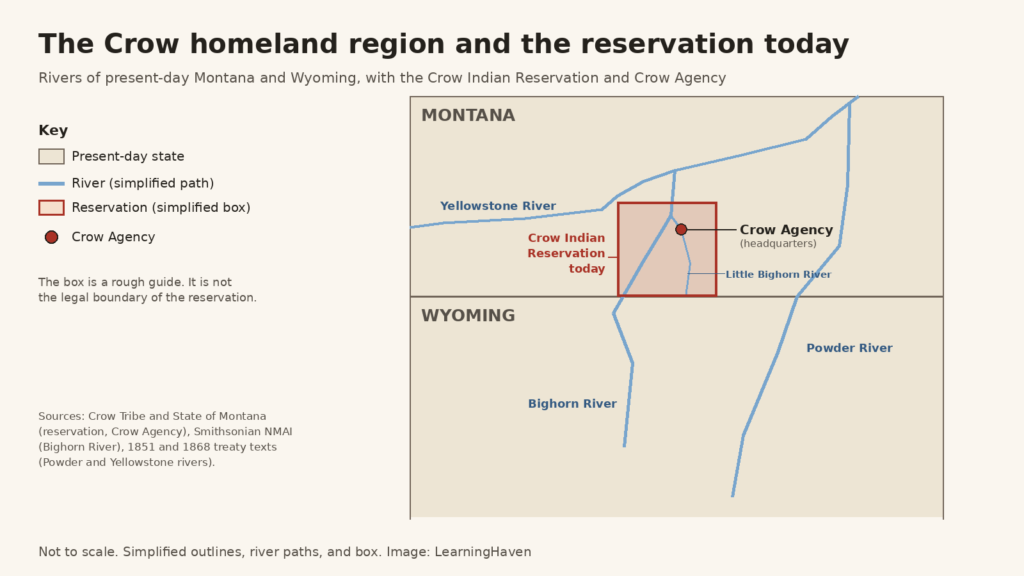
The Crow are a Siouan-speaking Native nation of the Northern Plains whose homeland lay in the Yellowstone River region of present-day Montana and Wyoming, and whose citizens today belong to the Crow Tribe on the Crow Indian Reservation in Montana. This page covers the name Apsáalooke, the homeland, life on the Plains, clans, treaties and land loss, the role of Crow scouts in 1876, the reservation today, government, Crow Fair, and two well-known Crow people.
Who are the Crow?
The Crow call themselves Apsáalooke. (Crow Tribe) The word means “children of the large-beaked bird.” Outsiders later misread it as “Crow.” (State of Montana, Britannica Kids) Spellings differ. Britannica Kids writes Absaroka. (Britannica Kids)
The Crow language belongs to the Siouan family. (Britannica Kids)
This section covers names and language. It doesn’t give speaker counts, which differ by source, or cover beliefs and ceremonies, which belong to the Nation.
Where was the Crow homeland?
The Smithsonian National Museum of the American Indian (NMAI) says the Crow homelands covered a large area of present-day Montana, Wyoming, and South Dakota. There were three Crow political divisions: the Mountain Crow, the River Crow, and the Kicked In The Bellies. The River Crow ranged from the Yellowstone River north to the Milk River. The Mountain Crow lands straddled the Montana-Wyoming border. (NMAI) The NMAI adds that the Yellowstone River and nearby lands are important to the history and culture of the Crow. (NMAI)
The 1851 Fort Laramie treaty describes the “territory of the Crow Nation” by its rivers and mountains. They include the Powder River, the Yellowstone River, and the Wind River Mountains. (Treaty text)
Accounts of how the Crow came to this region differ. In Crow oral history, as the NMAI gives it, the Crow intentionally migrated from the east. (NMAI) Britannica Kids says the Crow were once united with the Hidatsa, a farming people of present-day North Dakota, and split from them sometime between the mid-1600s and the early 1700s. (Britannica Kids) The Encyclopedia of the Great Plains says the move came probably before 1600. (Encyclopedia of the Great Plains) This page doesn’t pick one date.
This section covers the homeland in general terms. It doesn’t cover every camp or hunting ground.
How did the Crow live on the Northern Plains?
Britannica Kids says the Crow gave up farming after they moved west. They took up a Plains way of life and hunted bison (buffalo) on horseback. On the hunt they lived in portable, cone-shaped tents called tipis, covered with bison skins. Bison skins also became clothing, containers, and shields. The Crow ate bison meat and gathered berries, roots, and other wild plants. Women were responsible for preparing food, housing, and clothing. (Britannica Kids)
Horses came to Crow country early. Montana’s education office says the Crow acquired horses between 1700 and 1735. (Montana OPI) The NMAI says the Crow were famous for some of the largest horse herds on the northern Great Plains, and Crow artists made elaborate horse regalia to honor horses. (NMAI) For how horses changed life on the Plains, see our page on Native Americans and horses.
This section covers food, shelter, and horses. It doesn’t cover ceremonies or trade.
What is the Crow clan system?
The Encyclopedia of the Great Plains says the Crow kept a matrilineal clan system, and that today’s clans are based on thirteen original clans. Matrilineal means family ties are traced through the mother’s side. (Encyclopedia of the Great Plains)
The Crow word for clan, ashammaleaxia, means “driftwood lodges.” The encyclopedia explains the idea this way. A single piece of driftwood struggles in a strong river, but pieces lodged together along the bank hold. In the same way, a Crow person is supported by a wide web of kin. (Encyclopedia of the Great Plains)
This section covers clans in general terms. It doesn’t cover how names are given or any ceremony.
How did treaties and laws change Crow land?
Montana’s timeline says smallpox epidemics reached Crow country between 1840 and 1850, and the tribe’s population fell from an estimated 10,000 in 1830 to about 2,000. (Montana OPI)
The Fort Laramie Treaty of 1851 was signed on September 17, 1851, and the Crow were one of the nations that took part. (Treaty text) Montana’s timeline says the treaty identified 38 million acres as the Crow territory. (Montana OPI)
A second Fort Laramie treaty, signed with the Crow on May 7, 1868, set apart a district in what was then Montana Territory for the “absolute and undisturbed use and occupation” of the Crow. It also let them hunt on unoccupied U.S. lands as long as game could be found and peace held. (Treaty with the Crows, 1868) Montana’s timeline says this treaty reduced Crow lands to eight million acres. (Montana OPI)
Later acts of Congress cut the reservation again. The timeline lists acts in 1882, 1891, and 1904. The 1891 act covered nearly two million acres. After the 1904 act the reservation was its present size, 2.3 million acres. (Montana OPI)
In 1883 the government moved its boarding school to present-day Crow Agency. Parents were told their rations would be withheld if they did not send their children. The first three Crow children were sent to Carlisle Industrial School in Pennsylvania. (Montana OPI) For the wider story, see Effects of Colonization on Native Americans.
This section covers the main treaties and acts. It doesn’t cover every land sale or court case.
What role did Crow scouts play in 1876?
In 1876 the U.S. Army ran a campaign to force Lakota and Cheyenne bands living outside reservations to return to them. (National Park Service) Britannica Kids says the westward push of white settlement drove the Blackfeet and Sioux into Crow country, leading to wars in which the Crow suffered heavy losses. It says the Crow sided with the U.S. military in the Plains Wars of the 1860s and 1870s. (Britannica Kids) Our page on the Sioux nations explains that name.
The National Park Service (NPS) says about 260 Crow and Shoshone scouts served with General Crook’s force. Almost 30 Crow scouts were with Colonel Gibbon’s column. About a half-dozen Crow scouts were with Custer’s 7th Cavalry. At the Battle of the Rosebud on June 17, 1876, the NPS says, Crow and Shoshone scouts attacked a larger Lakota and Cheyenne force until Crook could form a defense. More than 10 of those scouts were killed. (NPS)
The Battle of the Little Bighorn was fought on June 25 and 26, 1876, in south-central Montana. The NPS describes it as a fight between Lakota, Northern Cheyenne, and Arapaho warriors and the 7th Cavalry with its Crow and Arikara scouts. (NPS) The Indian Memorial there was dedicated in 2003. It commemorates the sacrifices of the Arikara, Apsaalooke (Crow), Arapaho, Cheyenne, and Oyate (Lakota Sioux) tribes in the battle. (NPS)
This section covers what the NPS and Britannica Kids say about Crow scouts. It doesn’t retell the fighting or take sides.
Where is the Crow Indian Reservation today?
The Crow Indian Reservation is in south-central Montana, with Wyoming to its south. Its headquarters are in Crow Agency. It is the largest reservation in Montana. (State of Montana) Sources give its size as about 2.2 million acres or 2.3 million acres. (State of Montana, Advisory Council on Historic Preservation) The NMAI says the Bighorn River flows through the center of the reservation. (NMAI)
Chief Plenty Coups State Park, near Pryor, sits within the reservation. (Montana FWP) The NPS lists the address of Little Bighorn Battlefield National Monument as Crow Agency, Montana. (NPS) Guided bus tours there are offered by Apsáalooke Tours of the Crow Nation Office of Tourism. (NPS)
This section covers where the reservation is and a few places on it. It doesn’t cover every town or site.
How is the Crow Nation governed?
The Crow Tribe’s own site says the Crow Constitution and By-Laws of 2001 set up three branches of government: Executive, Legislative, and Judicial. (Crow Tribe) An earlier constitution was first adopted in 1948. (Crow Tribe) The Crow Tribal General Council is made up of all eligible tribal members 18 and older. The site says it has the power to elect the Executive Officials, the legislators, and the judges. (Crow Tribe) The State of Montana says Executive Branch members serve four-year terms. (State of Montana)
This section covers how the Nation’s own site describes its government. It doesn’t name officeholders or speak for the Nation.
What is Crow Fair?
Crow Fair is held each August at Crow Agency. The NMAI says it opens with a parade in which people dress themselves and their horses in elaborate regalia, and calls it one of the largest Native gatherings in the country. (NMAI) The Museum of the Rockies says Crow Agency becomes the “Tipi Capital of the World” during the fair, with powwows, rodeos, over 1,000 tipis, and a great gathering of families and friends. (Museum of the Rockies)
For more on powwow music, see our page on Native American music.
This section covers Crow Fair in general terms. It doesn’t give schedules, which change each year.
Who are some well-known Crow people?
Plenty Coups was made a chief of the Apsáalooke by age 28. In 1884 he settled on a farm near Pryor, where he opened a general store. He died in 1932 at age 84. At his request and his wife Strikes the Iron’s, 195 acres of his land became a public park. The Apsáalooke people voted to name him their last traditional tribal chief. (Montana FWP)
Joseph Medicine Crow (1913 to 2016) was a Crow historian and author. After World War II he became the tribal historian. (National Library of Medicine) He was the first member of his tribe to earn a master’s degree, in anthropology at the University of Southern California in 1939. (USC Dornsife) In 2009 President Barack Obama gave him the Presidential Medal of Freedom. (National Library of Medicine)
This section covers two historical figures. It doesn’t rank Crow leaders or list everyone.
Check what you learned
- What does the word Apsáalooke mean?
- Which river region was the Crow homeland?
- In which years were the two Fort Laramie treaties that named the Crow signed?
- What town is the headquarters of the Crow Indian Reservation?
Show answers and reasoning
- “Children of the large-beaked bird.” Outsiders later misread it as “Crow.”
- The Yellowstone River region of present-day Montana and Wyoming.
- 1851 and 1868.
- Crow Agency, Montana.
For more on Native nations, start at the Native Americans hub.
To compare regions, see Native American cultural regions and our social studies section.
For another Plains nation, see the Pawnee.
Sources
- Crow Tribe. Official site of the Crow Tribe Executive Branch.
- Crow Tribe. Crow Tribal Government.
- State of Montana. Crow Nation, Tribal Nations directory.
- Smithsonian National Museum of the American Indian. Crow Nation, Northern Plains History and Cultures.
- Britannica Kids. Crow.
- Frey, Rodney. Crows, Encyclopedia of the Great Plains, University of Nebraska-Lincoln.
- Montana Office of Public Instruction, Indian Education for All. Crow Reservation Timeline, 2017.
- Treaty of Fort Laramie, 1851. Treaty text, University of Nebraska-Lincoln Treaties Portal.
- Treaty with the Crows, 1868. Treaty text, Oklahoma State University Library.
- National Park Service. Story of the Battle, Little Bighorn Battlefield National Monument.
- National Park Service. Indian Scouts, Little Bighorn Battlefield National Monument.
- National Park Service. Indian Memorial, Little Bighorn Battlefield National Monument.
- National Park Service. Directions, Little Bighorn Battlefield National Monument.
- National Park Service. Apsaalooke Tours, Little Bighorn Battlefield National Monument.
- Advisory Council on Historic Preservation. Crow Tribe of Indians, Montana.
- Montana Fish, Wildlife and Parks. Chief Plenty Coups State Park.
- Museum of the Rockies. Crow Fair.
- National Library of Medicine. Native Voices, 2009: Presidential Medal of Freedom honors Apsáalooke (Crow) historian and veteran.
- USC Dornsife. The war chief who became a peace chief, June 28, 2022.