The Pawnee are a Caddoan-speaking Native nation whose homeland lay along the Platte, Loup, and Republican rivers in present-day Nebraska and northern Kansas, and whose citizens today belong to the Pawnee Nation of Oklahoma. This page covers the Pawnee name, the four bands, earth lodge villages, farming and bison hunting, the stars, treaties and removal, and the Nation today.
Who are the Pawnee?
A museum in Wyoming says the Pawnee call themselves Chahiksichahiks, meaning “Men of men.” (Center of the West) The Nation’s own newspaper is titled Chaticks si Chaticks. (Pawnee Nation) Spellings of Pawnee words differ from source to source. The word “Pawnee” itself may come from pariki, “horn,” for a hairstyle that stood up like a horn. (Encyclopedia of World Cultures)
Pawnee is a Caddoan language. It is related to the language of the Wichita and other Caddoan groups in Texas. (Kansas Historical Society) The Nation says its history spans more than 2,000 years. The Kansas Historical Society says Pawnee people have lived on the central plains for most of the last thousand years. (Pawnee Nation, Kansas Historical Society)
This section covers names and language. It doesn’t cover beliefs or ceremonies, which belong to the Nation.
Where was the Pawnee homeland?
The Pawnee lived along the Platte, Loup, and Republican rivers, which flow through present-day Nebraska and northern Kansas. (Center of the West) The Republican River in Kansas is named for the Kitkehahki band. (Kansas Historical Society)
Counts of Pawnee people vary a lot. About 12,000 Pawnee lived in the 1830s. (Center of the West, Texas State Historical Association) The Nation’s website says perhaps as many as 300,000 Pawnees lived on the central plains before European contact. (Pawnee Nation)
This section covers the homeland rivers. It doesn’t cover every place the Pawnee hunted.
What are the four Pawnee bands?
A band is a major division of a nation, made up of one or more villages. The Pawnee Nation has four bands. (Pawnee Nation)
| Band | English name | Place among the bands |
|---|---|---|
| Skidi | Wolf | North, on the Loup River |
| Chaui | Grand | Middle |
| Pitahawirata | Tappage | East |
| Kitkehahki | Republican | West, in north central Kansas and southern Nebraska |
(Center of the West for the names, Kansas Historical Society and Oklahoma Historical Society for the places)
The Skidi spoke a distinct dialect. The other three bands lived south of the Platte River, spoke one dialect, and are called the South Band. (Oklahoma Historical Society) The Nation’s own pages spell some band names with special letters, such as Čawî’ for Chaui.
This section covers the four bands. It doesn’t cover every village.
What was an earth lodge?
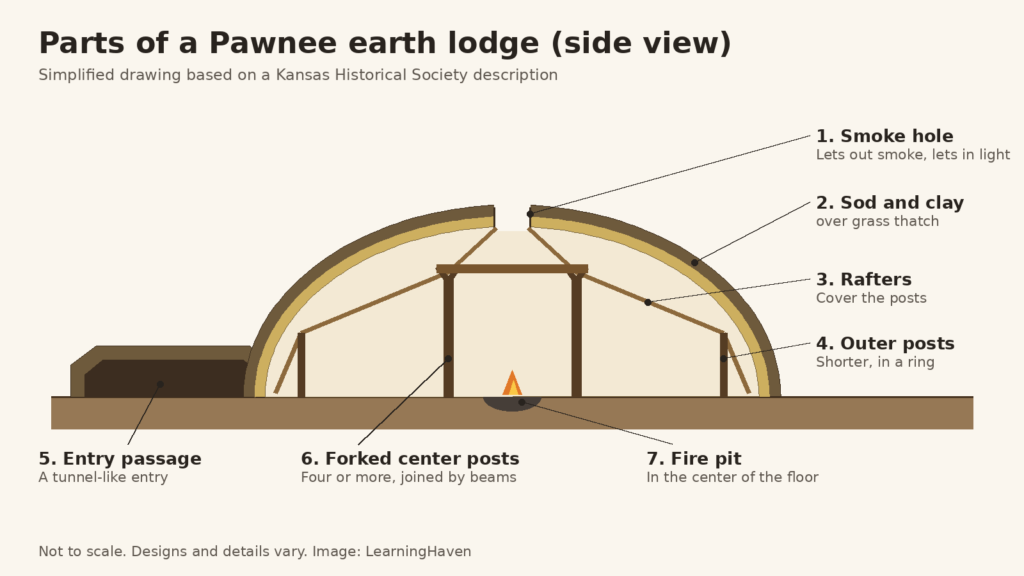
An earth lodge was a round, dome-shaped home with a heavy timber frame covered by branches, grass, and then earth. (Kansas Historical Society) Lodges were 20 to 60 feet across. Four center posts, forked at the top, held up beams. Shorter posts stood in a ring inside the outer wall. Rafters covered the posts, and thatch, sod, and clay went over the rafters. A hole at the top let out smoke and let in light. For the Pawnee, it also gave a view of the stars. A tunnel-like entry usually faced east. (Kansas Historical Society)
Up to 40 people from two extended families could live in one large lodge. The women built the lodges and owned them. (Kansas Historical Society)
You can see the floor of a real lodge in Republic County, Kansas. The Pawnee Indian Museum State Historic Site stands on a Kitkehahki village site, and the museum is built over the excavated floor of one lodge. (Kansas Historical Society) The Pawnee Nation’s tourism page also lists a virtual tour of an earth lodge. (Pawnee Nation)
This section covers how a lodge was built. It doesn’t cover any ceremony held in one.
How did the Pawnee farm and hunt?
The Pawnee farmed and hunted bison in a yearly cycle. (Oklahoma Historical Society)
- Spring. Women planted gardens of corn, beans, and squash in the villages.
- Summer hunt. In June, villagers traveled west to the High Plains for nearly three months to hunt bison.
- Harvest. In late August they came home to harvest the crops.
- Winter hunt. In late October or November they left again and lived in bison-hide tipis.
- Return. In February or March they came back to the earth lodges.
The men hunted. The women dried the meat and cleaned the hides, which became clothing, housing, and supplies. Vegetables were kept in storage pits that families could open all year. (Kansas Historical Society) The Texas State Historical Association says corn was seen as a sacred gift and was called “mother.” (Texas State Historical Association) For how horses changed Plains hunting, see our page on Native Americans and horses.
This section covers food and the seasons. It doesn’t cover every Pawnee craft or tool.
What did the stars mean to the Pawnee?
The Kansas Historical Society says Pawnee life was influenced by cosmology. The Pawnee studied the movement of the stars and made star charts to set their calendar. (Kansas Historical Society) The Oklahoma Historical Society says Pawnee priests acted as go-betweens for the village and the heavens, including the stars. (Oklahoma Historical Society)
This section covers the stars in general terms. It doesn’t describe sacred bundles or ceremonies. Those belong to the Pawnee Nation, and the Nation decides what to share.
What happened to the Pawnee in the 1800s?
Settlers and travelers crossed Pawnee land and used up game, wood, and grass. In 1833 the four bands gave up their lands south of the Platte River. In 1857 a treaty signed at Table Creek gave them a small reservation on the Loup Fork. (Oklahoma Historical Society)
Disease hit hard. Cholera killed more than a thousand Pawnee in 1849, and a smallpox epidemic struck in 1852. The Pawnee also faced attacks from the Sioux, an outside name for the Oceti Sakowin. (Oklahoma Historical Society) Our page on the Sioux nations explains that name.
Pawnee men served as scouts with the U.S. Army from the 1860s into 1877. (Center of the West) The Oklahoma Historical Society links this service to the pressure of Sioux attacks and says scouts protected workers building the Union Pacific Railroad. (Oklahoma Historical Society)
Between 1874 and about 1876, the Pawnee gave up the Nebraska reservation and moved to Indian Territory, in present-day Oklahoma. Sources give slightly different years for the move. The Nation bought new land from the Cherokee and Muscogee nations. (Pawnee Nation, Encyclopedia of World Cultures) By 1889 most Pawnee school-age children were enrolled in agency or off-reservation boarding schools. The population fell to about 630 around 1900. (Oklahoma Historical Society, Center of the West)
For the wider story, see Effects of Colonization on Native Americans and the Trail of Tears, which covers other removals.
This section covers the main events. It doesn’t cover every treaty, battle, or village.
Where do the Pawnee live today?
The Pawnee Nation of Oklahoma is a federally recognized government. Its headquarters are in Pawnee, Oklahoma. (Kansas Historical Society) The Nation’s website says it has more than 3,500 enrolled members. (Pawnee Nation)
The Nation’s site calls the Pawnee Business Council the supreme governing body. (Pawnee Nation) The Nasharo Council, also called the Chiefs Council or Rêsâru’karu, is the traditional form of Pawnee government. It has eight members who serve four-year terms, with two from each band. (Pawnee Nation) For another nation now based in Oklahoma, see the Shawnee.
The land of the old Pawnee Industrial School came back to the Nation in 1968. Its buildings now hold tribal offices and Pawnee Nation College. (Pawnee Nation) A roundhouse built in 1980 is modeled on the traditional earth lodge. (Oklahoma Historical Society) The Museum of the Pawnee Nation is at 657 Harrison Street in Pawnee. Its web page shows a “Pawnee Word of the Day.” (Pawnee Nation)
The Pawnee Indian Veterans Homecoming and Powwow is held on the weekend closest to July 4. (Pawnee Nation) Two Pawnee veterans began the homecoming in 1946 to honor World War II veterans. (Oklahoma Historical Society) The Nation’s report on the 2026 homecoming week lists daily flag raisings for veterans’ families, a 5K run, and a parade. (Pawnee Nation) To hear how powwow music works, see our page on Native American music.
This section covers the Nation as its own site and sources describe it. It doesn’t speak for the Nation or list every program.
Who are some well-known Pawnee people?
Sharitarish led the Grand band. In November 1821 he was part of a delegation that met President James Monroe in Washington, D.C. (Kansas Historical Society)
Mose YellowHorse, a Skidi Pawnee born in 1898, pitched for the Pittsburgh Pirates in 1921 and 1922. He was the first rookie in team history to win a home opener. (Oklahoma Historical Society)
This section covers two people. It doesn’t rank Pawnee leaders or list everyone.
Check what you learned
- What are the names of the four Pawnee bands?
- Which three rivers marked the Pawnee homeland?
- Why did the Pawnee leave their earth lodges twice a year?
- In what state is the Pawnee Nation headquartered today?
Show answers and reasoning
- Skidi, Chaui, Kitkehahki, and Pitahawirata.
- The Platte, Loup, and Republican rivers.
- They traveled to hunt bison, once in summer and once in winter, and came back to harvest and to plant.
- Oklahoma. The headquarters are in the town of Pawnee.
For more on Native nations, start at the Native Americans hub.
To compare regions, see Native American cultural regions and our social studies section.
Sources
- Center of the West. Paul Dyck Collection: The Pawnee.
- Kansas Historical Society. Pawnees, Kansapedia.
- Kansas Historical Society. Earth Lodges, Kansapedia.
- Kansas Historical Society. Pawnee Indian Museum, Kansapedia.
- Oklahoma Historical Society. Parks, Douglas R. Pawnee (tribe), The Encyclopedia of Oklahoma History and Culture.
- Oklahoma Historical Society. Fuller, Todd. YellowHorse, Moses J., The Encyclopedia of Oklahoma History and Culture.
- Pawnee Nation of Oklahoma. Pawnee History.
- Pawnee Nation of Oklahoma. Government.
- Pawnee Nation of Oklahoma. The Rêsâru’karu Council.
- Pawnee Nation of Oklahoma. Museum of the Pawnee Nation.
- Pawnee Nation of Oklahoma. 2026 Homecoming Week.
- Pawnee Nation of Oklahoma. Chaticks si Chaticks.
- Pawnee Nation of Oklahoma. Tourism.
- Reid, Gerald F. Pawnee, Encyclopedia of World Cultures, via Encyclopedia.com.
- Carlisle, Jeffrey D. Pawnee Indians, Handbook of Texas Online, Texas State Historical Association.