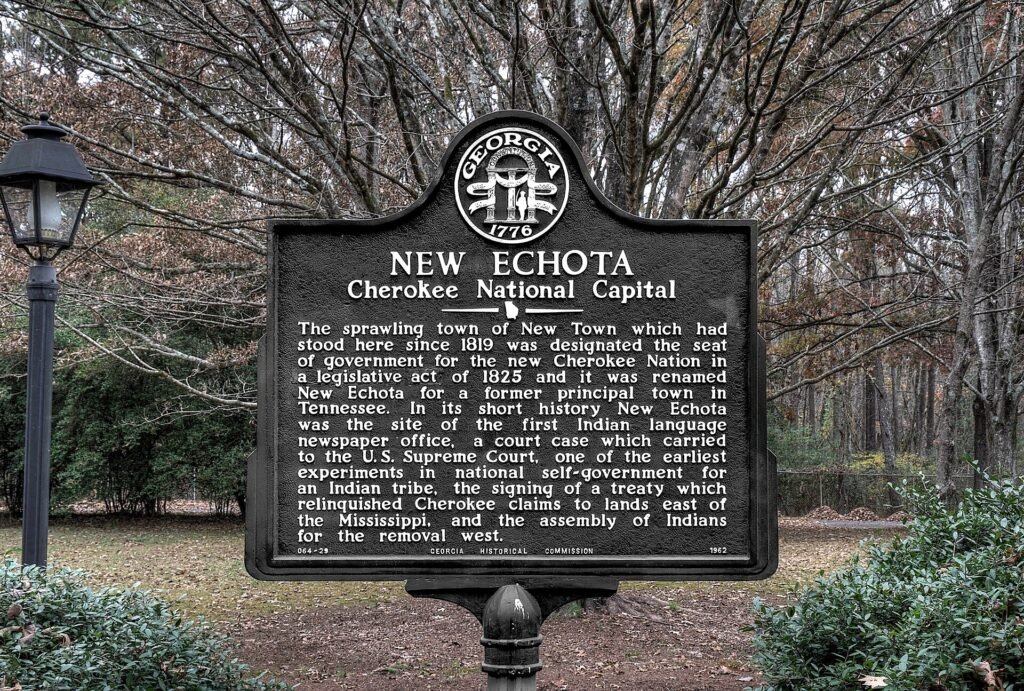
The Cherokee are a Native people whose homelands are in the southern Appalachian Mountains (NPS). Today the United States recognizes three Cherokee tribes: the Cherokee Nation and the United Keetoowah Band in Oklahoma, and the Eastern Band of Cherokee Indians in North Carolina. The Cherokee Nation is one of those governments, not all Cherokee people.
Key facts
- The Cherokee Nation has more than 450,000 citizens (Cherokee Nation).
- Sequoyah completed his syllabary, a way to write Cherokee, around 1821 (Library of Congress).
- The first Cherokee Phoenix was printed on February 21, 1828, at New Echota (Cherokee Phoenix).
- President Andrew Jackson signed the Indian Removal Act on May 28, 1830 (National Archives).
- The federal list of January 30, 2026, names 575 tribes, and three are Cherokee (Federal Register).
The Unicode Standard explains, “The Cherokee word for both the language and the people is ᏣᎳᎩ Tsalagi” (Unicode). Another Cherokee name, Ani’-Yun’wiya, means the “Principal People” (National Park Service). See our Native American hub for other nations.
What are the three Cherokee tribes today?
The United States recognizes three Cherokee tribes, and each one runs its own government. The Cherokee Nation says, “There are three federally recognized Cherokee tribes, with Cherokee Nation being the largest” (Cherokee Nation). The United Keetoowah Band calls itself “one of only three federally recognized Cherokee tribes in the United States” (UKB).
- Cherokee Nation, based in Tahlequah, Oklahoma. Its reservation covers about 7,000 square miles in all or parts of 14 counties (Cherokee Nation). Voters elect a Principal Chief (Cherokee Nation) and a 17-member Council (Cherokee Nation).
- Eastern Band of Cherokee Indians, based in Cherokee, North Carolina, on land called the Qualla Boundary (EBCI). A Principal Chief, a Vice Chief and a Tribal Council lead it (EBCI).
- United Keetoowah Band of Cherokee Indians in Oklahoma, also based in Tahlequah. Its Tribal Council has four officers and nine district representatives (UKB).
The Eastern Band explains, “Cherokee is a sovereign nation, meaning it has its own laws, elections, government, institutions, and the like” (EBCI). The Cherokee Nation says Congress never ended its reservation. Courts confirmed this after the U.S. Supreme Court’s 2020 McGirt v. Oklahoma ruling, which was about the Muscogee (Creek) Reservation (Cherokee Nation).
Each tribe sets its own citizenship rules. Cherokee Nation citizens need a direct ancestor on the Dawes Rolls, a federal census from 1898 to 1906 (Cherokee Nation). The Eastern Band requires an ancestor on its 1924 Baker Roll (EBCI).
Some websites call the Chickasaw, Choctaw and Creek parts of the Cherokee Nation. They are separate nations that the United States forced to Indian Territory in the same period (NPS). They are separate nations, each named on its own line of the 2026 federal list (Federal Register). Check a nation’s own website first.
Where did the Cherokee live before removal?
Cherokee homelands covered parts of eight present-day states in the Southeast. When Hernando de Soto’s expedition passed through in 1540, the Cherokee Nation held land in West Virginia, Kentucky, Virginia, North Carolina, Tennessee, South Carolina, Georgia and Alabama (Cherokee Nation). Those state lines did not exist yet.
Treaties took the land piece by piece. By 1817, the remaining Cherokee lands covered parts of North Carolina, Tennessee, Alabama and Georgia (Cherokee Nation). In 1827, the Cherokee Nation adopted a written constitution modeled on the U.S. Constitution (Cherokee Nation). Its capital was New Echota, in present-day Georgia (New Georgia Encyclopedia). Scholars group the Cherokee with other Southeast nations, a model with limits explained on our major groups page.
How did Sequoyah create the Cherokee syllabary?
Sequoyah, a Cherokee silversmith, completed a system for writing Cherokee around 1821 (Library of Congress). Cherokee people called written English “talking leaves” (NLM). Sequoyah never learned English. His daughter learned his system quickly and helped him teach it (NPS).
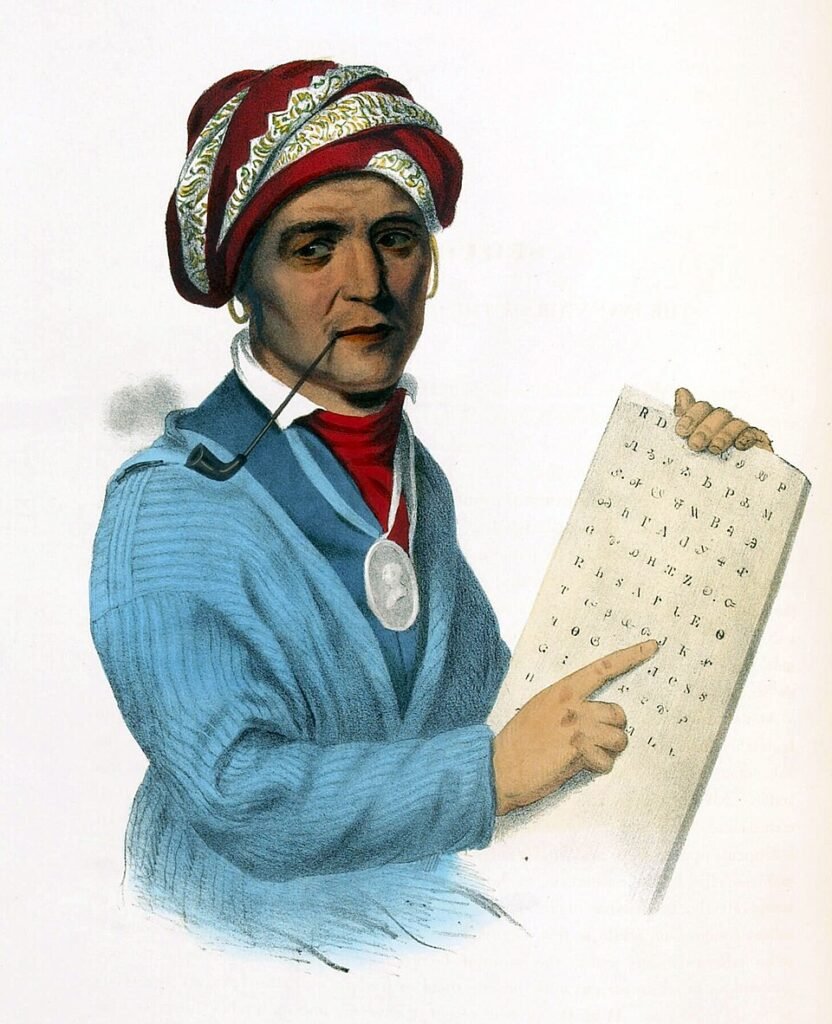
Many books say “Cherokee alphabet,” but it is a syllabary. Each character stands for a whole syllable, and most stand for a consonant plus a vowel (NPS).
You may see two counts. By 1821, the syllabary had 86 characters (NPS). When Cherokee printing type was finalized in 1827, one character, “MV,” was dropped, leaving 85 (Unicode). Both are right for their dates.
Cherokee belongs to the Iroquoian language family, along with languages such as Seneca and Mohawk (Unicode). Compare other scripts in our history of writing.
What was the Cherokee Phoenix?
The Cherokee Phoenix was the Cherokee Nation’s newspaper, first printed on February 21, 1828, at New Echota (Cherokee Phoenix). It printed news in English and in Cherokee, and its first editor was Elias Boudinot, a Cherokee leader. Missionary Samuel Worcester helped cast type in Sequoyah’s syllabary (Cherokee Phoenix).
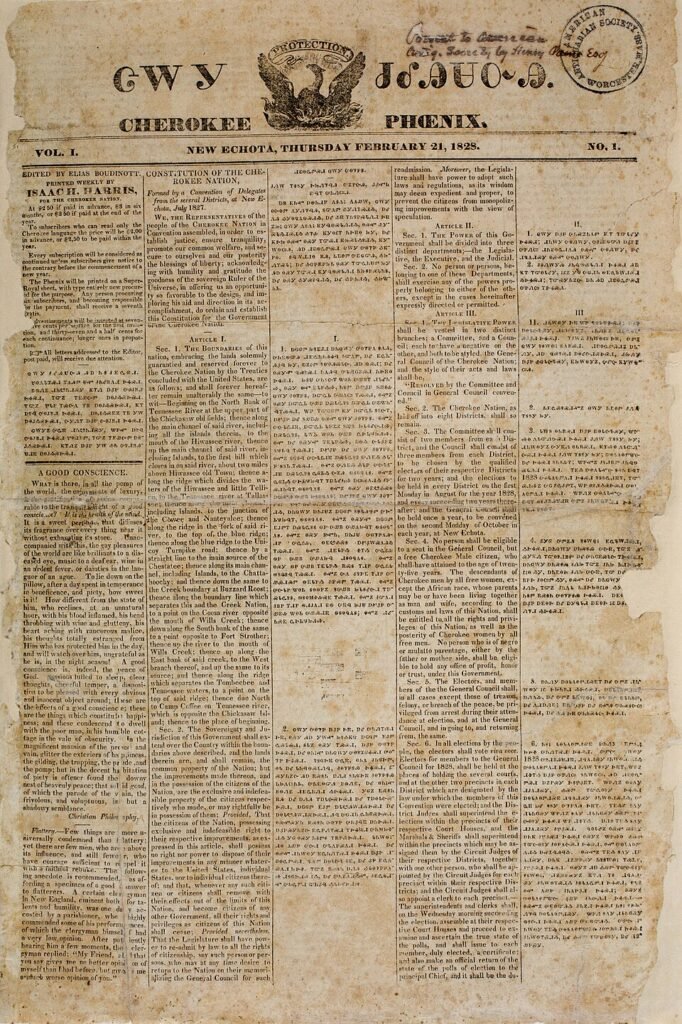
The weekly paper had subscribers across the United States and in Europe. It was the first Native American newspaper in the United States (New Georgia Encyclopedia). Some kids’ sites say “first in history,” which goes beyond the sources.
The paper stopped in May 1834, when the Cherokee government ran out of money for it (Cherokee Phoenix). The Georgia Guard, a state militia, later seized the press (Library of Congress). Yet the Cherokee Phoenix still publishes today. A 2000 Cherokee Nation law keeps it free from political control (Cherokee Phoenix).
Why were the Cherokee forced to leave their homelands?
The U.S. government forced most Cherokee people west in 1838 and 1839, after Georgia tried to take over Cherokee land. In Worcester v. Georgia (1832), the U.S. Supreme Court ruled that Georgia had no power to impose its laws in the Cherokee Nation (Cherokee Nation). President Andrew Jackson had already signed the Indian Removal Act on May 28, 1830 (National Archives).
In 1835, a group of Cherokees signed the Treaty of New Echota, giving up the nation’s lands in the East. The Cherokee Nation says those signers “lacked authority to do so under Cherokee Nation law” (Cherokee Nation). In 1838, U.S. troops under General Winfield Scott forced people into camps and then west. Some 4,000 Cherokees died in the camps or on the way, about one in four of the people removed (Cherokee Nation). About 16,000 Cherokee were removed in all (NPS). Read the full story on our Trail of Tears page.
Not everyone left. About a thousand Cherokee in Tennessee and North Carolina escaped the roundup. They set up a tribal government in 1868, and their descendants are the Eastern Band of Cherokee Indians (NPS). In the West, the Cherokee Nation adopted a new constitution in 1839 and built its capital at Tahlequah (Cherokee Nation). Removal hit other nations too, as our effects of colonization page shows.
How are Cherokee people keeping their language alive?
Cherokee people teach the language in immersion schools, classes and apps because few fluent speakers remain. In 2021, Principal Chief Chuck Hoskin Jr. told a U.S. Senate committee that “only about 2,000 people can speak Cherokee fluently.” He added, “Quite simply, the Cherokee language is the heart and soul of our tribe” (U.S. Senate).
- The Cherokee Nation’s Durbin Feeling Language Preservation Act began in 2019. In 2023, the nation set at least $18 million a year for language programs (Anadisgoi).
- The Cherokee Nation runs an immersion school for kindergarten through 6th grade, where students learn in Cherokee (Cherokee Nation).
- The Eastern Band runs New Kituwah Academy, a language immersion program (EBCI).
- The syllabary now appears in apps on phones and tablets (Library of Congress).
Most Cherokees speak English as their main language (Cherokee Nation). Hello in Cherokee is “Osiyo” (NPS).
Try this: read the sources yourself
- Open the Library of Congress record for the Cherokee Phoenix. Find out how often the paper came out.
- On a map, mark Tahlequah, Oklahoma, and Cherokee, North Carolina. How far apart are they?
- Put these years on a timeline: 1540, 1821, 1827, 1828, 1830, 1835, 1838, 1839 and 2026.
- Visit each tribe’s official website. Write one fact about its government.
Sources
- Cherokee Nation. History
- Cherokee Nation. Common Questions
- Cherokee Nation. Executive Branch
- Cherokee Nation. Legislative Branch
- EBCI. Government
- EBCI. Contact
- EBCI. Enrollment
- EBCI. Department of Education
- United Keetoowah Band. Home
- Federal Register. Indian Entities Recognized (2026)
- National Archives. On Indian Removal
- National Park Service. What is the Trail of Tears?
- National Park Service. Trail of Tears
- National Park Service. Cherokee Language
- Library of Congress. Sequoyah: A Man of Letters
- Library of Congress. Cherokee Phoenix record
- National Library of Medicine. 1821: Sequoyah’s syllabary
- Unicode Consortium. Unicode Standard, Chapter 20
- Cherokee Phoenix. About Us
- New Georgia Encyclopedia. Cherokee Phoenix
- U.S. Senate. Hoskin Testimony (2021)
- Anadisgoi. Language Revitalization (2023)