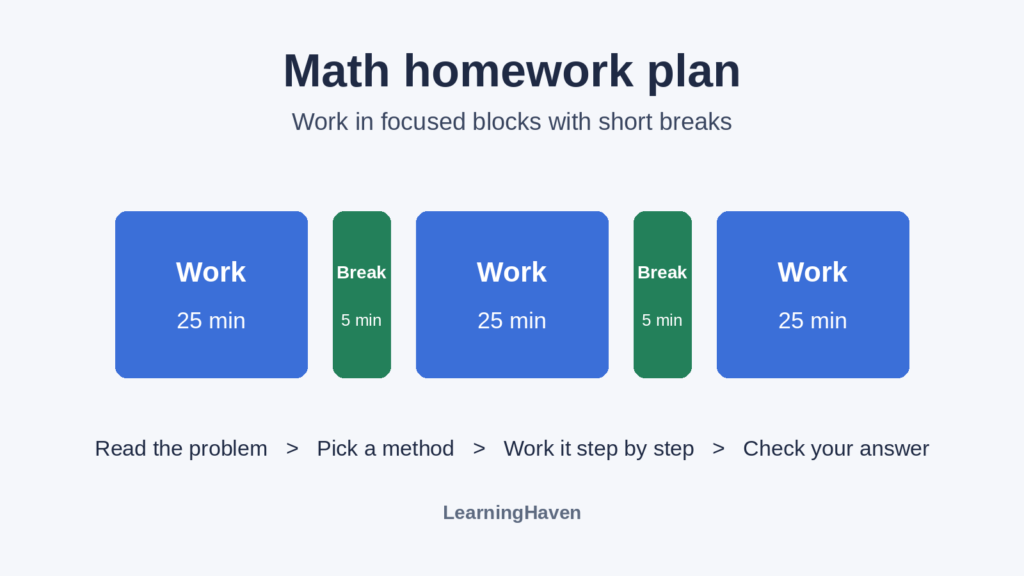
Getting unstuck on math homework usually means slowing down, re-reading the problem, and trying one step at a time rather than searching for the answer. A short, repeatable routine works better than starting over from scratch on every problem.
This page covers a general approach that works across grade levels, a simple way to pace your study time, links to LearningHaven’s own math topic pages, and a short list of free outside help.
What should you do first when a math problem feels impossible?
Read the problem twice before writing anything, and underline or say out loud what it is actually asking for. Sometimes a problem feels impossible because you misread the question, not because you lack the math.
After reading it twice, write down what you know and what you need to find, even before you pick an operation or formula. This turns a wall of text into a short list you can actually work with.
This step helps with word problems and multi-step questions the most. A problem that is only “what is 8 times 7” does not need this much unpacking.
How do you find the right method to use?
Look for a similar problem you already solved, in the same lesson or the one before it, and copy the steps of that method with your own numbers. Homework sets often repeat one method with different numbers instead of a new method every problem.
If nothing in the current lesson matches, back up to the topic itself. A stuck fraction problem might need a review of our fractions page, a stuck percent problem might need percentages, and a problem mixing both might need a look at decimals first.
This step is about finding a starting method, not guaranteeing the right answer. You still need to work the problem and check it once you have a method to try.
How do you work through a math problem step by step?
Write every step on paper, even the ones that feel obvious, so you can find exactly where a mistake happens if the answer looks wrong. Skipping steps in your head is where careless errors often hide.
Work one operation at a time. For a problem like dividing a fraction by a whole number, do the setup step first, then the calculation, then simplify, rather than trying to do all three in your head at once. Our pages on division, subtraction, and factoring break down the individual skills that show up inside a bigger problem.
This applies to computation-heavy problems most directly. A geometry proof or a word problem needs the same patience, but the “steps” look more like reasoning than arithmetic.
How do you check your own work?
Work the problem a second time using a different method, or plug your answer back into the original problem to see if it makes sense. Getting the same answer twice, by two different routes, is a strong sign it is correct.
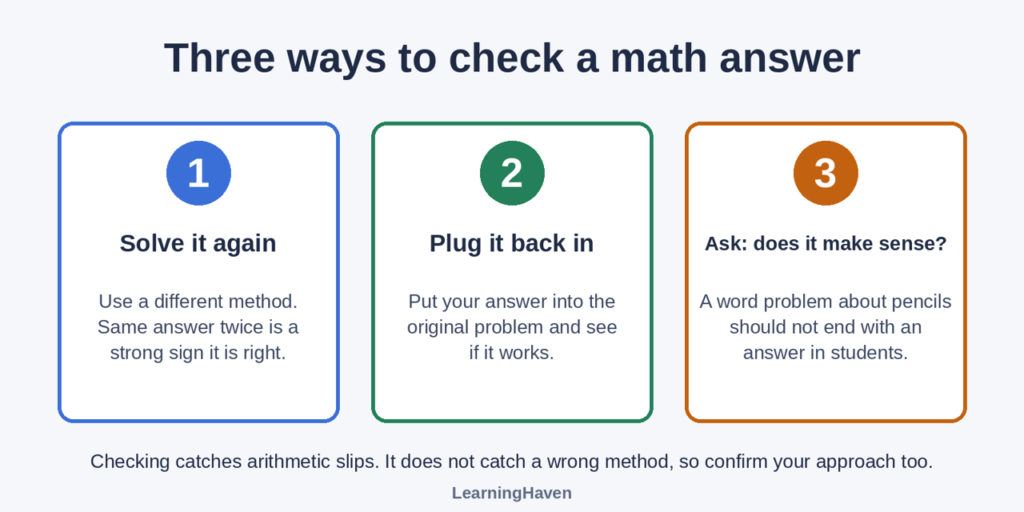
For word problems, ask whether the answer is reasonable for the situation. An answer of “45 students” for “how many pencils are left” is a sign to recheck the setup, not just the arithmetic. Our word problems page has practice sets built around this kind of reasonableness check.
Checking catches calculation mistakes well. It does not catch a wrong method applied correctly, so if the checked answer still feels off, go back and confirm you picked the right approach in the first place.
How long should you study math at one time?
A common plan is to work for 25 minutes, then take a 5-minute break (Duke Academic Resource Center).
This is the Pomodoro Technique. Francesco Cirillo created it in the 1980s while he was a university student. He built it “with a tomato-shaped kitchen timer” (Cirillo). Pomodoro means tomato in Italian (Duke).
Here is how to use it for math homework:
- Pick one task before you start, such as a set of practice problems.
- Set a timer for 25 minutes and put your phone in another room (Stanford Center for Teaching and Learning).
- Work on that task until the timer rings.
- Take a 5-minute break, preferably away from a screen (Duke). Stanford suggests you “get up and do something relaxing.”
- After four work blocks, take a longer break of 15 to 30 minutes (EBSCO Research Starters).
These times are a starting point. Duke says longer cycles can work, such as 52 minutes of work and a 17-minute break. Cirillo writes that the method “isn’t about forcing yourself to work in 25-minute chunks.” If 25 minutes feels too long, start with a shorter block.
This is a way to manage your time. This page makes no claim that it raises math scores. If a problem still makes no sense after a full block, go to the next section on asking for help. For more routines, see our time management page.
When is it time to ask for help instead of trying again?
If you have tried the same problem three separate times with three different approaches and still cannot get a sensible answer, stop and ask for help rather than guessing at a fourth attempt. Repeating the same mistake does not turn it into practice.
Ask a parent, sibling, or teacher to watch you work through one problem out loud. Often the stuck point becomes obvious the moment you have to explain your thinking to someone else.
This advice is for regular homework struggles. A student who is stuck on most problems most nights may need a different pace or a different explanation of the topic itself, which is worth raising with a teacher directly rather than solving one homework set at a time.
More math topics on LearningHaven
For practice by topic, see our pages on factoring, square roots, and printable algebra worksheets. For the full topic list, visit the main math section, and for homework help across every subject, see the homework help hub.
This page focuses on math homework specifically. It covers pacing a study session, but not other study habits or routines for other subjects, which need their own approach.
Sources
These sites were checked and live in October 2026.
- Khan Academy. Math, free courses and practice for K-12 and early college subjects, including math.
- Math Is Fun. Math Is Fun, math explained in easy language, plus puzzles, games and worksheets.
- Purplemath. Purplemath, free online algebra lessons with worked examples and clear explanations.
- Math Playground. Math Playground, math games, puzzles and word problem practice, mostly for kindergarten through grade 6.
- University of Cambridge. NRICH, problem-solving tasks from the Faculty of Mathematics at the University of Cambridge.
- Duke University Academic Resource Center. Pomodoro Technique, steps, break lengths and the 52 and 17 minute example.
- Francesco Cirillo. Francesco Cirillo, Creator of the Pomodoro Technique, his own account of how and when he created it.
- Stanford Center for Teaching and Learning. Concentrate to Improve Learning and Productivity, work blocks, breaks and keeping your phone in another room.
- EBSCO. Pomodoro Technique, Research Starters, the longer break after four work blocks.