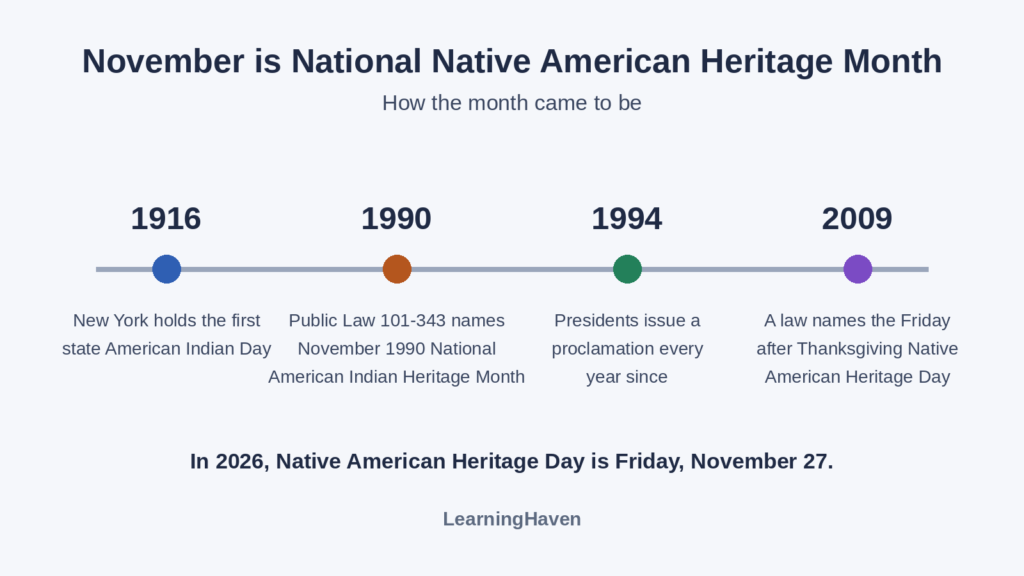
National Native American Heritage Month is observed every November in the United States to honor American Indian and Alaska Native peoples. Congress first set aside November in a 1990 law (GPO). Native American Heritage Day is the Friday after Thanksgiving. In 2026, that is November 27.
Key facts
- New York held the first state American Indian Day in May 1916 (Census Bureau).
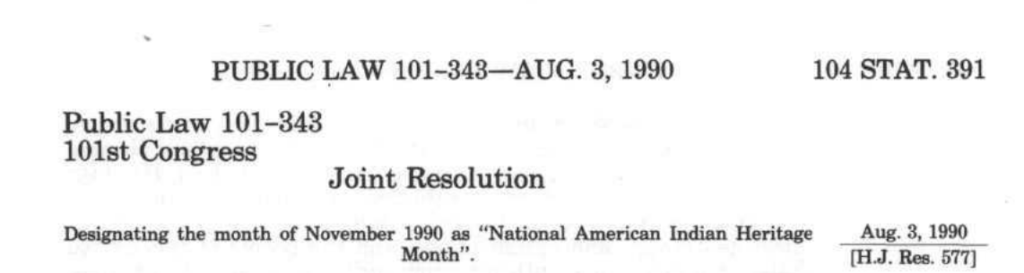
- Public Law 101-343, approved August 3, 1990, named November 1990 National American Indian Heritage Month (GPO).
- Presidents issued a similar proclamation every year from 1994 through 2024 (Census Bureau).
- A 2009 law names the Friday after Thanksgiving as Native American Heritage Day (GPO).
- The United States recognizes 575 tribes as of January 30, 2026 (BIA).
Our Native American studies hub has more pages on Native nations. A note on words: the Smithsonian’s National Museum of the American Indian (NMAI) says American Indian, Native American and Indigenous are all acceptable. It adds that “whenever possible, Native people prefer to be called by their specific tribal name” (NMAI).
What is National Native American Heritage Month?
National Native American Heritage Month is a November observance, set by Congress in 1990, that honors Native peoples and their contributions. The U.S. Senate Historical Office states that “the month of November is recognized as National Native American Heritage Month” (Senate).
The Bureau of Indian Affairs counts 575 federally recognized tribes as of January 30, 2026 (BIA). A federally recognized tribe is a Native nation that the United States deals with on a government-to-government basis. A 2009 law describes “the government-to-government relationship between the United States and Native American governments” (GPO).
The Census Bureau counts 7.7 million American Indian or Alaska Native people, alone or in combination with other races. That figure is a 2024 estimate for the whole country (Census Bureau).
The 575 count includes only nations with federal recognition. Some states recognize other Native nations too (NMAI).
How did Native American Heritage Month begin?
The month grew from campaigns for an American Indian Day that Native leaders began in the early 1900s.
- Early 1900s: Arthur C. Parker, a Seneca man, directed the Museum of Arts and Science in Rochester, New York. He convinced the Boy Scouts of America to hold a day for the first Americans for three years (LOC).
- September 28, 1915: Rev. Sherman Coolidge (Arapaho), president of the American Indian Association, called for an American Indian Day on the second Saturday of May (LOC).
- December 14, 1915: Red Fox James brought endorsements from 24 state governments to the White House (LOC). The Census Bureau says he was a member of the Blackfeet Nation who rode across the country on horseback (Census Bureau).
- May 1916: New York held the first state American Indian Day (Senate).
- 1976 and 1986: Congress asked for a Native American Awareness Week in October 1976 and an American Indian Week in November 1986 (Senate).
- August 3, 1990: Public Law 101-343 states “That the month of November 1990 is designated as ‘National American Indian Heritage Month'” (GPO). President George H. W. Bush signed it (Senate). He issued Proclamation 6230 on November 14, 1990 (UCSB).
- 1994 to 2025: Presidents issued similar proclamations every year from 1994 through 2024, under names such as National Native American Heritage Month (Census Bureau). In 2025, the White House marked the month with a presidential message dated November 4 (GPO).
Fact check: Some websites say the month began in 1915 or in 1986. Those years were earlier steps. The 1915 campaigns asked for one day, and the Library of Congress finds no record that a national day was proclaimed then (LOC). The 1990 law made November the month. In a report, give 1990 for the month and 1916 for the first state day.
This timeline covers national steps only. Many states set their own days, such as Illinois in 1919 (LOC).
What is Native American Heritage Day?
Native American Heritage Day is the Friday after Thanksgiving, named by the Native American Heritage Day Act of 2009. That law was approved on June 26, 2009 (GPO). A 2008 law had named only one date, Friday, November 28, 2008 (GPO).
The 2009 law says the day “will encourage public elementary and secondary schools in the United States to enhance understanding of Native Americans” (GPO). A proclamation may name the date. In 2024, President Joe Biden wrote, “I urge all Americans to celebrate November 29, 2024, as Native American Heritage Day” (GPO).
In 2026, Thanksgiving is Thursday, November 26, so Native American Heritage Day is Friday, November 27. The law encourages people, schools and governments to observe the day. Its text does not make it a legal public holiday.
How can students and families take part respectfully?
You can take part by learning which Native nations live near you, reading books by Native authors and using museum and park resources.
- Learn whose land you live on. The Bureau of Indian Affairs Tribal Leaders Directory is a map with contact information for each federally recognized tribe (BIA). The NMAI says “Land acknowledgment is a traditional custom that dates back centuries in many Native nations and communities” (NMAI). It suggests asking local nations, and nations forced to leave the area, how they want to be recognized.
- Read books by Native authors. The American Indian Library Association gives the American Indian Youth Literature Award every two years (ALA). The 2026 winners include the picture book Chooch Helped by Andrea L. Rogers (Cherokee Nation) and the middle grade book Buffalo Dreamer by Violet Duncan (Plains Cree and Taino).
- Use museum and park resources. The NMAI’s Native Knowledge 360° program “provides educators and students with new perspectives on Native American history and cultures” (NMAI). The National Park Service shares Indigenous heritage stories, lesson plans and park programs for the month (NPS).
- Learn the hard history too. Read about the effects of colonization on Native nations and the forced removal known as the Trail of Tears.
The BIA map lists federally recognized tribes only. It does not show every nation with ties to your area, such as nations that were removed from it.
What should you avoid during Native American Heritage Month?
Avoid costumes, crafts that copy meaningful Native clothing or objects, and lessons that treat all Native people as one group from the past.
- Costumes. The NMAI states, “Dressing up as a Native American is never appropriate” (NMAI). It explains that many outfits meant to look “Indian” have nothing to do with real Native cultures.
- Feather headdresses and copied objects. NMAI cultural specialist Dennis Zotigh writes, “Among the Wampanoag, and other American Indians, the wearing of feathers has significance” (Smithsonian).
- Past tense only. The NMAI notes that “Indigenous peoples are survivors and continue to thrive” (NMAI). Describe nations that exist today in the present tense.
- One-size-fits-all. Name the specific nation you are studying, such as the Cherokee Nation. Nations differ in history, language and ways of life (NMAI).
Swap paper headdresses or vests for a map, timeline or reading project. A nation’s own guidance always comes first.
Try this: Who lives here today?
This research task works in class or at home.
- Open the BIA Tribal Leaders Directory map. List the nations closest to your town.
- Visit one nation’s official website. Write down the name the nation uses for itself.
- Find one fact about that nation today, such as its government, schools or language program.
- Make a timeline with 1915, 1916, 1990, 2009 and this year’s Native American Heritage Day.
- Read one book by a Native author. Tell someone one thing you learned.
To compare Native nations across North America, see our guide to Native American culture areas. For other observances through the year, visit our holidays section.
Sources
- U.S. Government Publishing Office. Public Law 101-343
- U.S. Government Publishing Office. Public Law 111-33
- U.S. Government Publishing Office. Public Law 110-370
- U.S. Government Publishing Office. Proclamation 10853 (2024)
- U.S. Government Publishing Office. Presidential Message (2025)
- U.S. Senate. American Indian Heritage Month
- Library of Congress. About the Month
- U.S. Census Bureau. Facts for Features, November 2025
- UC Santa Barbara. Proclamation 6230 (1990)
- Bureau of Indian Affairs. Tribal Leaders Directory
- NMAI. Did You Know?
- NMAI. Land Acknowledgment
- NMAI. About Native Knowledge 360°
- Smithsonian. Thanksgiving from an Indigenous Perspective
- American Library Association. 2026 Youth Literature Awards
- National Park Service. Native American Heritage Month