A prism is a solid with two identical parallel bases joined by flat rectangular sides. Every cross section taken parallel to the base is the same shape and size as the base.
Prisms are named for the shape of that base. A prism with triangular bases is a triangular prism, and one with hexagonal bases is a hexagonal prism.
Properties every prism has
- Two identical parallel bases. Same shape, same size, facing each other.
- Flat side faces. Rectangles in a right prism, parallelograms in an oblique one.
- A constant cross section. Slice it anywhere parallel to the base and the slice matches the base.
- Straight edges and flat faces throughout. No curves anywhere on the solid.
That third property is the practical test. If the cross section changes as you move along the solid, it is not a prism. A cone and a pyramid both fail this test, because they narrow to a point.
Counting faces, edges and vertices
For a prism whose base has n sides:
| Feature | Count | Why |
|---|---|---|
| Faces | n + 2 | n side faces plus two bases |
| Edges | 3n | n around each base plus n connecting them |
| Vertices | 2n | n corners on each base |
These follow the same rule for every prism, so you never need to memorize them per shape.
Types of prism
Rectangular prism
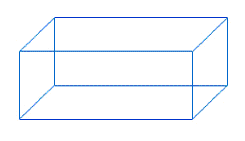
Six rectangular faces, 12 edges, 8 vertices. A box is a rectangular prism. A cube is the special case where all six faces are squares.
Surface area = 2(lw + wh + lh) and volume = lwh, where l, w and h are length, width and height.
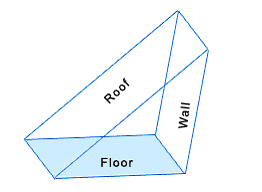
Triangular prism
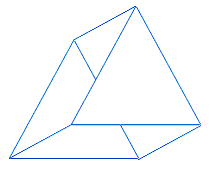
Two triangular bases and three rectangular sides, giving 5 faces, 9 edges and 6 vertices. It is a pentahedron, meaning a solid with five faces.
Hexagonal prism
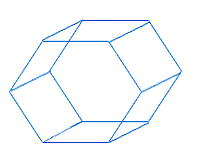
Two hexagonal bases and six rectangular sides. Applying the rules above gives 8 faces, 18 edges and 12 vertices.
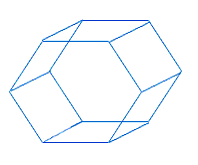
A regular hexagonal prism, where the bases are regular hexagons of edge length a and the height equals a, has a volume of (3√3 ÷ 2)a³.
The hexagonal prism is a space-filling solid, which is why honeycomb cells take that shape. Hexagons tile a plane with no gaps, so hexagonal prisms stack with no wasted space.
The general formulas
Rather than memorizing a formula per prism, use these two. They work for any base shape.
Surface area = 2 × (area of base) + (perimeter of base × height)
Volume = (area of base) × height
The volume rule is worth understanding rather than memorizing. A prism is its base stacked to a given height, so the volume is the base area multiplied by how far it is stacked.
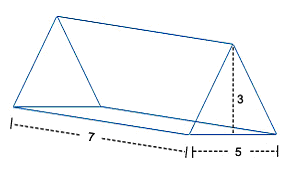
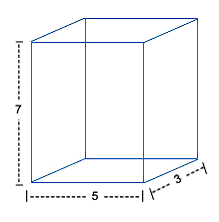
Worked example. A rectangular prism 5 by 3 by 7 inches has a volume of 5 × 3 × 7 = 105 cubic inches.
Nets, or the unfolded prism
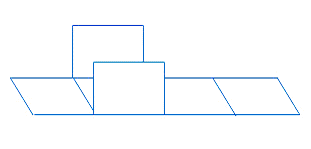
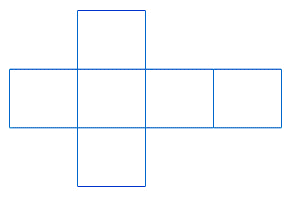
A net is what you get if you cut along enough edges to flatten the solid onto a table. Every face appears once, at its true size.
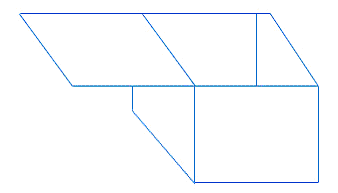
Nets make surface area obvious. Once the solid is flat, surface area is just the total area of the shapes in front of you, which is why the formula adds two bases to one wrapping rectangle.
An unfolded rectangular prism gives six rectangles in three matching pairs. The same solid can be unfolded in several different ways, and all of them are valid nets.
What this page does not cover
Pyramids, cones, cylinders and spheres are not prisms, because none of them has a constant cross section along its length. Oblique prisms, where the sides lean rather than standing square to the base, keep the same volume formula but need a different surface area treatment.
Where to go next
For the formulas applied to all solids, see surface area formulas. For curved solids, see cylinders, cones and spheres, and for solids in general, space figures. The section index is in geometry.