A cylinder is not a polyhedron. A polyhedron has flat polygon faces only, and a cylinder, a cone and a sphere each have a curved surface.
These three solids are grouped together because they all curve. This page defines each one, gives the volume and surface area formulas, and works an example of each.
A correction worth making
The claim: Cylinders and cones are just polyhedrons with circular bases.
Why it persists: A cylinder has two flat circular ends and a cone has one, so they look like they qualify. The word base appears in both definitions, which reinforces it.
The correction: A polyhedron is a solid whose faces are all polygons, and a circle is not a polygon because it has no straight sides. A cylinder and a cone both have a curved surface, so neither is a polyhedron. A sphere is not one either.
The test: If every surface is flat, the solid is a polyhedron. One curved surface anywhere and it is not.
Cylinder
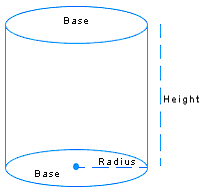
A cylinder has two parallel congruent circular bases joined by a curved surface.
Two measurements define it. The radius r of a base, and the height h, measured at a right angle between the two bases.
Volume = πr²h. The base area multiplied by the height.
Surface area = 2πr² + 2πrh. The two circular ends plus the curved surface, which unrolls into a rectangle.
Worked example. A cylinder with radius 3 cm and height 10 cm has a volume of π × 9 × 10 = 90π, about 282.7 cm³.
Cone
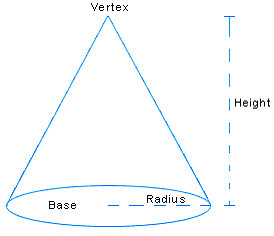
A cone has one circular base and a single vertex, also called the apex, which is not on the base.
A cone has two different lengths that both get called height, and mixing them up is the most common error on this topic.
- Height h is the perpendicular distance from the vertex to the base.
- Slant height l is the distance from the vertex to a point on the edge of the base.
They are linked by l = √(r² + h²), because the radius, the height and the slant height form a right triangle.
Volume = πr²h ÷ 3. Exactly one third of a cylinder with the same base and height.
Surface area = πr² + πrl. Use the slant height here, never the perpendicular height.
Worked example. A cone with radius 3 cm and height 4 cm has a slant height of √(9 + 16) = 5 cm. Its volume is π × 9 × 4 ÷ 3 = 12π, about 37.7 cm³. Its surface area is 9π + 15π = 24π, about 75.4 cm².
Sphere
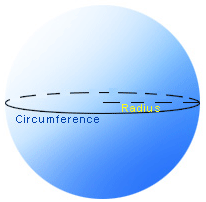
A sphere is the set of all points at an equal distance from a center point. That distance is the radius.
One measurement defines a sphere completely. Everything else follows from the radius.
Volume = 4πr³ ÷ 3.
Surface area = 4πr².
Worked example. A sphere of radius 6 cm has a surface area of 4 × π × 36 = 144π, about 452.4 cm². Its volume is 4 × π × 216 ÷ 3 = 288π, about 904.8 cm³.
Formula summary
| Solid | Volume | Surface area |
|---|---|---|
| Cylinder | πr²h | 2πr² + 2πrh |
| Cone | πr²h ÷ 3 | πr² + πrl |
| Sphere | 4πr³ ÷ 3 | 4πr² |
r is the radius, h is the perpendicular height, and l is the slant height of a cone.
What these three have in common
- Every one has at least one curved surface, so none of them is a polyhedron.
- Every one has a circular cross section. Slice a sphere anywhere, or slice a cylinder or cone parallel to the base, and the cut face is a circle.
- Every formula for all three contains π, for the same reason.
- None of them has an edge in the polyhedron sense, meaning a straight line where two flat faces meet.
The differences sit in how many flat faces each one has. A cylinder has two, a cone has one, and a sphere has none.
What this page does not cover
This page covers the three standard curved solids. Truncated cones, hemispheres and the spherical cone, which is a solid cut from a sphere rather than one of the three here, follow different formulas. Nets and cross sections are covered separately, and every formula on this page assumes a right cylinder or a right cone, where the axis meets the base at 90°.
Where to go next
For how these sit among all three-dimensional shapes, see space figures. For the flat-faced solids they are contrasted with, see prisms. For surface area across every solid, see surface area formulas. The section index is in geometry.