A space figure is a three-dimensional shape. Its points do not all lie in the same plane, which is what separates it from a flat figure.
Space figures divide into two groups. Polyhedrons have flat faces throughout. Cylinders, cones and spheres do not, because each has a curved surface.
The two groups
| Group | Surface | Examples |
|---|---|---|
| Polyhedrons | Flat faces only | Cube, prism, pyramid |
| Curved solids | At least one curved surface | Cylinder, cone, sphere |
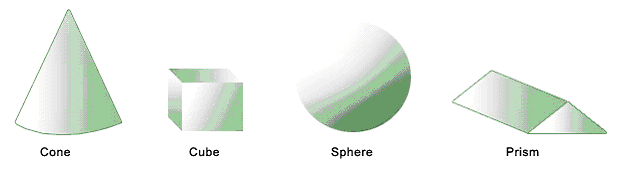
The test is simple. If every surface is flat, the solid is a polyhedron. One curve anywhere and it is not.
That is why a cylinder is not a polyhedron even though it has two flat circular ends. The tube between them curves.
Three dimensions
Space is described in three dimensions: length, width and height. A flat figure needs only two.
Three-dimensional geometry is what describes buildings, tools and manufactured objects, which is why it carries most of the practical weight in the subject.
Polyhedrons
A polyhedron is a three-dimensional figure whose faces are all polygons. The word comes from the Greek poly, meaning many, and hedron, meaning face or seat.
Every polyhedron has three features worth naming:
- Faces. The flat polygon surfaces.
- Edges. The lines where two faces meet.
- Vertices. The points where edges meet.
A polyhedron is convex when every diagonal drawn between its vertices stays inside the solid. If a diagonal passes outside, the polyhedron is concave.
Rectangular prism
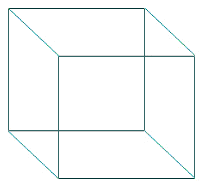
Six rectangular faces, 12 edges and 8 vertices. A square prism, where the ends are squares, is a special case, and a cube is the case where all six faces are squares.
Triangular prism
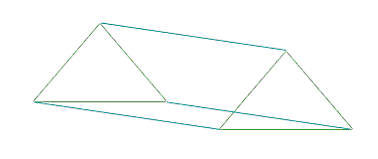
Two triangular ends and three rectangular sides, giving 5 faces, 9 edges and 6 vertices.
A glass triangular prism splits white light into the colors of a rainbow, which is where the optical instrument takes its name from.
Curved solids
Cylinder
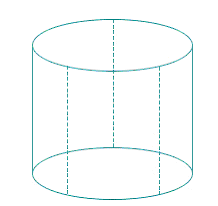
A cylinder has two parallel congruent circular bases joined by a curved surface.
Pipes, columns, cans and many musical instruments are cylinders. It is the most common curved solid in manufactured objects, because a circular cross section is the easiest shape to make on a lathe.
Cone
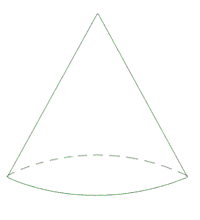
A cone has one circular base and a single vertex, called the apex, which is not on the base.
The distance from the apex to a point on the edge of the base is the slant height. It is longer than the perpendicular height, and the two are not interchangeable in formulas.
Sphere
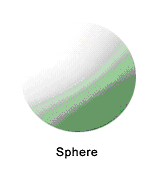
A sphere is the set of all points at an equal distance from a center point. It has no faces, no edges and no vertices.
A sphere is defined by one measurement, its radius. Everything else about it follows from that.
Comparing the solids
| Solid | Faces | Edges | Vertices | Curved surface |
|---|---|---|---|---|
| Cube | 6 | 12 | 8 | No |
| Rectangular prism | 6 | 12 | 8 | No |
| Triangular prism | 5 | 9 | 6 | No |
| Cylinder | 2 flat, plus a curved surface | 2 curved edges | 0 | Yes |
| Cone | 1 flat, plus a curved surface | 1 curved edge | 1 apex | Yes |
| Sphere | 0 | 0 | 0 | Yes |
The counts for cylinders and cones are worth a caution. Different textbooks count their curved surfaces and curved edges differently, so exam answers vary by syllabus. The counts for polyhedrons are not disputed.
What this page does not cover
This page names and describes space figures. The surface area and volume formulas for each are covered separately, as are nets and cross sections.
Where to go next
For prisms in depth, see prisms. For the curved solids and their formulas, see cylinders, cones and spheres. For calculating the outside of any solid, see surface area formulas. The section index is in geometry.