The formula for surface area is the total area of every face of a solid added together. For curved solids, the formula replaces that sum with a single expression.
Surface area tells you how much material would be needed to cover a solid, or how much of it is exposed. It is measured in square units such as cm² or m².
The general method
Surface area = the sum of the areas of all faces
That rule solves every flat-faced solid. To use it:
- Identify every face. A cube has 6, a rectangular prism has 6, a triangular prism has 5.
- Work out the area of each face using the ordinary two-dimensional area formulas.
- Add them together.
The named formulas below are shortcuts for solids where faces repeat. Spheres and cylinders need their own formulas because their surfaces curve.
Surface area formulas by solid
| Solid | Formula | What the letters mean |
|---|---|---|
| Cube | SA = 6a² | a is the edge length |
| Rectangular prism | SA = 2ab + 2bc + 2ac | a, b, c are the three edge lengths |
| Any prism | SA = (perimeter of base × length) + 2(area of base) | base is the repeated end face |
| Sphere | SA = 4πr² | r is the radius |
| Cylinder | SA = 2πr² + 2πrh | r is radius, h is height |
Cube
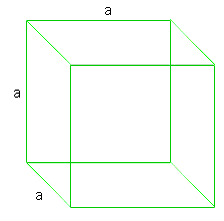
A cube is six identical squares. Each square has area a², so the total is 6a².
Worked example. A cube with 4 cm edges has a surface area of 6 × 4² = 6 × 16 = 96 cm².
Rectangular prism
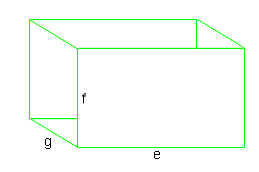
A rectangular prism has six faces in three matching pairs. The pairs have areas ab, bc and ac, so the total is 2ab + 2bc + 2ac.
Worked example. A prism 3 by 4 by 5 cm gives 2(12) + 2(20) + 2(15) = 24 + 40 + 30 = 94 cm².
Any prism
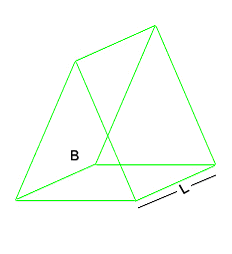
A prism is a solid with two identical parallel ends joined by flat sides. The general formula handles any base shape:
SA = (perimeter of base × length) + 2(area of base)
The first term is the wrapper around the sides. The second term is the two ends. A triangular prism, a hexagonal prism and a cube all follow this rule.
Sphere
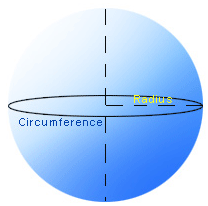
SA = 4πr²
A sphere’s surface area depends only on its radius. There is no length or width to supply.
Worked example. A sphere with a radius of 21 cm, taking π as 22/7, gives 4 × 22/7 × 21² = 4 × 22 × 3 × 21 = 5,544 cm².
That example uses 22/7 because 21 divides cleanly by 7. With any other radius, 3.14 is the easier approximation.
Cylinder
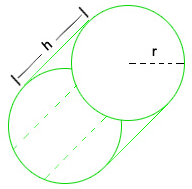
SA = 2πr² + 2πrh
A cylinder is two circles plus a rectangle rolled into a tube. The 2πr² term is the two circular ends. The 2πrh term is the curved side, which unrolls into a rectangle whose width is the circumference of the circle.
That unrolling is worth showing students physically. Cut the label off a tin, flatten it, and the rectangle is visible.
A correction worth making
The claim: Surface area and volume are often treated as interchangeable measures of size.
Why it persists: Both are calculated from the same dimensions, and the formulas look similar on the page.
The correction: Surface area measures the outside skin of a solid and is expressed in square units. Volume measures the space inside and is expressed in cubic units. A sphere of radius r has surface area 4πr² and a different quantity entirely for volume.
The check: Look at your units. Surface area answers end in cm² or m². If yours ends in cm³, you calculated volume.
What this page does not cover
These formulas apply to solids with regular geometry. Cones, pyramids and irregular solids need their own methods. Lateral surface area, which excludes the ends, is a different quantity from total surface area, and exam questions often specify which they want.
Where to go next
For two-dimensional shapes, see area formulas. For curved solids in more depth, see cylinders, cones and spheres, and for flat-faced ones, prisms. The section index is in geometry.