The Potawatomi are an Algonquian-speaking Native people of the Great Lakes region, and today they belong to seven separate federally recognized nations in the United States. This page covers the Potawatomi names, the Council of Three Fires, the homeland, the seasons, the fur trade, treaties and removal, and the nations today.
Who are the Potawatomi?
The Potawatomi call themselves Neshnabek, which means “original people” or “true people.” (Milwaukee Public Museum, Britannica Kids) Nations spell the word in different ways. The Pokagon Band’s site writes Neshnabé and Neshnabék. (Pokagon Band) The Citizen Potawatomi Nation uses Bodéwadmi for the Potawatomi in their own language. (Citizen Potawatomi Nation)
The name “Potawatomi” has more than one translation. Britannica Kids says it comes from an Ojibwe word meaning “people of the place of the fire.” (Britannica Kids) The Citizen Potawatomi Nation says its name refers to the people’s duty to the Council as Keepers of the Fire. (Citizen Potawatomi Nation)
The Potawatomi language is called Bodéwadmimwen. (Citizen Potawatomi Nation) It belongs to the Algonquian language family. (Britannica Kids)
This section covers names and language. It doesn’t cover beliefs or ceremonies, which belong to each nation.
What was the Council of Three Fires?
The Potawatomi, Ojibwe, and Odawa formed an alliance called the Three Fires Council. (Citizen Potawatomi Nation) The Citizen Potawatomi Nation says the Ojibwe are the eldest, the Odawa came second, and the Potawatomi are “the youngest brother and last to build our own fire.” (Citizen Potawatomi Nation)
Each people had a role. The Nation names the Ojibwe as Keepers of the Medicine and Faith, the Odawa as Keepers of the Trade, and the Potawatomi as Keepers of the Fire. (Citizen Potawatomi Nation) The Pokagon Band words the Ojibwe role as Keepers of Tradition. (Pokagon Band) Nations word the roles a little differently.
This section covers the alliance in general terms. It doesn’t cover its councils or sacred teachings.
Where was the Potawatomi homeland?
Nations tell the story of how the three peoples came to the Great Lakes in different ways. The Pokagon Band says each Indigenous nation has its own creation story. Some Potawatomi stories say the people have always been here. Others tell of a migration from the Atlantic coast with the Ojibwe and Odawa. (Pokagon Band)
Sources also place the split of the three peoples in different spots. The Citizen Potawatomi Nation says Niagara Falls. (Citizen Potawatomi Nation) The Forest County Potawatomi say near Sault Ste. Marie. (Forest County Potawatomi) The Milwaukee Public Museum says oral traditions name the Straits of Mackinac. (Milwaukee Public Museum) This page doesn’t pick one.
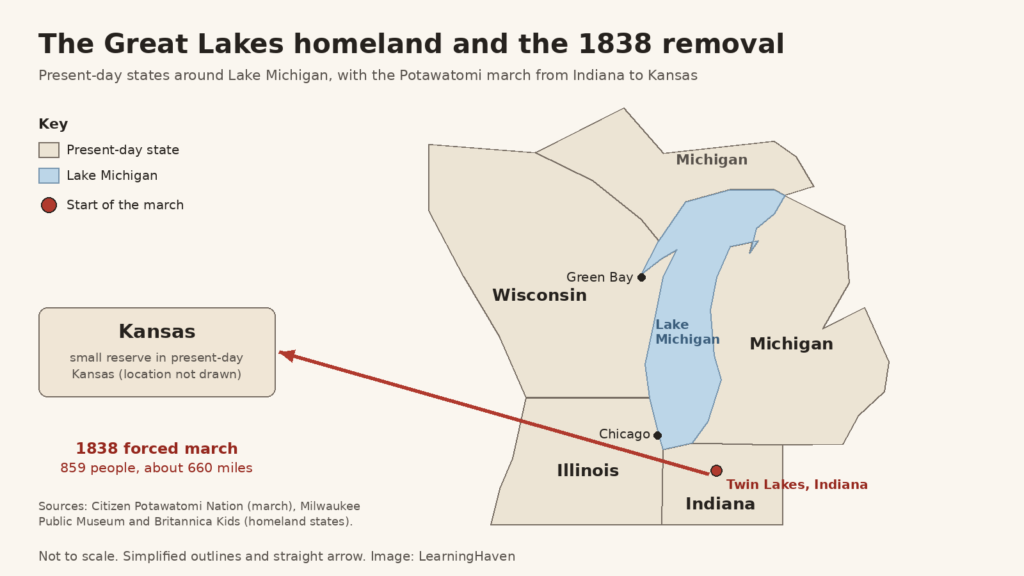
The homeland was around Lake Michigan. By 1800 it included northern Illinois, southeastern Wisconsin, northern Indiana, southern Michigan, and northwestern Ohio. (Milwaukee Public Museum) Places moved over time. In the 1640s and 1650s, wars with the Iroquois pushed Great Lakes peoples west. By 1665 the Potawatomi were on the Door County Peninsula in Wisconsin. After 1700 they moved south along the western shore of Lake Michigan and back into Michigan. (Milwaukee Public Museum)
This section covers the homeland in general terms. It doesn’t cover every village.
How did the Potawatomi live through the year?
The Citizen Potawatomi Nation says Potawatomi life followed four seasons: mnokme (spring), niben (summer), dgwaget (fall), and bbon (winter). (Citizen Potawatomi Nation)
- Spring. Families went to sugar bush camps and turned maple sap into sugar and syrup.
- Summer. People gathered together and used the long days to collect food for winter.
- Late summer and fall. People gathered at lakes to harvest wild rice, then stored food.
- Winter. People trapped and hunted game and spent much of their time indoors.
Britannica Kids says the Potawatomi lived in farming villages in summer. In autumn they split into smaller family groups and moved to winter hunting grounds. Women raised corn, beans, and squash and gathered berries, seeds, roots, and wild rice. Men fished and hunted deer, elk, and small animals. (Britannica Kids)
A wigwam is a round, dome-shaped home with a frame of saplings covered by birchbark, hides, or cattail mats. The Potawatomi used wigwams in their more permanent camps. On the move, they used lighter shelters of bark and poles called nsoe’gen. (Citizen Potawatomi Nation) The Nation adds that the Potawatomi also used the moon as a calendar, with names such as Berry Picking Moon and Ricing Moon. Moon names varied among groups. (Citizen Potawatomi Nation)
This section covers food, shelter, and the seasons. It doesn’t cover ceremonies or sacred medicines.
How did the fur trade change life?
In 1634 the French explorer Jean Nicolet met a few Potawatomi at Green Bay, Wisconsin. (Milwaukee Public Museum) The Potawatomi became trading partners of the French. They traded furs for metal tools, beads, cloth, and guns. The alliance lasted until the 1760s, when France lost control of the Great Lakes to Britain. (Britannica Kids) By 1679, the Citizen Potawatomi Nation says, Potawatomi people had helped develop the fur trade in Wisconsin. (Citizen Potawatomi Nation)
This section covers the fur trade in general terms. It doesn’t cover the wars of the period.
What happened to Potawatomi land in the 1800s?
The United States pressed the Potawatomi to sell land. The Forest County Potawatomi say the Potawatomi signed more than 40 treaties with the United States. (Forest County Potawatomi, Wisconsin DPI) In 1830 Congress passed the Indian Removal Act, which called for Native nations east of the Mississippi River to move west. (Pokagon Band) In the Treaty of Chicago, signed on September 26, 1833, the Potawatomi of Illinois and Wisconsin ceded the last of their lands. (Milwaukee Public Museum) The Forest County Potawatomi say that treaty took 5 million acres. (Forest County Potawatomi)
In 1838 a group of Potawatomi was forced to leave northern Indiana. The Citizen Potawatomi Nation says 859 people set out on September 4, 1838, on a march of 660 miles to a small reserve in present-day Kansas. More than 40 people died on the way. Many of those who died were children. The Potawatomi came to call the march the Trail of Death. (Citizen Potawatomi Nation) An Indiana Historical Bureau marker near Twin Lakes says some 800 Potawatomi were gathered there in August 1838 and forced to begin the march. (Indiana Historical Bureau)
Not every Potawatomi group went west. The Pokagon Band says Leopold Pokagon and a small group earned the right to stay in their homeland, partly because of their strong ties to Catholicism. (Pokagon Band) Other groups fled to Wisconsin, Michigan, and Canada. (Wisconsin DPI)
Most Potawatomi were moved to a reservation in Kansas in 1846. (Britannica Kids) A treaty signed on November 15, 1861, started the process of land allotments and U.S. citizenship for almost two-thirds of the Potawatomi Nation’s members. They became known as the Citizen Potawatomi. (Citizen Potawatomi Nation) Another group kept land held in common. (Prairie Band Potawatomi Nation) The first Citizen Potawatomi families reached Indian Territory, in present-day Oklahoma, in 1872. (Citizen Potawatomi Nation)
For other nations that moved to Indian Territory, see the Shawnee and the Pawnee.
For the wider story, see Effects of Colonization on Native Americans and the Trail of Tears.
This section covers the main events. It doesn’t cover every treaty or march.
Which Potawatomi nations exist today?
There is no single Potawatomi government. The Bureau of Indian Affairs list published on January 30, 2026, names seven Potawatomi nations. (Federal Register)
| Nation | State | Place named by the source |
|---|---|---|
| Citizen Potawatomi Nation | Oklahoma | Shawnee |
| Prairie Band Potawatomi Nation | Kansas | Mayetta |
| Forest County Potawatomi Community | Wisconsin | Forest County |
| Pokagon Band of Potawatomi Indians | Michigan and Indiana | Dowagiac, Michigan |
| Hannahville Indian Community | Michigan | Wilson, in the Upper Peninsula |
| Match-E-Be-Nash-She-Wish Band of Pottawatomi (Gun Lake) | Michigan | Shelbyville |
| Nottawaseppi Huron Band of the Potawatomi | Michigan | Fulton |
(Federal Register for the names, Citizen Potawatomi Nation, Kansas Native American Affairs, Forest County Potawatomi, and Michigan.gov for the places)
The city of Shawnee, Oklahoma, shares its name with the Shawnee people, but the Citizen Potawatomi Nation is a different nation. Britannica Kids says a small number of Potawatomi also live in southern Ontario, Canada. (Britannica Kids)
Each nation runs its own government and programs. The Pokagon Band says its sovereignty was restored in 1994. (Pokagon Band) The Prairie Band says that in 2025 the U.S. government placed several parcels of land in trust for the Nation, and that it is the only federally recognized tribe with a reservation in Illinois. (Prairie Band Potawatomi Nation)
This section covers the nations as their own sites and government lists name them. It doesn’t speak for any nation.
How are the nations keeping the Potawatomi language alive?
The Citizen Potawatomi Nation Language Department offers classes, workshops, online courses, and an online dictionary. (Citizen Potawatomi Nation) The Pokagon Band employs Pokagon citizens as language apprentices who are learning Bodéwadmimwen to become teachers. (Pokagon Band) The Prairie Band says it has offered language classes since 2007. (Prairie Band Potawatomi Nation)
Nations also work together. The Nottawaseppi Huron Band held an all-day language workshop in October 2023. It says two Pokagon language specialists trained for four years in Forest County, Wisconsin, with a fluent speaker. (Nottawaseppi Huron Band)
This section covers language programs as nations describe them. It doesn’t give speaker counts, which change and differ by source.
Check what you learned
- What does the word Neshnabek mean?
- Which three peoples formed the Council of Three Fires?
- Where did the 1838 Trail of Death begin and end?
- Is there one Potawatomi government today?
Show answers and reasoning
- “Original people” or “true people,” as the Milwaukee Public Museum and Britannica Kids give it.
- The Potawatomi, the Ojibwe, and the Odawa.
- It began in northern Indiana and ended at a small reserve in present-day Kansas.
- No. The federal list names seven separate Potawatomi nations, each with its own government.
For more on Native nations, start at the Native Americans hub.
To compare regions, see Native American cultural regions and our social studies section.
Sources
- Britannica Kids. Potawatomi.
- Citizen Potawatomi Nation. Home page.
- Citizen Potawatomi Nation Cultural Heritage Center. History.
- Citizen Potawatomi Nation Cultural Heritage Center. Three Fires Council.
- Citizen Potawatomi Nation Cultural Heritage Center. Trail of Death.
- Citizen Potawatomi Nation Cultural Heritage Center. Language Department.
- Citizen Potawatomi Nation. CHC’s section three provides glimpse into pre-European contact lifeways, May 24, 2018.
- Forest County Potawatomi Community. Home page.
- Forest County Potawatomi Community. Timeline of Potawatomi History.
- Indiana Historical Bureau. Trail of Death marker.
- Kansas Native American Affairs. Federally recognized Tribes in Kansas.
- Michigan Department of Health and Human Services. Federally Recognized Tribes in Michigan.
- Milwaukee Public Museum. Potawatomi History.
- Nottawaseppi Huron Band of the Potawatomi. Revitalizing Bodwéwadmimwen By Rekindling Words at Fall Language Workshop.
- Pokagon Band of Potawatomi. Home page.
- Pokagon Band of Potawatomi. Our Culture.
- Pokagon Band of Potawatomi. Learning the Language.
- Prairie Band Potawatomi Nation. Tribal History.
- Prairie Band Potawatomi Nation. Language.
- U.S. Bureau of Indian Affairs. Indian Entities Recognized by and Eligible To Receive Services, Federal Register, January 30, 2026.
- Wisconsin Department of Public Instruction. Forest County Potawatomi.