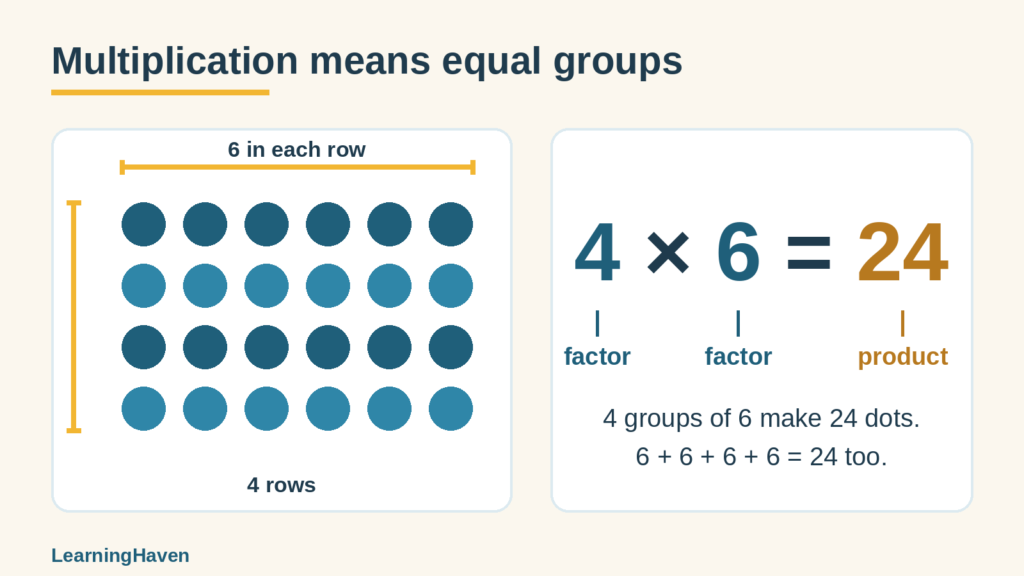
Multiplication finds the total when you combine equal groups, like 4 groups of 6 make 24. This page covers what multiplication means, the 12 x 12 multiplication chart with free printables, fact strategies, multiplying bigger whole numbers, missing factors, and practice.
What does multiplication mean?
Multiplication combines equal groups into one total, so 4 groups of 6 make 24. It is a shortcut for repeated addition (Britannica). Instead of writing 6 + 6 + 6 + 6, you write 4 x 6.
The numbers you multiply are called factors. The answer is the product. In 4 x 6 = 24, the factors are 4 and 6, and the product is 24. An array is a set of objects in equal rows and equal columns. An array with 4 rows of 6 dots shows 4 x 6.
The Grade 3 Common Core standard asks students to “interpret 5 × 7 as the total number of objects in 5 groups of 7 objects each” (CCSS.Math.Content.3.OA.A.1, Common Core State Standards Initiative).
Worked example. A shelf has 4 rows of books. Each row holds 6 books. How many books are on the shelf?
- Name the groups. There are 4 rows, and each row is a group of 6 books.
- Write the repeated addition: 6 + 6 + 6 + 6 = 24.
- Write the multiplication: 4 x 6 = 24.
The shelf holds 24 books.
This section covers equal groups and arrays with whole numbers. It doesn’t cover multiplying fractions or decimals, which are explained on our fractions and decimals pages.
What is a multiplication chart, and how do you read it?
A multiplication chart is a grid where each row number and column number meet at their product. A multiplication chart is also called a multiplication table or a times table. Numbers 1 to 12 run across the top and down the left side. Each box holds the product of its row number and its column number.
| x | 1 | 2 | 3 | 4 | 5 | 6 | 7 | 8 | 9 | 10 | 11 | 12 |
|---|---|---|---|---|---|---|---|---|---|---|---|---|
| 1 | 1 | 2 | 3 | 4 | 5 | 6 | 7 | 8 | 9 | 10 | 11 | 12 |
| 2 | 2 | 4 | 6 | 8 | 10 | 12 | 14 | 16 | 18 | 20 | 22 | 24 |
| 3 | 3 | 6 | 9 | 12 | 15 | 18 | 21 | 24 | 27 | 30 | 33 | 36 |
| 4 | 4 | 8 | 12 | 16 | 20 | 24 | 28 | 32 | 36 | 40 | 44 | 48 |
| 5 | 5 | 10 | 15 | 20 | 25 | 30 | 35 | 40 | 45 | 50 | 55 | 60 |
| 6 | 6 | 12 | 18 | 24 | 30 | 36 | 42 | 48 | 54 | 60 | 66 | 72 |
| 7 | 7 | 14 | 21 | 28 | 35 | 42 | 49 | 56 | 63 | 70 | 77 | 84 |
| 8 | 8 | 16 | 24 | 32 | 40 | 48 | 56 | 64 | 72 | 80 | 88 | 96 |
| 9 | 9 | 18 | 27 | 36 | 45 | 54 | 63 | 72 | 81 | 90 | 99 | 108 |
| 10 | 10 | 20 | 30 | 40 | 50 | 60 | 70 | 80 | 90 | 100 | 110 | 120 |
| 11 | 11 | 22 | 33 | 44 | 55 | 66 | 77 | 88 | 99 | 110 | 121 | 132 |
| 12 | 12 | 24 | 36 | 48 | 60 | 72 | 84 | 96 | 108 | 120 | 132 | 144 |
Worked example. Find 7 x 8.
- Find 7 in the left column.
- Find 8 in the top row.
- Follow row 7 across to column 8. The box says 56.
So 7 x 8 = 56. Check: row 8 and column 7 also meet at 56.
Free printables made by LearningHaven. Print them at 100 percent (actual size) on US Letter paper, landscape. Each box is 0.75 inch wide and 0.5 inch tall.
- Download the multiplication chart 1 to 12 (PDF). Color, one page, with the boxes for a number times itself in gold.
- Download the multiplication chart 1 to 12, black and white (PDF). Saves ink, one page, with the boxes for a number times itself in gray.
- Download the blank multiplication chart 1 to 12 (PDF). Two pages. Page 1 has the factors filled in. Page 2 is empty, so you write the factors too.
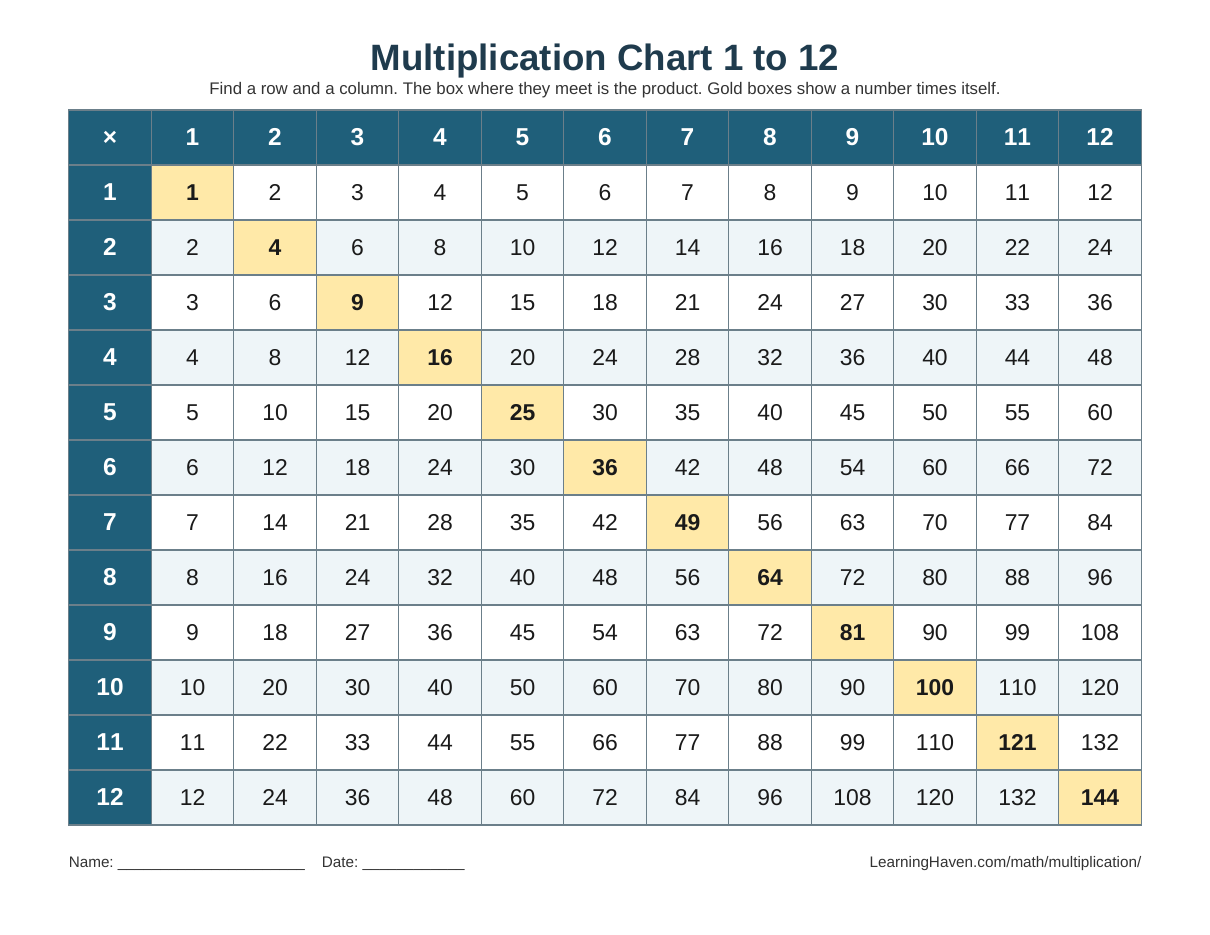
To practice with the blank chart, fill in what you remember, check it against the finished chart, and circle the boxes you missed. Practice only the circled facts next time. Games give the same practice in a different shape. Buzz and a multiplication version of Math War are on our math games page.
This section covers the 1 to 12 chart and a simple practice routine. It doesn’t cover charts that go past 12, a zero row, or timed fluency tests, which vary by school.
How many multiplication facts do you need to learn?
The 12 x 12 chart has 144 boxes, but only 78 different facts, because order doesn’t change the product. The commutative property says you can multiply two factors in either order and get the same product. The Common Core standards give this example: “If 6 × 4 = 24 is known, then 4 × 6 = 24 is also known” (CCSS.Math.Content.3.OA.B.5).
Here is where the count comes from:
- The diagonal from the top left to the bottom right holds 12 boxes. These are a number times itself, called square numbers: 1, 4, 9, 16, 25, 36, 49, 64, 81, 100, 121, and 144. You can read more on our squares and square roots page.
- The other 132 boxes form 66 matching pairs, like 7 x 8 and 8 x 7. Each pair is one fact.
- So 12 + 66 = 78 different facts.
The 1 to 9 part of the chart has 81 boxes and 45 different facts. Finding every factor pair of a number builds on the chart too, and our factoring page shows how.
A correction worth making.
The claim: A 12 x 12 chart makes it look as if Grade 3 requires all 144 boxes from memory.
The correction: The Common Core standard 3.OA.C.7 says, “By the end of Grade 3, know from memory all products of two one-digit numbers” (Common Core State Standards Initiative). One-digit numbers run from 0 to 9, so the standard stops at 9 x 9.
What to do: Learn the 1 to 9 part of the chart first. Add the 10s, 11s, and 12s next if your school or family wants them.
The chart also shows patterns, which the Common Core standards ask students to identify and explain (3.OA.D.9). Look for these:
- Every product in the 2, 4, 6, 8, 10, and 12 rows is even.
- Products in the 5 row end in 0 or 5.
- Products in the 9 row, from 9 x 1 to 9 x 10, have digits that add to 9.
- The chart is a mirror image across the diagonal.
This section covers how many facts are on the 1 to 12 chart and what the Common Core Grade 3 standards say. It doesn’t cover state standards that differ from Common Core, so check your own state’s standards.
Which strategies make the times tables easier?
Doubling, skip counting, adding a zero, and breaking a fact apart each give you a group of facts. Use the strategy that fits the table you are learning:
- Times 0 and times 1. Any number times 0 is 0. Any number times 1 is that same number. So 8 x 0 = 0 and 8 x 1 = 8.
- Times 2. Double the number. 6 x 2 = 12.
- Times 5. Skip count by 5, and the products end in 0 or 5. 5 x 7 = 35.
- Times 10. Write the number and add a zero. 10 x 7 = 70.
- Times 4. Double the number, then double again. For 4 x 6, double 6 to get 12, then double 12 to get 24.
- Times 8. Double three times. For 8 x 6, double 6 to get 12, double to get 24, and double again to get 48.
- Times 9. Take 10 times the number and subtract the number. 9 x 6 = 60 − 6 = 54. The digits of the answer add to 9, because 5 + 4 = 9.
- Times 11. For 11 x 1 up to 11 x 9, repeat the digit. 11 x 7 = 77.
- Times 12. Break 12 into 10 + 2. For 12 x 7, find 10 x 7 = 70 and 2 x 7 = 14, then add: 70 + 14 = 84.
- Times 3 and times 6. For 3 x 8, double 8 and add 8 once more: 16 + 8 = 24. For 6 x 7, find 5 x 7 = 35 and add 7: 35 + 7 = 42.
Breaking a factor into parts and adding the partial products is the distributive property. It works for any fact you have not memorized yet.
Worked example. Find 7 x 8 by breaking apart the 7.
- Split 7 into 5 + 2.
- Multiply each part by 8: 5 x 8 = 40 and 2 x 8 = 16.
- Add the parts: 40 + 16 = 56.
So 7 x 8 = 56.
This section covers strategies for facts from 0 x 0 to 12 x 12. It doesn’t cover tricks for larger numbers, which come from place value and appear below.
How do you multiply a bigger number by a one-digit number?
Break the bigger number into place-value parts, multiply each part by the one-digit number, then add the partial products. A partial product is the answer to one smaller multiplication inside a larger one. The Grade 4 standard 4.NBT.B.5 says students “Multiply a whole number of up to four digits by a one-digit whole number, and multiply two two-digit numbers, using strategies based on place value and the properties of operations” (Common Core State Standards Initiative).
First, multiply by 10, 100, and multiples of 10
Multiplying a whole number by 10 adds one zero at the end. Multiplying by 100 adds two zeros, and multiplying by 1,000 adds three zeros. So 7 x 10 = 70, 7 x 100 = 700, and 7 x 1,000 = 7,000. The Grade 3 standard 3.NBT.A.3 asks students to “Multiply one-digit whole numbers by multiples of 10 in the range 10-90” (Common Core State Standards Initiative).
To multiply by a multiple of 10, multiply the nonzero digits first. Then add the zeros.
Worked example. Find 40 x 30.
- Ignore the zeros and multiply 4 x 3 = 12.
- Count the zeros in both factors. 40 has one zero and 30 has one zero, so there are two zeros.
- Write the two zeros after the 12: 1,200.
So 40 x 30 = 1,200. Watch for facts that already end in zero. For 50 x 6, 5 x 6 = 30, and adding one zero gives 300. The answer has two zeros because 30 already had one.
Then multiply the parts and add
Worked example. Find 47 x 6 with partial products.
- Split 47 into 40 + 7.
- Multiply the tens: 40 x 6 = 240.
- Multiply the ones: 7 x 6 = 42.
- Add the partial products: 240 + 42 = 282.
So 47 x 6 = 282.
The column method gives the same answer. To regroup is to trade 10 of one place for 1 of the next place, just like carrying in addition.
- Multiply the ones: 6 x 7 = 42. Write 2 in the ones place and carry 4 tens.
- Multiply the tens: 6 x 4 = 24. Add the carried 4: 24 + 4 = 28.
- Write 28 to the left of the 2. The answer is 282.
This section covers multiplying whole numbers by 10, 100, 1,000, and multiples of 10, and a two-digit number times a one-digit number. The same steps work for longer numbers. It doesn’t cover decimals, where the decimal point moves instead, or multiplying by a two-digit number, which comes next.
How do you multiply two two-digit numbers?
Multiply by the tens and by the ones separately, then add the two partial products. An area model is a rectangle split into place-value parts, where each part is one partial product. The rectangle idea matches the area of a rectangle, which is length times width, as shown on our area formulas page.
Worked example. Find 36 x 24 with an area model.
- Split 36 into 30 + 6, and split 24 into 20 + 4.
- Multiply each pair of parts and put the products in a grid.
| x | 20 | 4 |
|---|---|---|
| 30 | 600 | 120 |
| 6 | 120 | 24 |
- Add the four partial products: 600 + 120 + 120 + 24 = 864.
So 36 x 24 = 864.
The column method uses two rows.
- Multiply 36 by the 4 ones: 36 x 4 = 144.
- Multiply 36 by the 2 tens: 36 x 20 = 720.
- Add the rows: 144 + 720 = 864.
Squared paper makes the grid easier. Try our printable graph paper for arrays and area models.
This section covers two-digit numbers times two-digit numbers. It doesn’t cover three-digit factors or decimals, which use the same partial products with more rows.
How do you find a missing factor?
Divide the product by the known factor to find the missing factor. A missing factor is the unknown number in a multiplication equation, like 7 x ? = 56. The Common Core standards ask students to “Determine the unknown whole number in a multiplication or division equation relating three whole numbers” (CCSS.Math.Content.3.OA.A.4).
Worked example. Find the missing factor in 7 x ? = 56.
- The known factor is 7 and the product is 56.
- Divide the product by the known factor: 56 ÷ 7 = 8.
- Check by multiplying: 7 x 8 = 56.
The missing factor is 8. You can also find it on the chart. Go along row 7 until you reach 56, then read the column number at the top: 8.
Division and multiplication are reverse operations. Our division page shows the same check from the other direction.
This section covers one missing factor in a whole-number equation. It doesn’t cover equations with letters, which come up in algebra.
How do you check a multiplication answer?
Check a product by estimating, by swapping the factors, or by dividing the product by one factor. An estimate tells you if the answer is close. Swapping and dividing tell you if it is exact. This matches how you check subtraction with addition, because each check uses the reverse operation.
Worked example. Check that 36 x 24 = 864.
- Estimate. Round 36 to 40 and 24 to 20. Then 40 x 20 = 800. The answer 864 is close to 800, so it is reasonable.
- Swap the factors. 24 x 36 = 24 x 30 + 24 x 6 = 720 + 144 = 864. It matches.
- Divide. 864 ÷ 24 = 36. This gives back the other factor, so the answer is correct.
There is also a quick last-digit check. Multiply just the ones digits of the two factors. The ones digit of that result must match the ones digit of the product. In 36 x 24, the ones digits are 6 and 4, and 6 x 4 = 24, which ends in 4. The product 864 ends in 4, so it passes. This check can catch a mistake, but it cannot prove an answer is right.
This section covers checking whole-number products. It doesn’t cover checking decimal or fraction products, which need matching place values first.
Practice set
Work through these on paper, then check your answers. For equal-group story problems, try our word problems page. For more printed practice, see our math worksheets and homeschool worksheets pages.
- 8 x 7
- 9 x 12
- 63 x 4
- 205 x 6
- 34 x 25
- 7 x ? = 84
Show answers and reasoning
- 8 x 7 = 56. Double 4 x 7 = 28 to get 56. Check: 56 ÷ 8 = 7.
- 9 x 12 = 108. Find 10 x 12 = 120, then subtract 12: 120 − 12 = 108. Check: 108 ÷ 9 = 12.
- 63 x 4 = 252. Split 63 into 60 + 3. Then 60 x 4 = 240 and 3 x 4 = 12, so 240 + 12 = 252. Check: 252 ÷ 4 = 63.
- 205 x 6 = 1,230. Split 205 into 200 + 5. Then 200 x 6 = 1,200 and 5 x 6 = 30, so 1,200 + 30 = 1,230. The tens digit is 0, so it adds nothing. Check: 1,230 ÷ 6 = 205.
- 34 x 25 = 850. Split 25 into 20 + 5. Then 34 x 20 = 680 and 34 x 5 = 170, so 680 + 170 = 850. Check: 850 ÷ 25 = 34.
- 7 x ? = 84, so the missing factor is 12. Divide: 84 ÷ 7 = 12. Check: 7 x 12 = 70 + 14 = 84.
This set covers whole-number multiplication and one missing factor. It doesn’t cover decimals or fractions.
Once the chart feels familiar, division is the natural next step, because it reverses multiplication. For more topics, visit our math hub.
Sources
- Britannica. Multiplication.
- Common Core State Standards Initiative. Grade 3, Operations and Algebraic Thinking.
- Common Core State Standards Initiative. Grade 3, Number and Operations in Base Ten.
- Common Core State Standards Initiative. Grade 4, Number and Operations in Base Ten.