Addition combines two or more numbers, called addends, to find their total, called the sum. This page covers the parts of an addition problem, fast fact strategies, place value, regrouping (carrying), missing addends, checking answers, and free printable worksheets with answer keys.
What are the parts of an addition problem?
Every addition problem has addends and a sum. In 7 + 5 = 12, the addends are 7 and 5, and the sum is 12.
Encyclopaedia Britannica Kids defines the terms this way: “In an addition equation, addends are the numbers that are added together to give a sum.” (Britannica Kids) The plus sign (+) means “add.” The equal sign (=) means both sides have the same value.
Order does not change the sum. The Common Core State Standards give this example in standard 1.OA.B.3: “If 8 + 3 = 11 is known, then 3 + 8 = 11 is also known.” (Common Core, Grade 1 Operations & Algebraic Thinking) That rule is called the commutative property of addition.
Grouping does not change the sum either. Standard 1.OA.B.3 gives this example: “To add 2 + 6 + 4, the second two numbers can be added to make a ten, so 2 + 6 + 4 = 2 + 10 = 12.” (Common Core, Grade 1 Operations & Algebraic Thinking) That rule is called the associative property of addition.
This section covers the basic vocabulary and the order rule only. It doesn’t cover subtraction terms, which are on our subtraction page.
Which addition facts should kids know, and by when?
An addition fact is a sum of two one-digit numbers, such as 6 + 7 = 13. There are 100 ordered facts from 0 + 0 through 9 + 9. Swapping the addends leaves 55 different facts to learn.
The Common Core State Standards set a clear target for Grade 2. Standard 2.OA.B.2 says: “By end of Grade 2, know from memory all sums of two one-digit numbers.” (Common Core, Grade 2 Operations & Algebraic Thinking) Standard 1.OA.C.6 asks for fluency within 10 in Grade 1 and uses strategies to reach sums within 20.
Memorizing 55 facts one by one is slow. The next section shows six strategies that cover all 100 facts.
This section covers the Common Core targets for facts. It doesn’t cover your state’s own standards, which can set different grade targets, so check your state’s list if you follow one.
Which strategies make addition facts faster?
Six strategies cover all 100 addition facts. Zero, one, doubles, and doubles plus one handle 58 of them. Making ten handles 30 more. Counting on handles the last 12.
Count each fact once, in the first row of this table that fits it.
| Strategy | Use it when | Example | Facts it covers (of 100) |
|---|---|---|---|
| Adding zero | One addend is 0 | 9 + 0 = 9 | 19 |
| Adding one | One addend is 1 | 7 + 1 = 8 | 17 |
| Doubles | Both addends are the same | 6 + 6 = 12 | 8 |
| Doubles plus one | The addends differ by 1 | 6 + 7 = 13 | 14 |
| Making ten | The sum is 10 or more | 8 + 6 = 14 | 30 |
| Counting on | The sum is 9 or less and no other row fits | 3 + 5 = 8 | 12 |
The table counts the 100 facts with addends from 0 to 9. LearningHaven built it by sorting every fact into the first row that fits. The counts add up to 100.
Adding zero. Any number plus 0 stays the same. 9 + 0 = 9.
Adding one. Adding 1 gives the next number when you count. 7 + 1 = 8.
Doubles. A double adds a number to itself. 6 + 6 = 12. Doubles are easy to remember because they follow a pattern: 2 + 2 = 4, 3 + 3 = 6, 4 + 4 = 8.
Doubles plus one. This strategy uses a double you know and adds 1 more. For 6 + 7, start with the double 6 + 6 = 12. Then add 1 to get 13. The Common Core State Standards describe the same idea in standard 1.OA.C.6: “adding 6 + 7 by creating the known equivalent 6 + 6 + 1 = 12 + 1 = 13.” (Common Core, Grade 1 Operations & Algebraic Thinking)
Making ten. Move part of one addend to the other addend to build a 10. Standard 1.OA.C.6 gives this example: “making ten (e.g., 8 + 6 = 8 + 2 + 4 = 10 + 4 = 14).” (Common Core, Grade 1 Operations & Algebraic Thinking)
Worked example. Add 9 + 7 by making ten.
- Ask how far 9 is from 10. It needs 1 more.
- Break 7 into 1 and 6. Now 9 + 7 = 9 + 1 + 6.
- Add the first two numbers: 9 + 1 = 10.
- Add what is left: 10 + 6 = 16.
So 9 + 7 = 16.
Counting on. Start at the larger addend and count up by the smaller one. For 3 + 5, start at 5 and count 6, 7, 8. The sum is 8.
This section covers strategies for one-digit facts. It doesn’t cover multiplication facts, which have their own strategies on our multiplication page.
Why does place value matter in addition?
Place value means a digit’s position tells you its value. In 346, the 3 means 3 hundreds, the 4 means 4 tens, and the 6 means 6 ones.
Adding bigger numbers works because you add matching places. Standard 2.NBT.B.7 says that when adding three-digit numbers, “one adds or subtracts hundreds and hundreds, tens and tens, ones and ones.” (Common Core, Grade 2 Number & Operations in Base Ten)
Worked example. Add 346 + 253.
- Ones: 6 + 3 = 9.
- Tens: 4 tens + 5 tens = 9 tens, which is 90.
- Hundreds: 3 hundreds + 2 hundreds = 5 hundreds, which is 500.
- Put the places together: 500 + 90 + 9 = 599.
So 346 + 253 = 599.
Here is the plan so far. Addends join to make a sum. Fast facts come from six strategies. Bigger sums come from adding ones to ones, tens to tens, and hundreds to hundreds. Next comes the case where a column adds up to 10 or more.
This section covers whole-number place value. It doesn’t cover decimal place value, which lines up around a decimal point, as covered on our decimals page.
How does regrouping (carrying) work?
Regrouping, also called carrying, happens when a column adds to 10 or more. You trade 10 of one place for 1 of the next place to the left.
Ten ones make 1 ten. Ten tens make 1 hundred. The same trade works in every column. Standard 2.NBT.B.7 names this step: “sometimes it is necessary to compose or decompose tens or hundreds.” (Common Core, Grade 2 Number & Operations in Base Ten)
Worked example. Add 48 + 37.
- Ones: 8 + 7 = 15. Write 5 in the ones place. Carry 1 ten to the tens column.
- Tens: 4 + 3 + the carried 1 = 8. Write 8 in the tens place.
Reading the columns gives 85. So 48 + 37 = 85.
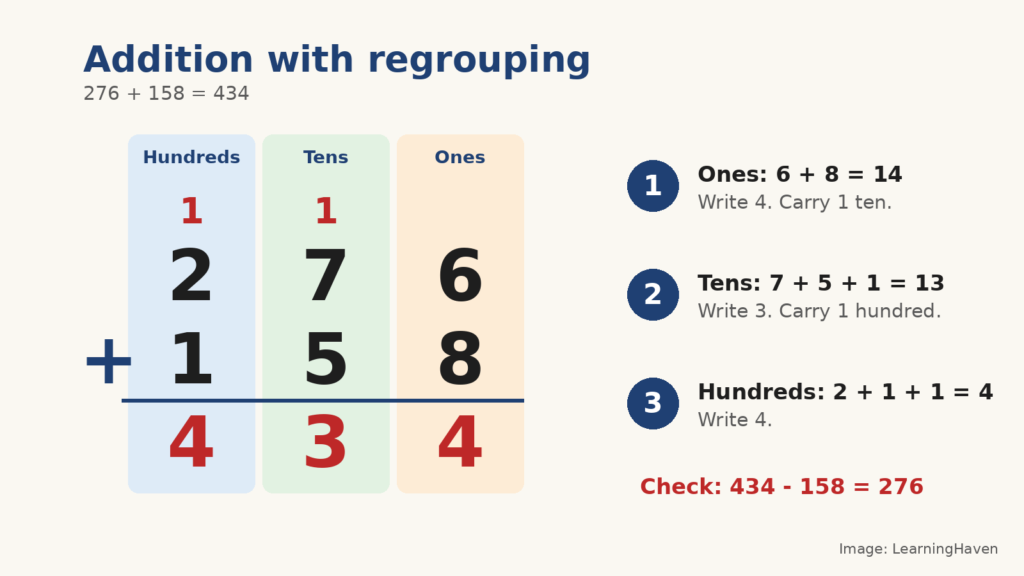
Worked example. Add 276 + 158. The picture at the top of this page shows these steps.
- Ones: 6 + 8 = 14. Write 4. Carry 1 ten.
- Tens: 7 + 5 + the carried 1 = 13. Write 3. Carry 1 hundred.
- Hundreds: 2 + 1 + the carried 1 = 4. Write 4.
Reading the columns gives 434. So 276 + 158 = 434.
Worked example. Add 509 + 396. The tens column has a zero, and a carry still lands in it.
- Ones: 9 + 6 = 15. Write 5. Carry 1 ten.
- Tens: 0 + 9 + the carried 1 = 10. Write 0. Carry 1 hundred.
- Hundreds: 5 + 3 + the carried 1 = 9. Write 9.
Reading the columns gives 905. So 509 + 396 = 905.
A column sum of exactly 10 still needs a carry. You write 0 in that place and carry the 1.
This section covers regrouping in whole-number addition up to three digits. It doesn’t cover adding decimals or fractions, which use the same idea with matching parts.
What is a missing addend?
A missing addend is the unknown number in an addition problem. In 8 + ? = 15, the missing addend is the number that makes the sum 15.
Subtract the known addend from the sum. For 8 + ? = 15, find 15 − 8 = 7. Check by adding: 8 + 7 = 15.
The Common Core State Standards use this skill in standard 1.OA.D.8: “Determine the unknown whole number in an addition or subtraction equation relating three whole numbers.” (Common Core, Grade 1 Operations & Algebraic Thinking)
Worked example. Find the missing addend in 46 + ? = 83.
- Subtract the known addend from the sum: 83 − 46.
- Ones: 3 is smaller than 6, so regroup. 13 − 6 = 7.
- Tens: 8 tens became 7 tens. 7 − 4 = 3.
The missing addend is 37. Check: 46 + 37 = 83.
This section covers missing addends in one equation. It doesn’t cover algebra with letters for unknowns, which comes later on our algebra page.
How do you check an addition answer?
You can check addition in two ways that use math you already know. Both take less than a minute.
Method 1. Subtract an addend from the sum. The result should be the other addend. Addition and subtraction undo each other. The Common Core State Standards describe subtraction as an unknown-addend problem in standard 1.OA.B.4. (Common Core, Grade 1 Operations & Algebraic Thinking)
Checking example. Check that 276 + 158 = 434. Subtract 158 from 434: 434 − 158 = 276. That matches the other addend, so the answer is correct.
Method 2. Estimate with rounding. Round each addend to the nearest ten, add, and see if the sum is close.
Checking example. Estimate 276 + 158. Round 276 to 280 and 158 to 160. Then 280 + 160 = 440. The real sum, 434, is 6 away from 440, so it is reasonable. An answer like 534 would be far from 440, which signals an error.
You can also swap the addends and add again. 158 + 276 = 434 gives the same sum.
This section covers checking whole-number addition. It doesn’t prove an answer is right in every case, because an estimate only shows whether an answer is close.
Where can you get free addition worksheets?
LearningHaven made two free addition worksheets, each with an answer key. Both print on US Letter paper at 100% scale. You don’t need an account.
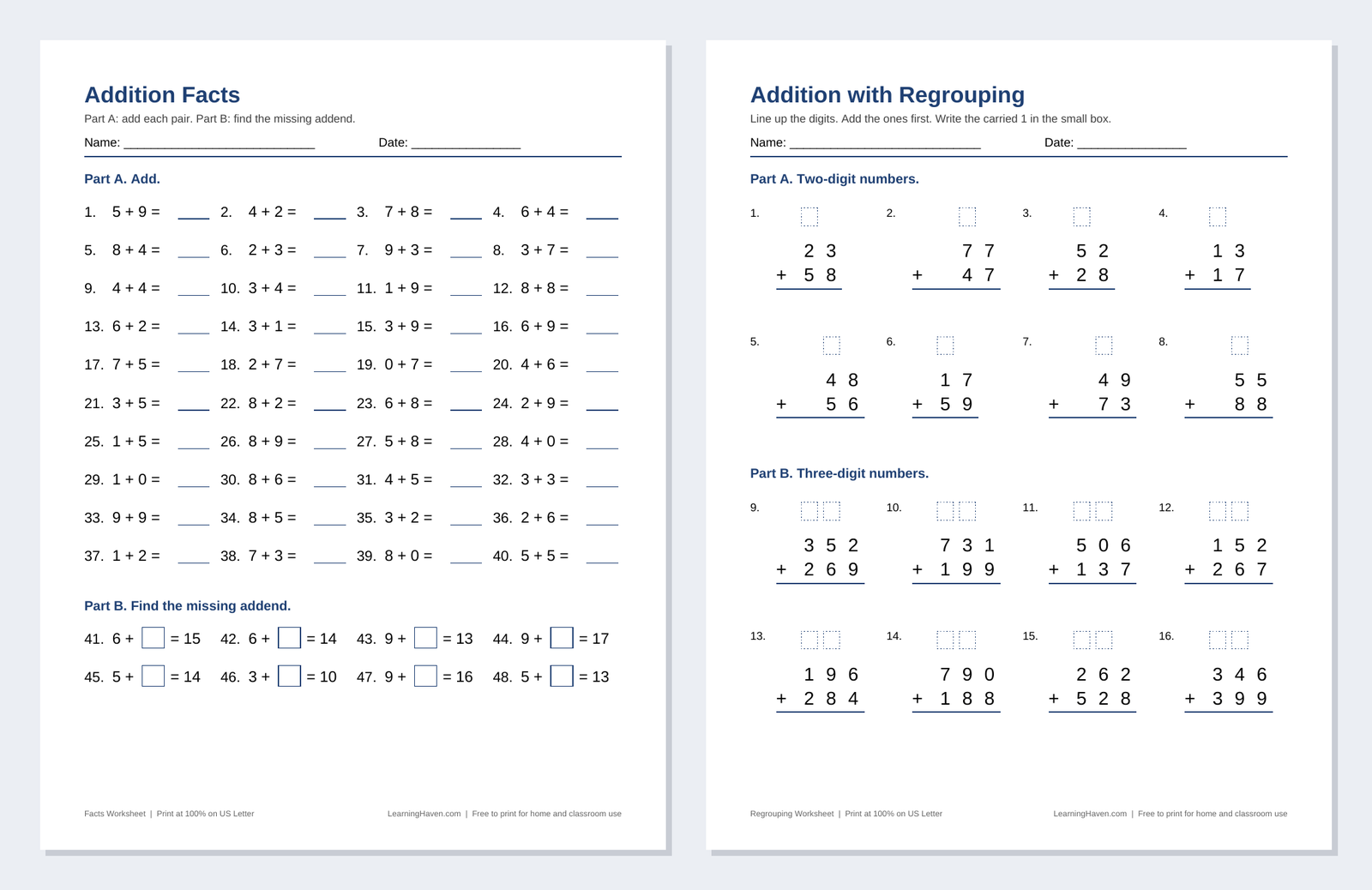
Addition facts worksheet. It has 48 problems. Part A has 40 facts with sums to 18: 4 with zero, 4 with one, 5 doubles, 6 doubles plus one, 16 that use making ten, and 5 that use counting on. Part B has 8 missing addend problems. Use it after you practice the strategies above.
Addition with regrouping worksheet. It has 16 vertical problems, and every one needs at least one regroup. Part A has 8 two-digit problems. Part B has 8 three-digit problems. All sums stay below 1,000, the range named in standard 2.NBT.B.7 (Grade 2) and standard 3.NBT.A.2 (Grade 3). Small dotted boxes above the digits give space to write each carried 1. The answer key shows every carry.
How to use them at home or in a homeschool day: print the worksheet, let the child work with pencil, then use the answer key to check. Where an answer is wrong, find the column where the mistake started and redo that step. For more printables, see our math worksheets page and our homeschool worksheets page.
This section covers the two worksheets made for this page. It doesn’t cover worksheets for decimals, fractions, or word problems, which have their own pages.
Practice set
Work through these on paper, then check your answers.
- 8 + 7
- 6 + 7
- 58 + 36
- 346 + 275
- 7 + ? = 16
- 4,587 + 2,968
Show answers and reasoning
- 8 + 7 = 15. Make ten: 8 + 2 + 5 = 10 + 5 = 15. Check: 15 − 8 = 7.
- 6 + 7 = 13. Doubles plus one: 6 + 6 = 12, then 12 + 1 = 13. Check: 13 − 7 = 6.
- 58 + 36 = 94. Ones: 8 + 6 = 14, write 4 and carry 1. Tens: 5 + 3 + 1 = 9. Check: 94 − 36 = 58.
- 346 + 275 = 621. Ones: 6 + 5 = 11, write 1 and carry 1. Tens: 4 + 7 + 1 = 12, write 2 and carry 1. Hundreds: 3 + 2 + 1 = 6. Check: 621 − 275 = 346.
- The missing addend is 9. Subtract: 16 − 7 = 9. Check: 7 + 9 = 16.
- 4,587 + 2,968 = 7,555. Ones: 7 + 8 = 15, write 5 and carry 1. Tens: 8 + 6 + 1 = 15, write 5 and carry 1. Hundreds: 5 + 9 + 1 = 15, write 5 and carry 1. Thousands: 4 + 2 + 1 = 7. Check: 7,555 − 2,968 = 4,587.
Subtraction undoes addition, as the checking steps above show, so the subtraction page is the natural next stop. For more topics, visit our math hub.
The Grade 2 standards group addition of equal groups under the heading “Work with equal groups of objects to gain foundations for multiplication” (Common Core, Grade 2 Operations & Algebraic Thinking), so the multiplication page is a good step after that.
Addition also shows up in word problems, and for adding parts of a whole, see our fractions page.
Sources
- Encyclopaedia Britannica Kids. Arithmetic equations and their parts.
- Common Core State Standards Initiative. Grade 1 Operations & Algebraic Thinking.
- Common Core State Standards Initiative. Grade 2 Operations & Algebraic Thinking.
- Common Core State Standards Initiative. Grade 2 Number & Operations in Base Ten.
- Common Core State Standards Initiative. Grade 3 Number & Operations in Base Ten.