Area is the amount of surface a two-dimensional shape covers. It is always measured in square units such as cm² or m².
This page gives the area formula for every common shape, with a labeled diagram and a worked example for each one.
Area formulas by shape
| Shape | Formula | What the letters mean |
|---|---|---|
| Square | A = a² | a is the side length |
| Rectangle | A = a × b | a is length, b is width |
| Parallelogram | A = b × h | b is base, h is perpendicular height |
| Trapezoid | A = ½ × h × (a + b) | a and b are the parallel sides, h is height |
| Triangle | A = ½ × b × h | b is base, h is perpendicular height |
| Equilateral triangle | A = (√3 ÷ 4) × a² | a is the side length |
| Circle | A = πr² | r is the radius |
One rule underlies most of these: height always means perpendicular height, measured at a right angle to the base. It is not the length of a slanted side.
The three steps
- Name the shape. Square, rectangle, parallelogram, trapezoid, triangle or circle.
- Match the measurements to the letters. This is where most marks are lost. Height means perpendicular height, and radius is half the diameter.
- Substitute and calculate. Keep the units, and remember the answer is in square units.
Square
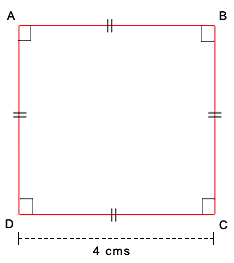
A square has four equal sides and four right angles, so area is side multiplied by side.
A = a²
Worked example. Square ABCD has DC = 4 cm. Area = 4 × 4 = 16 cm².
All four sides are equal, so one measurement is all you are given and all you need.
Rectangle
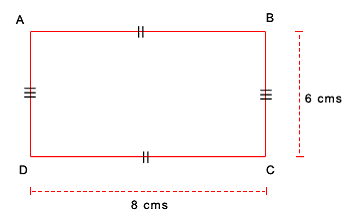
A rectangle has two pairs of parallel sides and four right angles, with a length and a width that differ.
A = a × b
Worked example. Rectangle ABCD has DC = 8 cm and BC = 6 cm. Area = 8 × 6 = 48 cm².
Opposite sides are equal, shown by the tick marks, so you only need one measurement from each pair.
Parallelogram
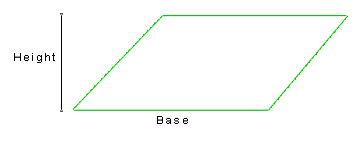
A parallelogram has two pairs of parallel opposite sides.
A = b × h
Worked example. Base 10 cm and height 4 cm gives 40 cm².
Note the boundary carefully. h is the perpendicular distance between the two parallel sides, not the length of the sloping side. Using the sloping side gives an answer that is always too large.
Trapezoid
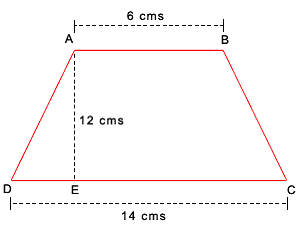
A trapezoid has exactly one pair of parallel sides.
A = ½ × h × (a + b), where a and b are the two parallel sides.
Worked example. This trapezoid has parallel sides AB = 6 cm and DC = 14 cm, with a perpendicular height AE = 12 cm. Area = ½ × 12 × (6 + 14) = ½ × 12 × 20 = 120 cm².
The same answer by splitting
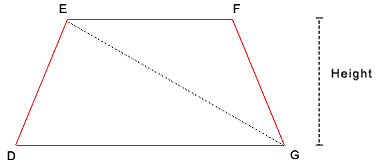
A diagonal cuts any trapezoid into two triangles that share the same height. Adding their areas gives the same result.
Area = ½ × 12 × 14 + ½ × 12 × 6 = 84 + 36 = 120 cm²
The two methods agree because the single formula is the split method with the common factor taken outside the bracket. That is also why the formula collapses to the rectangle formula when a and b are equal.
Triangle
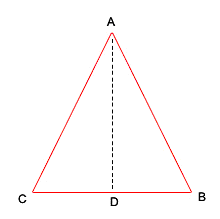
A = ½ × b × h, where b is the base and h is the perpendicular height.
Worked example. Triangle ABC has base CB = 6 cm, with the perpendicular AD drawn from vertex A to the base. AD = 8 cm. Area = ½ × 6 × 8 = 24 cm².
AD is the height, not AB or AC. The dashed line is drawn at a right angle to the base for exactly that reason.
Any of the three sides can be treated as the base, as long as the height is measured perpendicular to that side.
Equilateral triangle
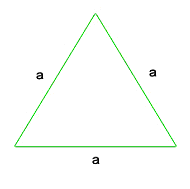
An equilateral triangle has three equal sides and three 60° angles.
A = (√3 ÷ 4) × a², where a is the side length.
Worked example. A side of 4 cm gives (√3 ÷ 4) × 16 = 4√3, about 6.93 cm².
Circle
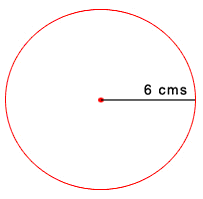
A = πr², where r is the radius.
Worked example. A circle of radius 6 cm has an area of π × 6² = π × 36 = 113.1 cm² to one decimal place.
Square the radius first, then multiply by π. Multiplying 6 by π and then squaring gives a completely different and wrong answer.
Watch the radius too. If you are given the diameter, halve it first. Squaring a diameter instead of a radius makes the answer four times too big.
A correction worth making
The claim: The value of π is 22/7.
Why it persists: 22/7 is taught as the fraction to use in school arithmetic, and it is easy to multiply by, so it gets remembered as the value rather than as a convenience.
The correction: π is irrational, which means it cannot be written exactly as any fraction. 22/7 gives 3.142857 while π is 3.141593 to six decimal places. The approximation is close enough for classroom work and wrong at the third decimal place.
What it changes here: Using 22/7 for this circle gives 113.14 cm² against a true value of 113.10 cm². Fine for a homework answer, not fine if you state it as exact.
Heron’s formula
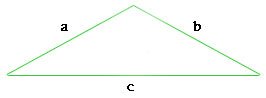
Heron’s formula finds the area of a triangle from its three side lengths alone, with no height needed.
A = √[s(s − a)(s − b)(s − c)], where s = (a + b + c) ÷ 2
s is the semi-perimeter, meaning half the perimeter.
Worked example. A triangle with sides 3, 4 and 5 cm has s = 12 ÷ 2 = 6. The area is √[6 × 3 × 2 × 1] = √36 = 6 cm².
That matches ½ × 3 × 4 = 6, because 3-4-5 is a right triangle and both methods must agree.
Three equivalent forms
Heron’s formula can be written without calculating s first. All three forms below give the same answer as the version above.
- A = √[(a + b + c)(a + b − c)(b + c − a)(c + a − b) ÷ 16]
- A = √[(2(a²b² + a²c² + b²c²) − (a⁴ + b⁴ + c⁴)) ÷ 16]
- A = √[(a² + b² + c²)² − 2(a⁴ + b⁴ + c⁴)] ÷ 4
Checked against the 3-4-5 triangle, each returns 6 cm². Form 1 is the semi-perimeter version with the halves multiplied out. Forms 2 and 3 are useful when you are working algebraically and do not want a nested subtraction.
Use Heron’s formula when you know all three sides and no height. Use ½ × b × h when you have a base and a perpendicular height. Neither is better, they just need different inputs.
Common mistakes
| Mistake | What happens |
|---|---|
| Using a sloping side as the height | Answer comes out too large |
| Using the diameter as the radius | Circle area comes out four times too large |
| Forgetting the ½ on a triangle | Answer comes out double |
| Adding all four sides of a trapezoid | That is the perimeter, not the area |
| Leaving the answer in plain units | Area is always in square units |
What this page does not cover
These formulas are for flat shapes. Three-dimensional solids have surface area and volume instead. Regular polygons with more than four sides use the apothem method, and irregular shapes are handled by splitting them into shapes that do have a formula, then adding the parts.
Where to go next
For the distance around a shape rather than the space inside, see perimeter formulas. For solids, see surface area formulas. Circle parts are defined in circle properties, and the section index is in geometry.