Handwriting worksheets give young children short, guided practice at forming letters and numbers on lined paper. This page has five free printables for PreK to grade 2, plus a parent guide to readiness, pencil grip, posture, writing lines, and how long to practice.
What free handwriting worksheets can you print?
LearningHaven made five free handwriting printables for US Letter paper. Print as many copies as you need.
- Download the uppercase letters A to Z (PDF, 2 pages)
- Download the lowercase letters a to z (PDF, 2 pages)
- Download the numbers 0 to 9 (PDF, 1 page)
- Download the short word practice sheet (PDF, 1 page)
- Download the blank handwriting paper, wide and narrow rows (PDF, 2 pages)
On the letter and number sheets, each row has one black model, five gray copies to trace, and empty space to write on your own. Every sheet has a name and date line.
| Sheet | Pages | Rows | Row height, top line to baseline |
|---|---|---|---|
| Uppercase A to Z | 2 | 26 (13 per page) | 0.44 inch |
| Lowercase a to z | 2 | 26 (13 per page) | 0.44 inch |
| Numbers 0 to 9 | 1 | 10 | 0.56 inch |
| Short word practice | 1 | 12 (3 start boxes, 9 empty rows) | 0.44 inch |
| Blank paper, wide rows | 1 of 2 | 8 | 5/8 inch |
| Blank paper, narrow rows | 2 of 2 | 14 | 3/8 inch |
Print at 100 percent so the rows keep these heights. On the short word sheet, a grown-up writes a word such as cat, sun, or map in each box. The child copies it beside the box, then again on the empty rows.
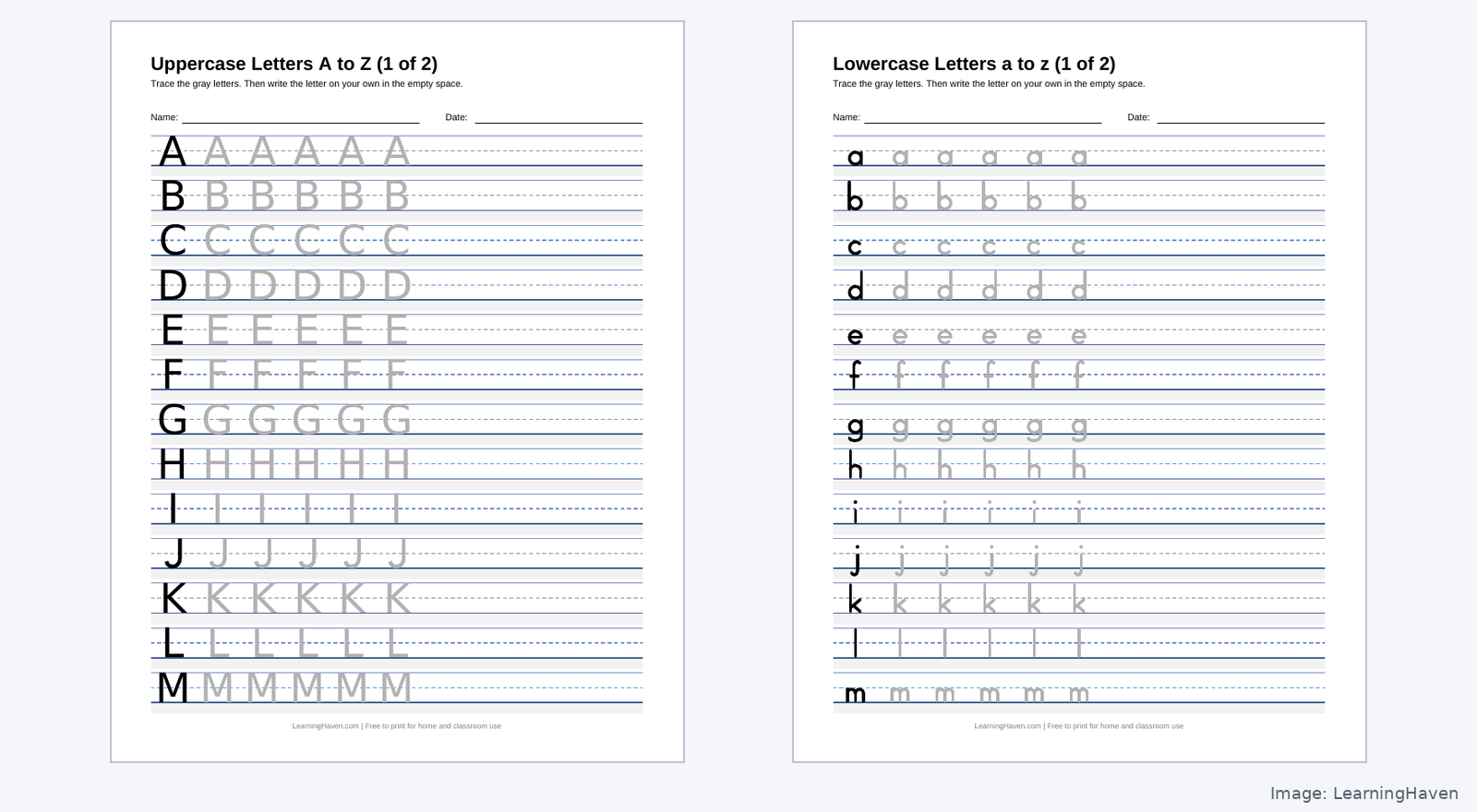
Both letter sets are here, so you can follow your school’s order. We found no fetched source that says one set should come first.
This section covers the five files on this page. It doesn’t cover cursive, which these files don’t include.
When are children ready to write letters?
Handwriting starts with copying basic shapes. An NHS Wales children’s occupational therapy page says the next steps are forming letters, writing on a line, sizing letters, and spacing words.
An Aneurin Bevan University Health Board leaflet says children start to copy basic lines at 2 to 3 years, trace dotted lines at 3 to 4, and copy a square, a cross, a circle, and a triangle at 4 to 6. Sources differ on the grip. A Central Coast Local Health District leaflet in Australia says a tripod grasp starts at about 4 to 5 years. The Aneurin Bevan leaflet says: “Most children will master the tripod grip by the age of 6 or 7.” Treat these ages as a rough guide. Do not rush: the Central Coast leaflet says it is important “not to force your child to use a grasp that is too hard for their age and skill level.”
Standards set school targets, not a readiness test. Common Core L.K.1.a asks Kindergartners to “Print many upper- and lowercase letters.” L.1.1.a asks first graders to “Print all upper- and lowercase letters.” (Kindergarten Language and Grade 1 Language)
This section covers the usual order and ages that these sources give. It doesn’t cover diagnosis, which only a clinician can make.
How should your child hold the pencil and sit?
A comfortable grip and a steady seat help a child write without tiring. The What Works Clearinghouse (WWC) writing guide says early instruction should begin with how to hold a pencil “comfortably between the thumb and forefinger, resting on the middle finger.” It adds that “a comfortable pencil grip is necessary in order to avoid fatigue.” (WWC practice guide)
A Leicester NHS children’s occupational therapy leaflet (last reviewed June 2020) gives a seating checklist.
- Bottom back in the seat, and feet flat on the floor. Use a firm non-slip footrest if feet cannot reach.
- Table just above the elbow, with the chair pulled in close.
- Straight back, not lying over the page.
The leaflet says to tilt the paper slightly, in opposite directions for left-handers and right-handers, and to let the non-writing hand hold the paper. Another NHS Wales leaflet adds that this hand moves the paper down the page.
This section covers grip and seating basics. It doesn’t cover special equipment, which an occupational therapist can advise on.
What are the three writing lines?
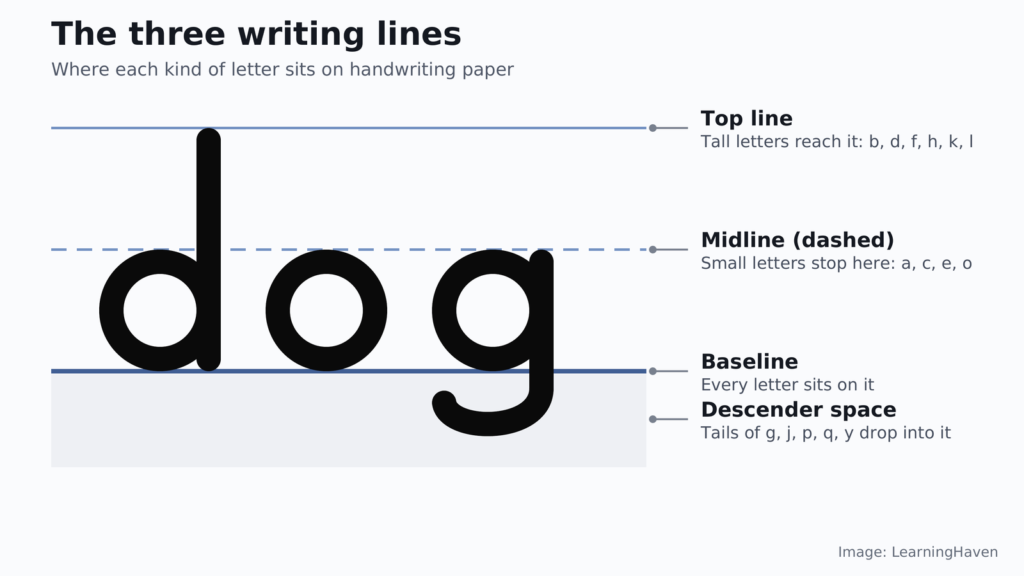
Each row on our sheets has a top line, a dashed midline, and a baseline, with a shaded space below for tails.
- Tall letters b, d, f, h, k, and l reach the top line. The letter t stops a little short of it, with its cross on the midline.
- Small letters such as a, c, e, m, and o stop at the dashed midline.
- Tails of g, j, p, q, and y drop below the baseline into the shaded space.
The midline sits halfway between the baseline and the top line, as on most school paper. Our lowercase letters use simple ball-and-stick shapes, built from straight lines and circles, so they fit that halfway line.
The NHS Wales leaflet on letter formation says: “Letters in print should be written from top to bottom and from left to right.” Our sheets don’t show start points or stroke arrows. The WWC guide says guided practice can use “numbered arrows depicting the order and direction of each stroke,” so ask your child’s school for its model and follow it.
This section covers the line system and letter positions on our sheets. It doesn’t cover cursive lines or the stroke order of any one program.
How do you practice letters well?
Keep sessions short and frequent. The letter-formation leaflet says “daily practice for 10-15 minutes is preferable to an hour a week.” The WWC guide says: “Because handwriting is a motor skill, it works best to practice in multiple short sessions.” Students might practice one letter “only five to eight times before moving to another activity.”
Worked example. Run one session with the lowercase sheet.
- Warm up for 2 to 3 minutes with coloring, a maze, or dot-to-dots.
- Pick one goal, such as the tall letters b, d, and h. The NHS Wales leaflet suggests one goal at a time.
- Trace the five gray copies in a row. Then cover the black model with a sticky note and write the letter from memory in the empty space.
- Stop at five to eight tries per letter, then move to the next letter.
- Finish with a short word that uses those letters.
The session runs 12 to 18 minutes, from 2 + 10 = 12 to 3 + 15 = 18. The 10 to 15 minutes of practice comes from the NHS Wales leaflet. No source we fetched gives a time for PreK, so watch your child, not the clock.
Do not stop at single letters. The WWC guide says “writing letters in isolation is insufficient.” The American Occupational Therapy Association (AOTA) children and youth infographic says research does not support isolated skill practice.
This section covers practice habits for print. It doesn’t cover spelling or composing, which the WWC guide treats as separate skills.
When should you ask a teacher or therapist?
A handout from the National Association of Special Education Teachers (NASET) lists signs that can lead to an occupational therapy referral. The writing signs include illegible handwriting, tiring quickly, poor pencil grasp, and trouble with spacing, sizing, or letter formation. The handout says a child may need a referral if several signs show, or if any one of them causes a functional delay or problem.
Start by telling your child’s teacher what you see, and ask whether an occupational therapy evaluation makes sense.
This section covers when to ask for help. It doesn’t cover diagnosis or treatment.
Why does handwriting still matter?
The WWC guide recommends teaching students to become fluent with handwriting, spelling, sentence construction, typing, and word processing. The panel rates the evidence as moderate, from nine studies, three of them on handwriting. The panel sees sentence construction as more directly tied to writing quality. The panel explains: “When basic writing skills become relatively effortless for students, they can focus less on these basic writing skills and more on developing and communicating their ideas.”
A 2012 study tested 15 children aged 4 to 5 who could not yet read. The children printed, typed, or traced letters and shapes, then had brain scans. A reading-related circuit was active “only after handwriting,” not after typing or tracing. The authors write that handwriting “may facilitate reading acquisition in young children.” It was a small study, so treat it as a clue, not proof. Our rows pair tracing with empty space for writing for this reason.
This section covers research summaries. It doesn’t cover typing lessons or any one school’s policy.
A note for older kids. The WWC guide lists grades 1 to 6 on its landing page. An older child who still writes slowly can use the narrow rows on page 2 of the blank paper with the same one-goal plan. If writing stays tiring or hard to read, talk with the teacher.
Pair handwriting with reading practice from our language arts hub, reading worksheets, phonics guide, and Dolch sight words list. For numerals, see the counting page and the number words page.
For help choosing sheets, read our homeschool worksheets guide. For younger children, see the preschool page and the K to 3 plan. For math grids, try our graph paper.
Sources
- Common Core State Standards Initiative. English Language Arts Standards, Language, Kindergarten.
- Common Core State Standards Initiative. English Language Arts Standards, Language, Grade 1.
- U.S. Department of Education, Institute of Education Sciences, What Works Clearinghouse. Teaching Elementary School Students to Be Effective Writers (practice guide) and its landing page.
- American Occupational Therapy Association, Children and Youth Special Interest Section. Pre-Writing and Handwriting Skills infographic.
- NHS Wales. Handwriting, children’s occupational therapy.
- NHS Wales. Letter formation leaflet.
- NHS Wales. Hand writing, children’s occupational therapy.
- Aneurin Bevan University Health Board. Development of a Tripod Pencil Grip.
- Central Coast Local Health District, New South Wales. Pencil Grasp Skills for Children.
- Children’s Occupational Therapy Service, Leicester. Let me sit ready for handwriting.
- National Association of Special Education Teachers. Reasons for an Occupational Therapy Evaluation.
- James, K. H., and Engelhardt, L. (2012). The effects of handwriting experience on functional brain development in pre-literate children. Trends in Neuroscience and Education.