A polygon is a closed flat figure made of straight line segments. The segments meet end to end and do not cross.
Polygons are named for how many sides they have. This page covers what they are made of, how to count their parts, and how to work out their angles.
What makes a figure a polygon
Four conditions, all required:
- Flat. Every point lies in the same plane.
- Closed. The boundary joins up with no gaps.
- Straight sides. Built from line segments, never curves.
- Sides that do not cross. They meet only at their endpoints.
A circle fails on straight sides. An arc fails on closed. A five-pointed star drawn in one stroke fails on crossing, and is called a star polygon rather than a simple polygon.
Counting the parts
Each polygon has a fixed number of sides, vertices, diagonals and angles. The counts follow rules rather than needing to be memorized.
| Polygon | Sides | Vertices | Diagonals | Angles |
|---|---|---|---|---|
| Triangle | 3 | 3 | 0 | 3 |
| Quadrilateral | 4 | 4 | 2 | 4 |
| Pentagon | 5 | 5 | 5 | 5 |
| Hexagon | 6 | 6 | 9 | 6 |
| Heptagon | 7 | 7 | 14 | 7 |
| Octagon | 8 | 8 | 20 | 8 |
| Nonagon | 9 | 9 | 27 | 9 |
| Decagon | 10 | 10 | 35 | 10 |
Sides, vertices and angles are always equal in number. If a polygon has n sides, it has n vertices and n angles.
Diagonals follow their own rule: number of diagonals = n(n − 3) ÷ 2
A hexagon gives 6 × 3 ÷ 2 = 9, which matches the table. The formula works because each vertex connects to every other vertex except itself and its two neighbors, and dividing by two stops each diagonal being counted from both ends.
A triangle has no diagonals, because every vertex is a neighbor of the other two.
Splitting a polygon into triangles
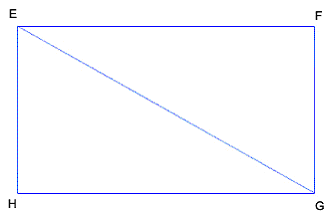
Drawing diagonals from a single vertex cuts any polygon into triangles. A quadrilateral EFGH split from vertex E to vertex G becomes triangle EFG and triangle EGH.
This is more than a drawing exercise. It is where the angle formula comes from.
A polygon with n sides splits into n − 2 triangles. Since each triangle’s angles add to 180°, the polygon’s angles must add to (n − 2) × 180°.
Sum of the interior angles
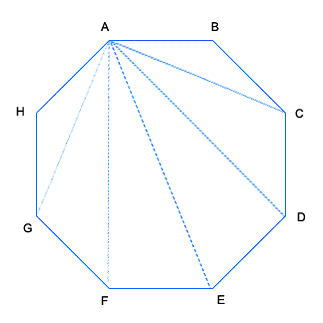
Sum of interior angles = (n − 2) × 180°
Worked example. A pentagon has n = 5, so the sum is (5 − 2) × 180 = 3 × 180 = 540°.
A hexagon gives (6 − 2) × 180 = 720°. A decagon gives 1,440°.
For a regular polygon, divide by n to get each angle. A regular pentagon has 540 ÷ 5 = 108° at every vertex.
That division only works for regular polygons. In an irregular polygon the angles still sum to (n − 2) × 180° but they are not equal to each other.
Triangles
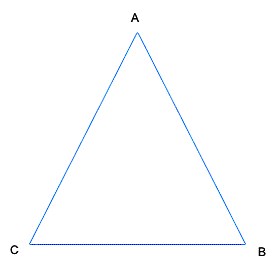
The triangle is the simplest polygon, with three sides, three vertices and three angles. The prefix tri means three.
Applying the formula, a triangle’s angles sum to (3 − 2) × 180 = 180°. Every triangle, regular or not, obeys this.
Triangles matter structurally because they cannot be deformed without changing a side length. That rigidity is why bridges and roof frames are built from them.
Regular polygons
A regular polygon has all sides equal and all angles equal. Both conditions are required.
- A rhombus has equal sides but unequal angles, so it is not regular.
- A rectangle has equal angles but unequal sides, so it is not regular.
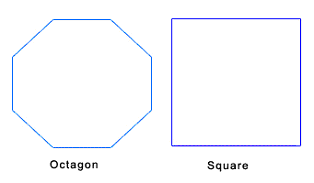
- A square has both, so it is the regular quadrilateral.
Familiar regular polygons include the equilateral triangle, the square, and the regular hexagon found in honeycomb.
What this page does not cover
This page covers polygons in general. The full naming system for polygons above ten sides, and the convex and concave classification, are covered separately. Area formulas for each shape are on their own page.
Where to go next
For the naming system up to a million sides, see polygon properties. For calculating the space inside, see area formulas, and for the boundary, perimeter formulas. The section index is in geometry.