A polygon is named for its number of sides. Three sides is a triangle, twelve is a dodecagon, and seventy-three is a heptacontakaitrigon. The names follow a rule you can apply to any number.
This page is the lookup table plus the rule that generates it, followed by the properties that apply to every polygon regardless of how many sides it has.
Polygon names, 3 to 20 sides
These names are memorized rather than constructed. Everything above 20 is built from parts.
| Sides | Name | Sides | Name |
|---|---|---|---|
| 3 | Triangle (trigon) | 12 | Dodecagon |
| 4 | Quadrilateral (tetragon) | 13 | Tridecagon |
| 5 | Pentagon | 14 | Tetradecagon |
| 6 | Hexagon | 15 | Pentadecagon |
| 7 | Heptagon | 16 | Hexadecagon |
| 8 | Octagon | 17 | Heptadecagon |
| 9 | Nonagon (enneagon) | 18 | Octadecagon |
| 10 | Decagon | 19 | Enneadecagon |
| 11 | Hendecagon | 20 | Icosagon |
How to name a polygon with 21 to 99 sides
Take the tens prefix, add “kai”, add the ones prefix, then add “gon.”
tens prefix + kai + ones prefix + gon
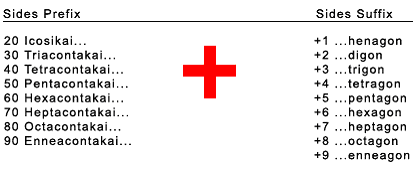
| Tens | Prefix | Ones | Suffix |
|---|---|---|---|
| 20 | icosikai | +1 | henagon |
| 30 | triacontakai | +2 | digon |
| 40 | tetracontakai | +3 | trigon |
| 50 | pentacontakai | +4 | tetragon |
| 60 | hexacontakai | +5 | pentagon |
| 70 | heptacontakai | +6 | hexagon |
| 80 | octacontakai | +7 | heptagon |
| 90 | enneacontakai | +8 | octagon |
| +9 | enneagon |
Exact multiples of ten drop the “kai” and the ones part. Thirty sides is a triacontagon, forty is a tetracontagon, and ninety is an enneacontagon.
Worked examples
- 36 sides: triacontakai + hexagon = triacontakaihexagon
- 50 sides: exact ten, so pentacontagon
- 73 sides: heptacontakai + trigon = heptacontakaitrigon
- 86 sides: octacontakai + hexagon = octacontakaihexagon
Large polygon names
| Sides | Name |
|---|---|
| 100 | Hectogon |
| 1,000 | Chiliagon |
| 10,000 | Myriagon |
| 1,000,000 | Megagon |
Beyond these, mathematicians normally write “n-gon” and state the number. A 47-sided figure is usually called a 47-gon in working mathematics, not a tetracontakaiheptagon. The systematic names exist, but almost nobody uses them past about 20 sides.
A correction worth making
The claim: Searches for “1 sided polygon” and “2 sided polygon” assume both exist.
Why it persists: The naming system generates a word for any number, so “monogon” and “digon” look like they should name real shapes.
The correction: A monogon is not generally recognized as a polygon, though graph theory sometimes uses the term. A digon is not generally recognized as a polygon in the Euclidean plane, although it can exist as a spherical polygon. A polygon in the plane needs at least three sides to enclose an area.
What to do with that: When a student asks what a one-sided shape is called, the honest answer is that there is not one in ordinary geometry, and the reason why is more interesting than a name would be.
The parts of a polygon
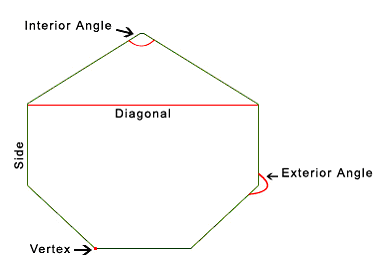
- Side. One of the straight line segments forming the boundary.
- Vertex. A point where two sides meet. A polygon has as many vertices as sides.
- Diagonal. A line segment joining two vertices that are not next to each other.
- Interior angle. The angle inside the polygon at a vertex.
- Exterior angle. The angle between one side and the extension of the side next to it.
A polygon is a closed, two-dimensional figure made of three or more straight line segments. The sides meet at vertices and do not cross one another. A circle is not a polygon, because its boundary is not made of straight segments.
Regular and irregular
A polygon is regular when all its sides are the same length and all its interior angles are equal. That means regular polygons are both equilateral and equiangular.
- Equilateral. All sides equal. A rhombus is equilateral but not regular, because its angles differ.
- Equiangular. All angles equal. A rectangle is equiangular but not regular, because its sides differ.
Both conditions must hold for the polygon to be regular. A square is the regular quadrilateral. Neither a rhombus nor a rectangle qualifies on its own.
Convex and concave
Draw a straight line through the polygon. If it never crosses more than two sides, the polygon is convex. If some line crosses more than two sides, the polygon is concave.
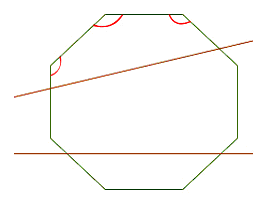
A convex polygon has every interior angle below 180 degrees.
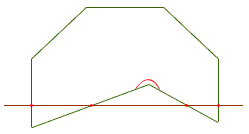
A concave polygon has at least one interior angle greater than 180 degrees. That angle is what creates the dent, and the dent is what lets a line cross extra sides.
Formulas
Sum of the interior angles of a simple polygon with n sides:
(n − 2) × 180°
A pentagon has 5 sides, so (5 − 2) × 180 = 540 degrees. A polygon with 73 sides gives (73 − 2) × 180 = 12,780 degrees.
Each interior angle of a regular polygon with n sides:
(n − 2) × 180° ÷ n
A regular pentagon gives 540 ÷ 5 = 108 degrees per angle.
Area of a regular polygon using the apothem, which is the distance from the center to the midpoint of a side:
Area = apothem × perimeter ÷ 2
This formula applies only to regular polygons. Irregular polygons have to be split into triangles and added up, or handled with coordinate methods.
Where to go next
For the definitions and classification in more depth, see polygon basics. For measuring the outside edge, see perimeter formulas, and for the inside, area formulas. The section index is in geometry.
Sources
- Wikipedia. Polygon, systematic naming table, construction rule for 21 to 99 sides, interior angle sum, regular polygon area, and the status of the monogon and digon.