A circle is the set of all points in a plane that sit at a constant distance from a fixed point. That fixed point is the center and that constant distance is the radius.
Every other property of a circle follows from those two things. This page defines each part, gives the formulas, and covers how circles relate to each other.
The parts of a circle
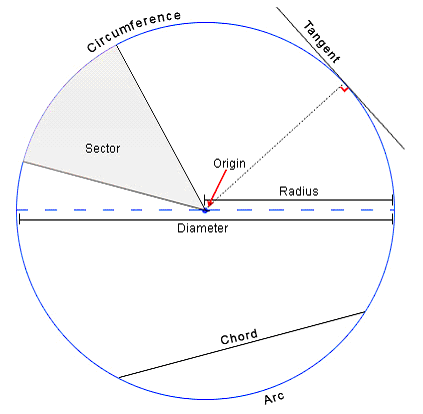
| Part | Definition |
|---|---|
| Center | The fixed point every point on the circle is equidistant from |
| Radius | The distance from the center to any point on the circle |
| Diameter | A straight line through the center with both ends on the circle. Always twice the radius |
| Circumference | The distance all the way around the circle |
| Chord | A straight line joining any two points on the circle |
| Arc | Any connected part of the circle itself |
| Sector | The region between two radii and the arc between them |
| Segment | The region between a chord and the arc it cuts off |
| Tangent | A line touching the circle at exactly one point |
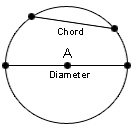
Two distinctions students routinely blur. A chord joins two points on the circle but need not pass through the center. A diameter is the special chord that does, and it is the longest chord any circle has.
An arc is part of the curved line. A sector is a region of the area, shaped like a slice of pie. They are not the same thing and they are measured in different units.
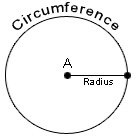
Diameter and radius
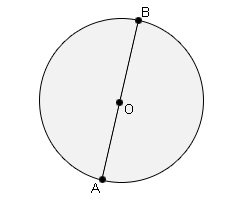
With center O and diameter AB, the segments OA and OB are both radii.
AB = 2 × OA, so the diameter is always twice the radius.
Going the other way, the radius is half the diameter. Most circle errors trace back to using one where the formula wanted the other, so read the question before choosing a formula.
Circle formulas
| Quantity | Formula |
|---|---|
| Circumference | C = 2πr, or πd |
| Area | A = πr² |
| Arc length, angle θ in degrees | L = (θ ÷ 360) × 2πr |
| Sector area, angle θ in degrees | A = (θ ÷ 360) × πr² |
The arc and sector formulas are the same idea twice. θ divided by 360 is the fraction of the full circle you are taking, so you multiply the whole circumference or the whole area by that fraction.
Worked example. A circle of radius 6 cm has an area of π × 6² = 3.14 × 36 = 113.04 cm². A 90° sector of it has an area of (90 ÷ 360) × 113.04 = 28.26 cm².
π is the ratio of any circle’s circumference to its diameter. It is the same number for every circle, which is what makes these formulas work at all.
Semicircles
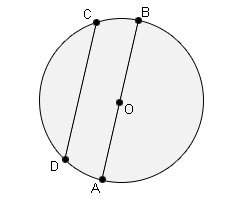
A diameter cuts a circle into two semicircles. A semicircle measures 180°.
Note the boundary: a semicircle as a region is bounded by the arc and the diameter together. Its perimeter is πr + 2r, not just half the circumference, because the straight edge counts.
How circles relate to each other
Concentric circles
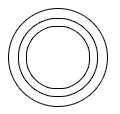
Circles that share a center but have different radii are concentric. A target and the rings of a tree trunk are everyday examples.
Intersecting circles
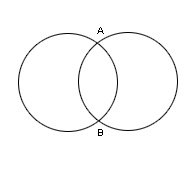
Two circles that cross each other at two different points are intersecting circles.
Two distinct circles can meet at two points, one point, or none. Meeting at exactly one point means they are tangent to each other. They cannot meet at three or more points.
Circumscribed and inscribed
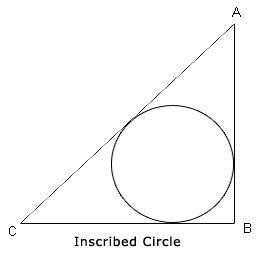
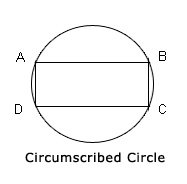
A circle is circumscribed about a figure when the figure sits inside it with all vertices touching the circle. The same circle is described as the circumcircle of that figure.
Reversed, a circle drawn inside a figure and touching each side is inscribed in it.
What this page does not cover
Circle theorems involving inscribed angles, cyclic quadrilaterals and tangent-chord relationships are separate topics. Spheres are three-dimensional and follow different formulas. Radians as an angle measure are not used here, and every θ on this page is in degrees.
Where to go next
For circumference alongside other shapes, see perimeter formulas, and for the area formula in context, area formulas. For the three-dimensional versions, see cylinders, cones and spheres. The section index is in geometry.