Two non-adjacent angles formed by two intersecting lines are called vertical angles. Vertical angles are always congruent, meaning they are equal in measure.
Two lines crossing create four angles. This page names every one of them, and names the angle pairs that appear when a third line crosses a pair of parallel lines.
Angles formed by two intersecting lines
When two straight lines cross, they create four angles at the point of intersection. Those four angles form two kinds of pair.
| Pair type | Position | Relationship |
|---|---|---|
| Vertical angles | Opposite each other, not touching | Always equal |
| Adjacent angles | Next to each other, sharing a vertex and a ray | Add to 180° on a straight line |
Vertical angles are the answer to several ways of asking the same question:
- Two non-adjacent angles formed by two intersecting lines are vertical angles.
- Opposite angles formed by two intersecting lines are vertical angles.
- A pair of opposite congruent angles formed by intersecting lines are vertical angles.
Separately: lines that intersect to form right angles are perpendicular lines. Two lines meeting at 90° are perpendicular, and all four angles they create measure 90°.
A correction worth making
The claim: Vertical angles are the ones that are supplementary, adding to 180°.
Why it persists: Both relationships appear at the same intersection, and older classroom material sometimes states the definition loosely.
The correction: Vertical angles are congruent, not supplementary. It is the adjacent pairs along a straight line that add to 180°. Vertical angles are equal to each other.
The exception that catches people: When the lines are perpendicular, every angle is 90°, so vertical angles are both equal and supplementary at once. That special case is where the confusion usually starts.
Reading the labels on a figure
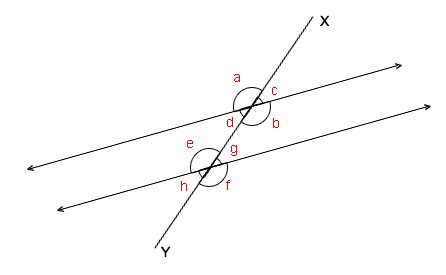
In this figure, line XY is the transversal and it crosses two parallel lines, creating eight angles.
Vertical angle pairs: ∠a and ∠b, ∠c and ∠d, ∠e and ∠f, ∠g and ∠h.
Adjacent angle pairs: ∠a and ∠c, ∠b and ∠d, ∠e and ∠g, ∠h and ∠f.
Adjacent and non-adjacent
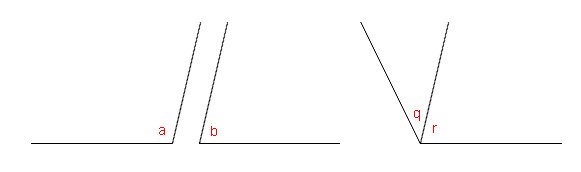
Adjacent angles share a common vertex and a common ray, and sit side by side. The word adjacent means next to.
Two angles drawn beside each other are not adjacent unless they share both the vertex and the ray. In the figure, ∠q is adjacent to ∠r because they share a vertex and a ray. ∠a is not adjacent to ∠b, because they share neither.
This distinction is what makes the vertical angle definition work. Vertical angles are specifically the pair that is not adjacent.
Vertical angles in detail
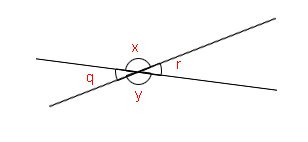
Vertical angles sit directly across the intersection from each other. They share only the vertex, never a ray.
They are always congruent. That is not a coincidence of the drawing, it follows from the fact that each of them is supplementary to the same adjacent angle.
Angles made by a transversal
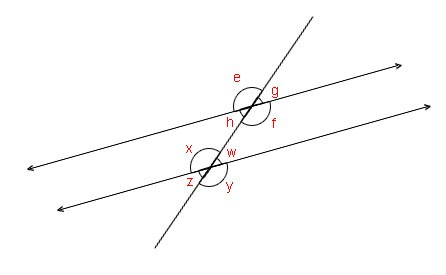
A transversal is a line that crosses two or more other lines. When the lines it crosses are parallel, two more angle relationships appear.
Corresponding angles
Corresponding angles occupy the same position at each intersection. In the figure, the corresponding pairs are ∠e and ∠x, ∠g and ∠w, ∠h and ∠z, and ∠f and ∠y.
Corresponding angles are always equal when the two crossed lines are parallel.
Alternate angles
Alternate angles sit on opposite sides of the transversal. In the figure, ∠f and ∠x are alternate angles, as are ∠h and ∠w.
Alternate angles are always equal when the two crossed lines are parallel.
The parallel condition matters. If the two crossed lines are not parallel, corresponding and alternate angles are simply unequal, and neither rule applies.
Using these relationships
Given one angle in a transversal figure, you can find all eight. Work outward using three moves:
- The vertical angle is equal to the one you know.
- Each adjacent angle is 180° minus the one you know.
- The corresponding angle at the other intersection is equal to the one you know.
Knowing one angle of 70° gives you 70° for its vertical and corresponding angles, and 110° for every adjacent one.
What this page does not cover
This page covers angle pairs made by intersecting and parallel lines. Classifying single angles as acute, right, obtuse or reflex is a separate topic, as is the relationship between the four line pair types.
Where to go next
For how two lines relate before any angles are measured, see pairs of lines. For angles inside shapes, see polygon properties. The section index is in geometry.