Two lines can be related in four ways: they intersect, they are parallel, they are perpendicular, or they are skew. Which one applies depends on whether they meet and whether they share a plane.
This page defines each relationship and gives you a method for working out which one a given pair has.
The four relationships
| Relationship | Same plane? | Do they meet? | Angle where they meet |
|---|---|---|---|
| Intersecting | Yes | Yes, at one point | Any angle |
| Parallel | Yes | No, ever | Not applicable |
| Perpendicular | Yes | Yes, at one point | Exactly 90° |
| Skew | No | No, ever | Not applicable |
Perpendicular lines are a special case of intersecting lines, not a separate category. Every perpendicular pair intersects. Most intersecting pairs are not perpendicular.
How to tell which relationship a pair has
Work through three questions in order. The first one that gives a definite answer settles it.
- Are both lines in the same plane? If no, they are skew, and you are finished. Skew lines only occur in three dimensions.
- Do they meet at any point, including where they would meet if extended? If no, they are parallel.
- Is the angle at the meeting point 90 degrees? If yes, perpendicular. If no, simply intersecting.
On a flat diagram or a coordinate grid, skip question one. Everything drawn on a single sheet of paper is in the same plane, so skew is not available as an answer.
On a coordinate grid you can answer question two with slopes. Two lines with the same slope and different intercepts are parallel. Two lines whose slopes multiply to −1 are perpendicular.
Intersecting lines
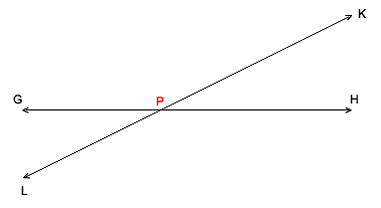
Two straight lines in the same plane running in different directions meet at exactly one point. That point is called the point of intersection.
One boundary: two distinct straight lines in a plane can never meet at more than one point. If they share two points, they are the same line.
Parallel lines
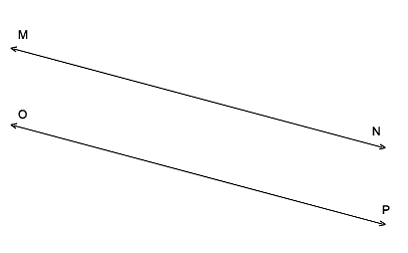
Two straight lines in the same plane that never meet, no matter how far they are extended, are parallel. The distance between them stays constant.
That constant distance is the useful test. Lines that appear to drift together or apart are not parallel, even if they do not meet inside the diagram.
Perpendicular lines
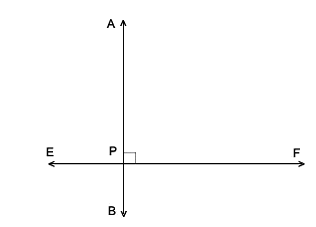
Two lines in the same plane that meet at a right angle are perpendicular. The angle formed is exactly 90°, usually marked with a small square rather than a curve.
When two lines are perpendicular, all four angles at the intersection are 90°, not just the one that is marked.
Skew lines
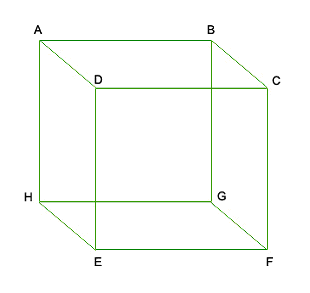
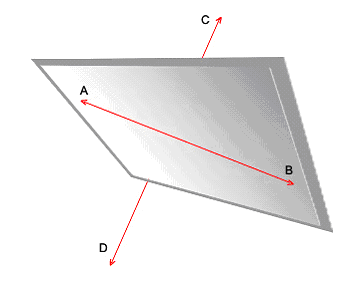
Two lines that are neither parallel nor intersecting, because they lie in different planes, are skew.
Skew lines require three dimensions. A cube is the standard example: an edge on the top face and a non-matching edge on the bottom face never meet and never run parallel.
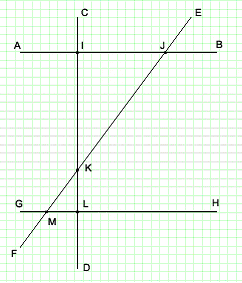
The common error is calling skew lines parallel because they do not meet. Not meeting is necessary for parallel but not sufficient. Parallel lines must also share a plane.
A correction worth making
The claim: If two lines do not cross, they are parallel.
Why it persists: In two dimensions it is true, and most classroom work happens on flat paper where skew lines cannot exist.
The correction: In three dimensions, two lines can fail to cross without being parallel. They are skew. Parallel requires both conditions: never meeting, and lying in the same plane.
What to do with that: When a question involves a solid figure rather than a flat one, check the plane before answering parallel.
What this page does not cover
This page is about pairs of lines. Angle relationships created when a third line crosses a pair, such as corresponding and alternate angles, are covered separately. Line segments and rays behave differently from full lines, because they have endpoints and cannot be extended indefinitely.
Where to go next
For the angles formed where lines cross, see angles and intersecting lines. For plotting and slope methods, see coordinate geometry. The section index is in geometry.