Native American music is the music of many distinct Native nations, and each nation has its own songs, instruments, and rules about when songs are shared. This page covers what music does in Native communities, singing styles, drums, rattles and flutes, powwow music, musicians working today, and how to listen with respect.
What does music do in Native communities?
Songs have jobs. They give thanks, honor people, mark gatherings, and carry teachings. The Onondaga Nation says it considers “singing and dancing as another way to give thanks.” (Onondaga Nation) The Canadian Encyclopedia adds that “Songs serve a specific purpose and have a particular meaning.” (The Canadian Encyclopedia)
Many nations sort songs into two groups. Social songs go with dances and gatherings. Ceremonial songs belong to a ceremony and its setting. The Onondaga Nation explains that its ceremonial songs “are only performed in the longhouse and are not for public viewing,” while social songs can be performed anywhere. (Onondaga Nation)
Some songs are composed by one person. Others are received in a dream or a vision. Most are taught by singing with someone, not by writing them down. (The Canadian Encyclopedia)
This section covers the purpose and the main types of songs. It doesn’t describe any ceremony, because ceremonial songs are not meant for public use.
Is there one kind of Native American music?
No. Each nation has its own musical traditions, songs, and meanings. The Canadian Encyclopedia says Indigenous peoples “have their own distinct musical traditions, repertoire, and meanings.” (The Canadian Encyclopedia)
Some patterns do show up in many places. Traditional music is mostly vocal, and drums, rattles, and flutes are common instruments. Musicians also pick up other styles and tools, such as guitars and fiddles. (The Canadian Encyclopedia) The table shows how different the examples are.
| Nation | Musical example | Source |
|---|---|---|
| Onondaga (Haudenosaunee) | Social songs sung with a water drum and a horn rattle | Onondaga Nation |
| Omaha | Songs on wax cylinders recorded between 1890 and 1910, and a 1983 powwow documented | Library of Congress |
| Kwakwaka’wakw | Songs tied to chiefs’ rights and a single wooden plank drum struck by several players | U’mista Cultural Centre, Met Museum |
| Inuit (Arctic Québec and Baffin Island) | Katajjaq, a vocal game for two women | The Canadian Encyclopedia |
| Western Apache | A one-string fiddle called tsii’ edo’a’tl | NEA |
This section covers five documented examples. It doesn’t cover every nation or sort all Native music into regions.
What are vocables, and how do Native singers sing?
Vocables are syllables that do not translate to a specific word. Some songs use only vocables. Others mix vocables with words in an Indigenous language, English, or French. (The Canadian Encyclopedia)
Most songs have a single melody that singers often sing together. Songs are often short and repeated. Singing style differs from nation to nation, and roles for women and men are often set by community custom. (The Canadian Encyclopedia)
Two traditions show the range:
- Powwow singing. Songs often begin at the top of the singers’ range and drift lower. (The Canadian Encyclopedia)
- Katajjaq. This Inuit vocal game is usually played by two women face to face. They repeat short sound patterns and trade breathing in and out. The game ends when one player runs out of breath or laughs. Missionaries banned these games, and a revival began in the 1980s. (The Canadian Encyclopedia)
Katajjaq is the name used in Arctic Québec and the south of Baffin Island. Other Inuit regions use other names and styles. (The Canadian Encyclopedia)
This section covers vocables and two singing traditions. It doesn’t teach how to perform these songs, which is for the communities that carry them to decide.
Which instruments do Native musicians play?
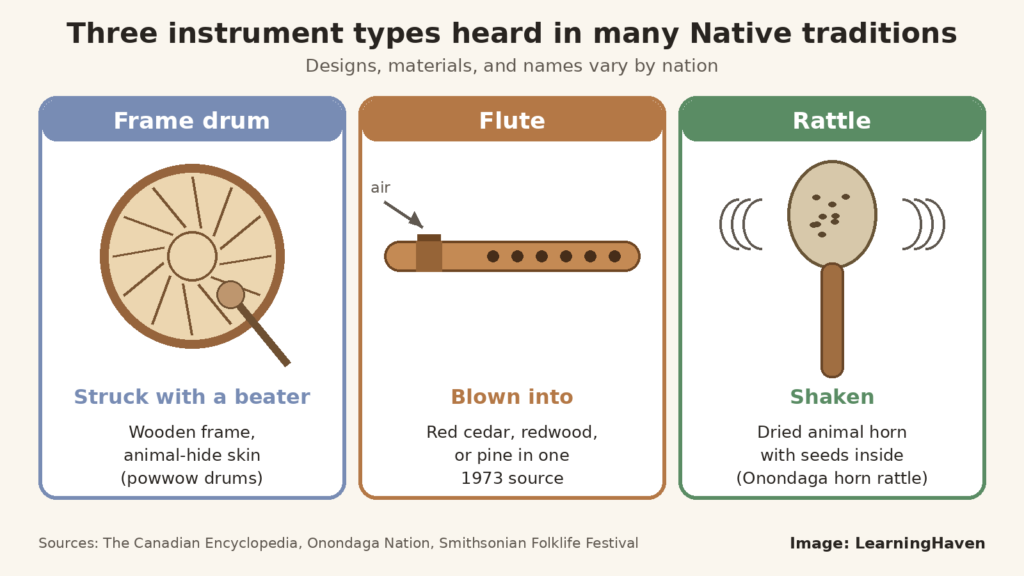
Drums, rattles, and flutes are the common ones. Makers build them from local materials such as seeds, wood, and animal parts, and many communities treat instruments as living beings. (The Canadian Encyclopedia)
Drums. A water drum is a drum with water poured inside. The Onondaga Nation describes its drum as a hollowed cedar log with water in the bottom and deer hide stretched over the top. The singer tests it and “listens for a nice high tone.” (Onondaga Nation) Powwow drums usually have a wooden frame and an animal-hide skin, and several singers strike one large drum together. (The Canadian Encyclopedia) On the Northwest Coast, drummers more often play individual hand drums together. (Met Museum)
Rattles. The Onondaga horn rattle is a dried, hollowed animal horn with seeds inside. Singers who back up the lead water-drum singer play it. The Onondaga Nation calls its turtle rattle “very sacred” and uses it in only a few ceremonies, so it is not a craft project. (Onondaga Nation) The Met Museum shows carved rattles by Haida, Tsimshian, and Tlingit artists. (Met Museum)
Flutes. A 1973 Smithsonian Folklife Festival article by Ed Wapp, Jr. says the courting flute was used mainly by Woodlands, Southwestern, and Plains peoples. It says flutes were made from red cedar, redwood, or pine, and that a young man most often used one to communicate his love. (Smithsonian Folklife Festival) That is one dated source, so check each nation’s own makers for current practice.
Not only drums and flutes. The Western Apache fiddle, tsii’ edo’a’tl, means “wood that sings.” The National Endowment for the Arts says it is usually made from a dried agave stalk and played with one horsehair string. (NEA) The Smithsonian notes that early records are unclear. The design may be Native in origin or modeled on European violins that arrived through Spanish influence. (Smithsonian)
This section covers four kinds of instruments with named nations. It doesn’t cover how to build one or instruments from every nation.
What is powwow music?
A powwow is a gathering with Native music, dance, and regalia. The Canadian Encyclopedia says “all powwow activities revolve around the beat of the drum and the sounds of the singers’ voices.” (The Canadian Encyclopedia) Many powwows are open to the public. (The Canadian Encyclopedia)
The musicians are in drum groups, often called Drums. Each group has its own name, and its members are often family and friends. A host drum makes sure the right songs are sung for key moments such as the Grand Entry and the Flag Song. (The Canadian Encyclopedia)
Powwow songs follow a common shape:
- The drummers hit the beat together.
- The lead singer sings the opening line alone.
- The rest of the group repeats it, then everyone sings on.
- The song is usually sung four times in all.
Songs are usually named for their purpose, such as honor songs and healing songs. Northern style uses a higher singing range than Southern style. (The Canadian Encyclopedia)
This section covers the shared outline of powwow music. It doesn’t cover one nation’s own songs or the dance categories.
Who makes Native American music today?
Native musicians work in many styles. The Canadian Encyclopedia lists success in country, folk, rock, blues, jazz, hip hop, and electronic music. (The Canadian Encyclopedia) Here are four examples with sources.
- Black Lodge Singers. This powwow drum group is led by Kenneth ScabbyRobe of the Blackfeet Nation and based at the Yakama Nation in Washington. They were first nominated for a Grammy in 2000. In November 2020 they earned an eighth nomination, for the album My Relatives. (Indianz.com, KTVH)
- Jeremy Dutcher. Dutcher is Wolastoqiyik from Tobique First Nation. His 2018 album blended wax cylinder recordings from 1907 to 1913 with new music, all in the Wolastoqey language. It won the Polaris Music Prize in 2018, and his 2023 album Motewolonuwok won it again in 2024. (The Canadian Encyclopedia)
- Tanya Tagaq. Tagaq is an Inuk throat singer from Cambridge Bay, Nunavut. She won the 2014 Polaris Music Prize for Animism (The Canadian Encyclopedia) and released the album Saputjiji on March 6, 2026. (Inuit Art Quarterly)
- PIQSIQ. The throat-singing duo of sisters Tiffany Ayalik and Inuksuk Mackay was nominated for a 2026 Juno Award for the album Legends, released in 2025. (Inuit Art Quarterly)
Old recordings help too. The Library of Congress holds about ten thousand wax cylinders of Native songs and stories. In 1979 it began the Federal Cylinder Project to get copies to tribal archives. (Library of Congress)
This section covers four sourced examples. It doesn’t rank artists or name any one musician the leading voice of Native music.
How can you listen and learn with respect?
Start with sources from the nations themselves, and ask before you record, copy, or imitate.
- Read the nation’s own words. The Onondaga Nation’s song page names what is public and what is not.
- Honor what is not public. The Library of Congress keeps most of its cylinders offline because many songs are sacred.
- Follow the host at a powwow. The Citizen Potawatomi Nation asks visitors to get permission before photographing or filming dancers and calls the dance arena a sacred space. (Citizen Potawatomi Nation) Rules differ by host, so read the host’s guidance first.
- Don’t turn sacred objects into crafts. Our symbols page explains why meanings belong to specific nations.
- Name the nation. Say Onondaga, Kwakwaka’wakw, or Inuit, not “Indian music.”
This section covers basic respect for listeners and visitors. It doesn’t cover any one nation’s full rules, which each nation sets.
Check what you learned
- What are vocables?
- What is the difference between social songs and ceremonial songs?
- How does the Onondaga Nation say a water drum is made?
- About how many times is a powwow song usually sung?
- Why can’t the Library of Congress put most of its cylinder recordings online?
Show answers and reasoning
- Vocables are syllables that do not translate to a specific word. Songs can use only vocables or mix them with words.
- Social songs go with dances and gatherings. Ceremonial songs belong to a ceremony, and the Onondaga Nation says its own are only performed in the longhouse.
- A hollowed cedar log has water poured into the bottom and deer hide stretched over the top. The singer listens for a high tone.
- Four times in all, according to The Canadian Encyclopedia.
- Many songs are sacred, so the proper use of the recordings and the proper audiences must be considered first.
For more on Native nations, start at the Native Americans hub or the page on the major groups of Native North America.
The Onondaga Nation is one of the original nations of the Haudenosaunee Confederacy (Haudenosaunee Confederacy), so the Haudenosaunee Confederacy page and the page on Haudenosaunee art are a natural next stop.
You can also read about the Oceti Sakowin (Sioux) and the Cherokee Nation.
Each November, see National Native American Heritage Month. More topics live in our social studies section.
Sources
- Haudenosaunee Confederacy. The League of Nations.
- Onondaga Nation. Song.
- Hoefnagels, Anna. The Canadian Encyclopedia. Music of Indigenous Peoples in Canada.
- Hoefnagels, Anna. The Canadian Encyclopedia. Powwow Music.
- Nattiez, Jean-Jacques. The Canadian Encyclopedia. Inuit Vocal Games.
- Boyko, John. The Canadian Encyclopedia. Jeremy Dutcher.
- Library of Congress, Folklife Today. Indigenous American Cylinder Recordings and the American Folklife Center.
- Metropolitan Museum of Art. Northwest Coast Indians Musical Instruments.
- U’mista Cultural Centre. Keeping the Song Alive Exhibit Comes to U’mista.
- National Endowment for the Arts. Chesley Goseyun Wilson, Apache Fiddle Maker.
- Smithsonian. Chesley Goseyun Wilson’s Apache Fiddle.
- Smithsonian Folklife Festival. The Courting Flute in Native American Tradition.
- Citizen Potawatomi Nation. Powwow etiquette refresher.
- Indianz.com. Black Lodge Singers earn another GRAMMY nomination.
- KTVH. Drum group led by Blackfeet member nominated for another Grammy award.
- Inuit Art Quarterly. Tanya Tagaq Releases New Album.