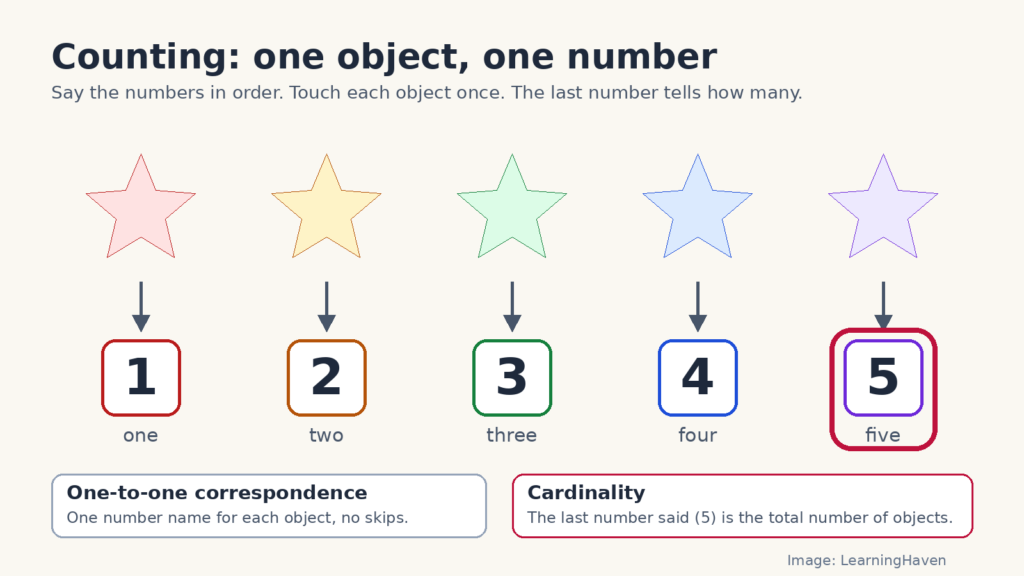
Counting means saying number names in order, matching each name to one object, and knowing that the last number said tells how many. This page covers counting to 10, 20, and 100, counting on, skip counting, writing numerals, ways to practice at home, and two free printables with an answer key.
What do kids need to know to count?
Counting uses three ideas together: a fixed number order, one number for each object, and the last number as the total.
The first idea is stable order. The New Zealand Ministry of Education says: “The spoken and written names that are said and read have a fixed order.” (Counting on counting)
The second idea is one-to-one correspondence, which means each object gets one number name. Standard K.CC.B.4.a says to pair “each object with one and only one number name and each number name with one and only one object.” (Common Core, Kindergarten Counting & Cardinality)
The third idea is cardinality, which means the last number said is the total. Standard K.CC.B.4.b says: “Understand that the last number name said tells the number of objects counted.” (Common Core, Kindergarten Counting & Cardinality)
Reciting the count words is not the same as knowing cardinality. The What Works Clearinghouse practice guide notes: “when asked how many they just counted, some children count again or just guess.” (Teaching Math to Young Children, WWC)
Worked example. Count the stars in a row of five.
- Touch the first star and say “one.”
- Touch the next star and say “two.” Keep going, one touch per star.
- Touch the last star and say “five.” The last number said is the total.
This section covers the three core ideas behind counting. It doesn’t cover place value, which is on our addition page.
Which counting skills come when?
Common Core Kindergarten standards ask children to count to 100 by ones and by tens. Standard K.CC.A.1 says: “Count to 100 by ones and by tens.” (Common Core, Kindergarten Counting & Cardinality)
Before Kindergarten, the What Works Clearinghouse guide starts with small groups of one to three items that children can name without counting. Its next step is: “Next, promote accurate one-to-one counting as a means of identifying the total number of items in a collection.” (Teaching Math to Young Children, WWC) The guide rates the evidence for this recommendation as moderate.
| Skill | Standard | Grade |
|---|---|---|
| Count to 100 by ones and by tens | K.CC.A.1 | Kindergarten |
| Write numbers from 0 to 20 | K.CC.A.3 | Kindergarten |
| Count to 120, starting at any number less than 120 | 1.NBT.A.1 | Grade 1 |
| Skip-count by 5s, 10s, and 100s | 2.NBT.A.2 | Grade 2 |
Grade 1 extends Kindergarten by 20 numbers, from 100 to 120.
This section covers Common Core targets. It doesn’t cover state standards, which can set different grade targets, so check your state’s list if you follow one.
How do you teach counting to 10 and 20?
Start with small groups of real objects, then add more. Standard K.CC.B.5 sets the limits. Children count “as many as 20 things arranged in a line, a rectangular array, or a circle, or as many as 10 things in a scattered configuration.” (Common Core, Kindergarten Counting & Cardinality)
In a scattered group, a child must keep track of which objects are already counted. A simple fix is to slide each counted object to one side.
Worked example. Count seven buttons scattered on a table.
- Put an empty plate beside the buttons.
- Slide one button onto the plate and say “one.” Slide the next and say “two.” Keep going until the table is empty.
- The last number said is 7. Say “seven buttons.” Then ask, “How many?” A child who understands cardinality answers “seven” without counting again.
- Spread the buttons in a new pattern and count again. The total stays 7.
For counting to 20, use the same steps with a line of objects.
This section covers counting objects up to 20. It doesn’t cover comparing two groups to see which has more.
How do you count to 100?
Counting to 100 means learning the number names once and then seeing the pattern. A 1 to 100 chart has 10 rows of 10 numbers, and each row ends in a ten.
Count by tens first, as K.CC.A.1 asks: 10, 20, 30, 40, 50, 60, 70, 80, 90, 100. That is 10 numbers. Then fill in the numbers between two tens. Counting does not always start at 1. Standard K.CC.A.2 says: “Count forward beginning from a given number within the known sequence (instead of having to begin at 1).” (Common Core, Kindergarten Counting & Cardinality)
Worked example. Count forward from 47 to 62.
- Start at 47 and say each next number: 47, 48, 49.
- After the ones digit reaches 9, the tens digit changes. Say 50.
- Keep going to 59, then say 60, 61, 62.
You said 16 numbers, from 47 through 62. Check: 62 – 47 + 1 = 16.
Grade 1 extends the sequence. Standard 1.NBT.A.1 says: “Count to 120, starting at any number less than 120.” (Common Core, Grade 1 Number & Operations in Base Ten)
This section covers counting by ones and tens to 120. It doesn’t cover three-digit numbers, which come with place value in Grade 2.
What is counting on?
Counting on means starting at a number you know and counting up from there, instead of starting at 1. Standard 1.OA.C.5 says: “Relate counting to addition and subtraction (e.g., by counting on 2 to add 2).” (Common Core, Grade 1 Operations & Algebraic Thinking)
Worked example. Find 5 + 3 by counting on.
- Start at the larger number. Say “5” without counting from 1.
- Count up 3 more: “6, 7, 8.” Use three fingers to keep track.
- The last number said is 8.
So 5 + 3 = 8. Check: 8 – 5 = 3.
Counting on is one of six fact strategies on our addition page.
Here is the plan so far. Counting needs a fixed order, one number for each object, and the last number as the total. Counting to 100 and counting on build on those ideas. Skipping by 2s, 5s, and 10s comes next.
This section covers counting on to add. It doesn’t cover counting back, which is on our subtraction page.
What is skip counting?
Skip counting means counting by a number larger than 1, such as 2, 5, or 10. Standard 2.NBT.A.2 includes the phrase “skip-count by 5s, 10s, and 100s.” (Common Core, Grade 2 Number & Operations in Base Ten)
| Count by | First numbers | Numbers said to reach 100 |
|---|---|---|
| 2s | 2, 4, 6, 8, 10, 12, 14, 16, 18, 20 | 50 |
| 5s | 5, 10, 15, 20, 25, 30, 35, 40, 45, 50 | 20 |
| 10s | 10, 20, 30, 40, 50, 60, 70, 80, 90, 100 | 10 |
The last column divides 100 by the step: 100 / 2 = 50, 100 / 5 = 20, and 100 / 10 = 10.
Worked example. Skip count by 5s from 15 to 40. Start at 15 and add 5 each time: 15, 20, 25, 30, 35, 40. That is 6 numbers. Check: 40 – 15 = 25, and 25 / 5 = 5 jumps, which makes 6 numbers.
The numbers you say when you skip count by 5 are the same numbers in the 5 row of the chart on our multiplication page.
This section covers skip counting by 2s, 5s, and 10s. It doesn’t cover counting backward by steps.
How do kids learn to write numerals?
A numeral is the written symbol for a number, such as 7. Standard K.CC.A.3 says: “Write numbers from 0 to 20. Represent a number of objects with a written numeral 0-20 (with 0 representing a count of no objects).” (Common Core, Kindergarten Counting & Cardinality)
Try this order at home. Trace the numeral with a finger, then a pencil, and say the number name while tracing. Then write it beside a group of that many objects, so the child sees that 4 goes with four objects. Start with 1 to 10 and add 0 and 11 to 20 later. A zero means there is nothing to count.
This section covers writing numerals as a counting skill. It doesn’t cover handwriting for letters or cursive.
Where can you get free counting worksheets?
LearningHaven made two free counting worksheets. Both print on US Letter paper at 100% scale. You don’t need an account.
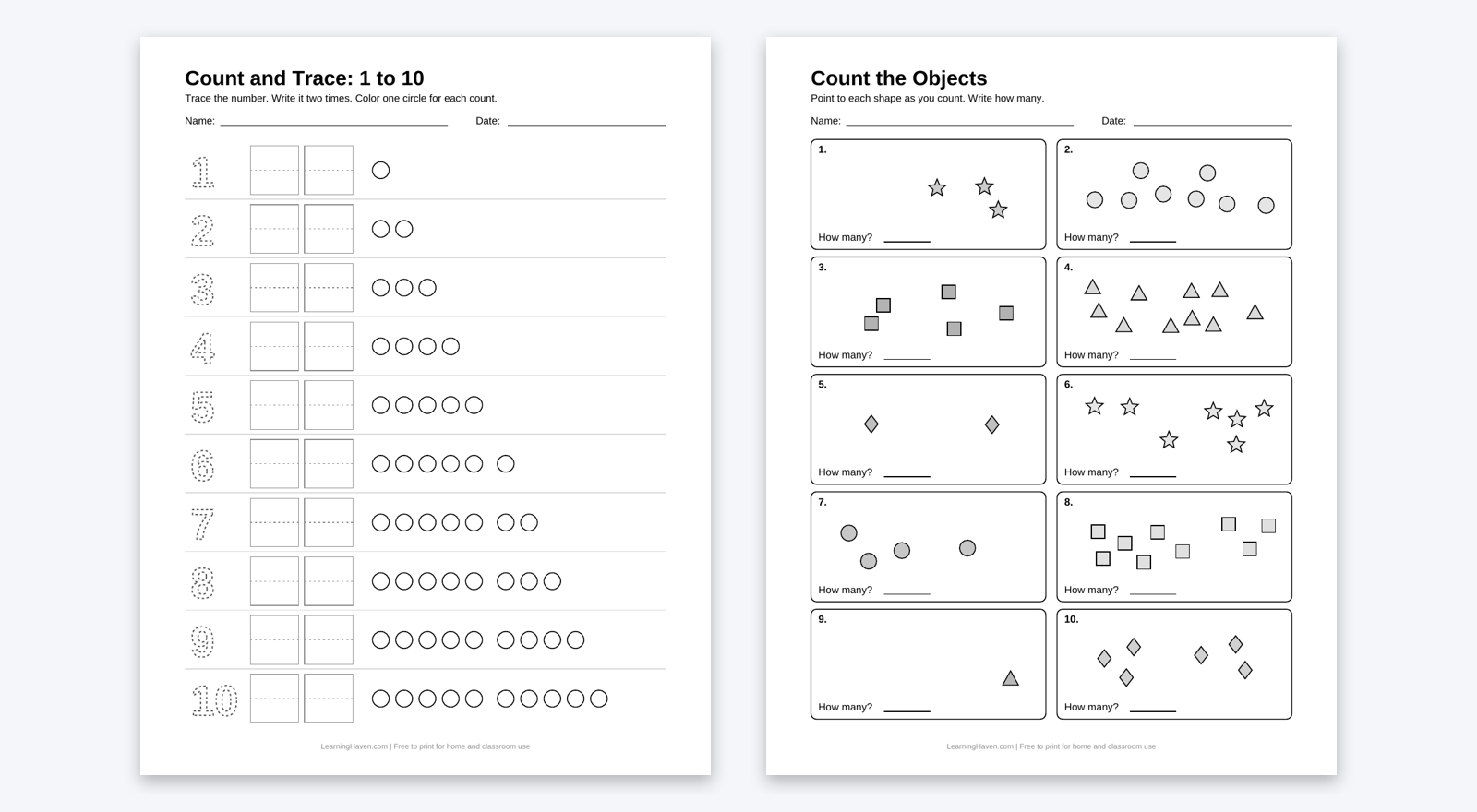
Count and trace 1 to 10. It has 10 rows, one per number. Each row has a dotted numeral to trace, two boxes to write it, and that many circles to color. The sheet has 55 circles in all.
Count the objects. It has 10 boxes of scattered shapes, with a different count from 1 to 10 in each box. A child counts and writes the total on the line. The counts follow the scattered limit of 10 in standard K.CC.B.5, and the sheet has 55 shapes in all.
Let the child point to each item while counting. Check with the key, then recount any wrong box. For more printables, see our math worksheets page and our homeschool worksheets page.
This section covers the two worksheets made for this page. It doesn’t cover worksheets for counting to 100 or skip counting.
How can parents help at home?
Keep sessions short and use things that are already part of the day.
- Count real things. Count stairs, spoons, or socks. The What Works Clearinghouse guide gives a snack example: “As children receive or eat their snacks, they can count how many items they have.” (Teaching Math to Young Children, WWC)
- Repeat the total. The guide advises teachers to “emphasize or repeat the last number word used in the counting process.”
- Play games with a die or a spinner. Each roll is one counting task. See our math games page for no-prep ideas.
This section covers home practice ideas. It doesn’t cover how to tell whether a child needs extra help, which a teacher can help you judge.
Practice set
Work through these on paper, then check your answers.
- Count the dots: ● ● ● ● ● ● ● ●
- What number comes right after 19? What number comes right before 40?
- Count forward from 57 to 63 and write each number. How many numbers did you write?
- Use counting on to find 5 + 3.
- Skip count by 10s from 30 to 90. Write each number.
- Skip count by 5s. Start at 25 and write the next five numbers.
Show answers and reasoning
- There are 8 dots. The last number said is 8. Check: count again from the other end and the total is still 8.
- The number right after 19 is 20. The number right before 40 is 39. Check: 19 + 1 = 20 and 40 – 1 = 39.
- 57, 58, 59, 60, 61, 62, 63, which is 7 numbers. Check: 63 – 57 + 1 = 7.
- Start at 5 and count up 3: 6, 7, 8. So 5 + 3 = 8. Check: 8 – 5 = 3.
- 30, 40, 50, 60, 70, 80, 90, which is 7 numbers. Check: 90 – 30 = 60, and 60 / 10 = 6 jumps.
- 30, 35, 40, 45, 50. Check: 50 – 25 = 25, and 25 / 5 = 5 jumps.
Counting on connects to adding, so the addition page is a natural next stop. For more topics, visit our math hub.
For younger children, see our preschool activities page and the K to 3 plan.
Sources
- Common Core State Standards Initiative. Kindergarten Counting & Cardinality.
- Common Core State Standards Initiative. Grade 1 Number & Operations in Base Ten.
- Common Core State Standards Initiative. Grade 1 Operations & Algebraic Thinking.
- Common Core State Standards Initiative. Grade 2 Number & Operations in Base Ten.
- U.S. Department of Education, Institute of Education Sciences, What Works Clearinghouse. Teaching Math to Young Children (practice guide).
- New Zealand Ministry of Education. Counting on counting.