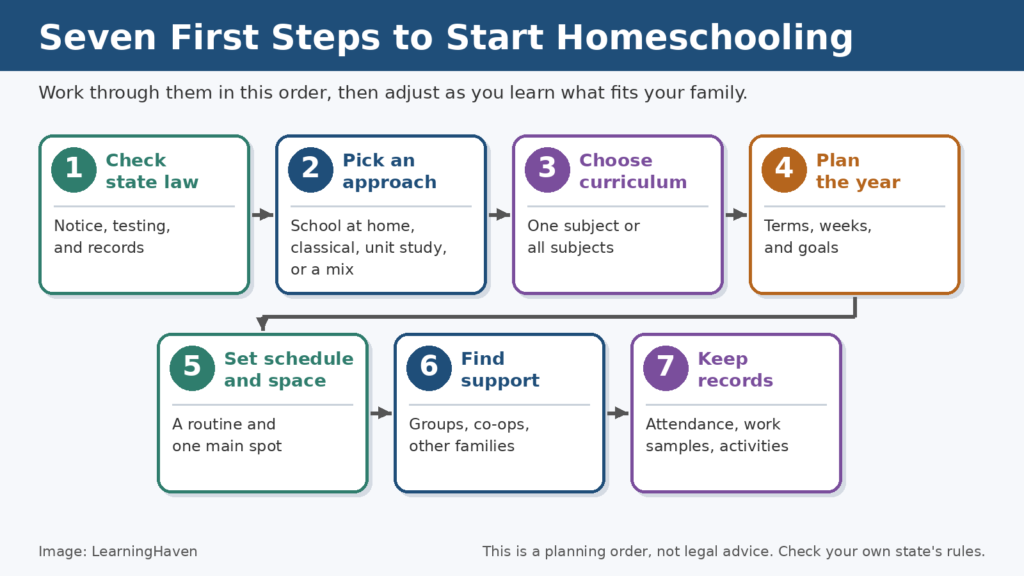
Starting to homeschool means choosing how your child will learn and following the rules where you live. This page covers checking your state’s law, choosing an approach, planning the year, setting up a schedule and space, finding support, keeping records, and what to expect in the first weeks.
How many families homeschool?
In the 2022 to 2023 school year, parents reported that about 3.4 percent of U.S. students ages 5 to 17 were homeschooled. The National Center for Education Statistics (NCES) found that 5.2 percent received instruction at home, a group that also includes students in full-time virtual school. (NCES, First Look: Parent and Family Involvement in Education 2023)
NCES relies on what parents report. In its 2019 survey, a child counted as homeschooled if they were schooled at home instead of at a public or private school, were enrolled in school no more than 24 hours a week, and were not homeschooled only because of a temporary illness. (NCES Fast Facts) NCES advises caution when comparing across survey years, so this page does not compare 2019 with 2023.
This section covers national survey counts. It doesn’t cover counts for any one state, and it doesn’t tell you whether homeschooling is right for your child.
What should you check first: your state’s homeschool law?
Start with the law, because it can change what you file and what you keep. HSLDA, a homeschool legal advocacy organization, treats homeschool law as state law. It says to follow the law of the state where you are physically present. (HSLDA legal page, checked 2026-10-31)
A notice of intent is a short form that tells a school district or state agency you plan to homeschool. Some states ask for one and some do not. HSLDA’s map sorts every state into one of four levels.
| HSLDA level | What the state asks parents to send |
|---|---|
| No notice, low regulation | Nothing. No notice to a school district or any other agency |
| Low regulation | A notice to the local school district |
| Moderate regulation | A notice, plus test scores or a professional evaluation of progress |
| High regulation | A notice, test scores or evaluations, plus more, such as state approval of curriculum, teacher qualifications, or home visits |
Do all states use the same kind of homeschool law?
No. States set up homeschooling in different legal ways, so the route you pick decides your rules.
- Texas treats a homeschool as a private school. HSLDA lists four required subjects there: math, reading, spelling and grammar, and good citizenship. It says you must use some form of written curriculum. (HSLDA, How to comply with Texas homeschool law, checked 2026-10-31)
- California gives three routes. You can run a home-based private school and file a private school affidavit each year from October 1 to 15. You can join a private school satellite program. Or a tutor with a California teaching credential can teach your child. (HSLDA, How to comply with California’s homeschool law, checked 2026-10-31)
Your state’s page tells you which routes you have and what each one asks of you.
Worked example. Find your state’s rule in five steps.
- Search for your state education department’s homeschool page. Try the words “homeschool,” “home instruction,” and “home education.”
- Open HSLDA’s state law map and choose your state. HSLDA says each state page covers how to withdraw from public school, testing, and mandatory subjects.
- Compare the two pages. If they disagree, follow your state agency and ask the agency your question.
- Write down the answers to four questions from HSLDA’s start guide: Do I notify my school district? Is testing required? Do I keep records? Can my child join sports or activities at the local public school? (HSLDA, 7 Simple Steps)
- Put every due date on your calendar. If your child is leaving a school now, read your state’s withdrawal steps before the last day.
This section covers how to find your rule, with two state examples. It doesn’t cover every state’s rule, and it isn’t legal advice. Rules change, so check the date on every page you use.
How do you choose an approach?
An approach, also called a homeschool style, is your overall way of teaching. HSLDA describes nine common ones and says many families combine two or more. (HSLDA, Educational Approaches)
| Approach | In brief |
|---|---|
| Traditional or textbook | School at home, with textbooks and a routine like a school day |
| Boxed curriculum | A complete set of lessons, often for one grade and one year |
| Classical | Stages that move from facts to reasoning to expression, with reading and discussion |
| Charlotte Mason | Short lessons built on “living books,” nature study, and read-alouds |
| Montessori | Child-directed, hands-on learning in a prepared space, often for younger ages |
| Waldorf | Story, art, and hands-on work, with a rhythm built on days and seasons |
| Unit study | One theme ties several subjects together, which can suit several ages at once |
| Unschooling | Child-led learning with no set curriculum or tests |
| Eclectic | A mix of the styles above |
Ask three questions to narrow the choice. How does your child like to learn? What is your own teaching style? What is your budget? HSLDA frames the decision the same way. (HSLDA, Homeschool GPS)
A curriculum is the set of books and lessons you teach from. It can cover every subject or only one. HSLDA suggests you look at samples and ask parents who use it. (HSLDA, Selecting My Curriculum) Pick one approach to try first. You can change it.
This section covers the common approaches in brief. It doesn’t cover rankings or curriculum brands.
How do you plan the year?
Scope and sequence means what you will cover and in what order. Write a short list for each child and subject, then split it into steps with start and finish dates.
HSLDA suggests planning in short stretches, such as a week or a month, and using pencil for anything further ahead. (HSLDA, Choosing Planning Tools)
Worked example. A math program has 128 lessons. You plan 4 math lessons a week in a 36-week year.
- Find the weeks the program needs: 128 ÷ 4 = 32 weeks.
- Find the spare weeks: 36 − 32 = 4 weeks for sick days, trips, and review.
- Split the year into four terms of equal length: 36 ÷ 4 = 9 weeks each.
- Each term has 9 × 4 = 36 lesson slots and needs 128 ÷ 4 = 32 lessons. That leaves 36 − 32 = 4 spare slots per term.
Check: 4 terms × 4 spare slots = 16 slots, and 4 spare weeks × 4 lessons = 16.
If your state sets a minimum number of days or hours, count your calendar against it before the year starts.
This section covers planning with a calendar and goals. It doesn’t cover your state’s required subjects, which you can find on your state’s page.
How do you set up a schedule and a space?
Start with a routine, not a minute-by-minute timetable. HSLDA says a clear routine at the start helps you and your children share expectations. (HSLDA, 7 Simple Steps)
For space, pick one main spot for school supplies. HSLDA notes that a dining table can double as a desk and that many families have no dedicated room. (HSLDA, Where Will We Homeschool?) Expect interruptions and build a routine that bends.
This section covers the first routine and one study spot. It doesn’t cover block schedules, loop schedules, or a full sample day, which are on our time management page.
Where can you find support?
Look for a local or online homeschool group, a co-op, or classes outside the home. A co-op is a group of families who share the teaching load by sharing classes. (Homeschool.com) HSLDA also points new families to conferences, where you can meet other homeschoolers and see curriculum. (HSLDA, homeschool conferences)
Ask families who already homeschool which groups and books they use.
This section covers the kinds of support to look for. It doesn’t cover how to judge a particular group.
What records should you keep?
Keep what your state asks for, even if it repeats what you keep for yourself. Our record-keeping page lists the usual types: attendance, coursework and hours, outside activities, and dated work samples.
Start in the first week, because a dated page beats a memory. Printable logs are on our attendance forms and activity forms pages.
This section covers what to keep and when to start. It doesn’t cover which records your state requires.
What should you weigh before you commit?
Homeschooling has real tradeoffs in time, subject knowledge, cost, and your child’s own view.
- Time. HSLDA says the typical homeschool day, especially for elementary-aged children, takes a lot less time than a traditional school day. You also take full responsibility for planning, arranging any required testing, and keeping records. (HSLDA, Get Started)
- Subjects you don’t know. HSLDA suggests textbooks with teacher’s guides for the elementary grades. For older students, it suggests tutors, co-ops, online courses, or community college classes. (HSLDA, Get Started)
- Cost. HSLDA describes a lower-cost path built on library books, used curriculum, and free resources, and a higher-cost path with tutors, online classes, and complete packages. (HSLDA, Homeschooling on a Budget)
- Your child’s view. Ask what they hope to keep from school and what they hope to change.
HSLDA advocates for homeschooling, so also read the NCES data above and talk with families who made a different choice.
This section covers questions to weigh. It doesn’t cover the decision itself, which is yours.
What should the first weeks look like?
Treat the first weeks as a trial with a light routine and a few core subjects. Add more as the routine holds.
- Keep one dated work sample from each child each week.
- Re-evaluate with your kids from time to time and change what isn’t working, as HSLDA suggests. (HSLDA, 7 Simple Steps)
- Post your child’s best work where the family can see it.
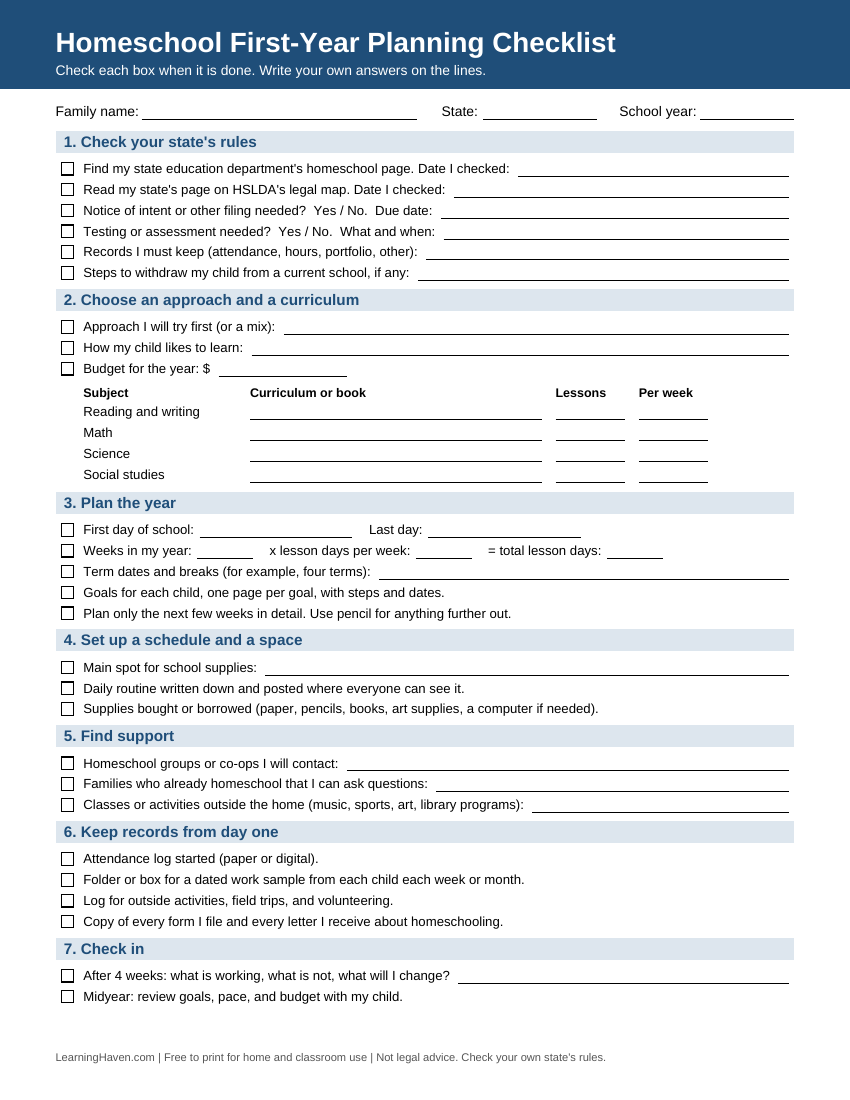
The one-page printable below puts the first-year steps on a single sheet, with room for your state’s rules, your plan, and your support list.
This section covers the first weeks and the printable. It doesn’t cover a year-long course plan for any one grade.
Practice set
Work through these planning problems on paper, then check your answers.
- A school year has 36 weeks with 4 lesson days a week. How many lesson days is that?
- Suppose a rule asked for 180 days. This is a made-up number, not any state’s rule. At 4 days a week, how many weeks would you need?
- A reading program has 90 lessons. You do 5 a week. How many weeks does it take?
- You teach 3 hours a day, 4 days a week, for 36 weeks. How many hours is that?
- A science unit takes 7 weeks. How many whole units fit in 36 weeks, and how many weeks are left?
Show answers and reasoning
- 36 × 4 = 144 lesson days. Check: 144 ÷ 4 = 36.
- 180 ÷ 4 = 45 weeks. Check: 45 × 4 = 180. That is more than a 36-week year, so you would need more lesson days a week or a longer year.
- 90 ÷ 5 = 18 weeks. Check: 18 × 5 = 90.
- 3 × 4 = 12 hours a week. Then 12 × 36 = 432 hours. Check: 432 ÷ 36 = 12.
- 36 ÷ 7 = 5 with 1 left over. Five units fit, with 1 week left. Check: 5 × 7 = 35 and 35 + 1 = 36.
Once you know your state’s rule and have a first-year plan, our homeschooling hub links to the rest of the section. For the daily routine, see time management.
For younger learners, see our pages for preschool and grades K to 3.
For older students, see grades 4 to 8 and our book lists.
For practice sheets, visit our homeschool worksheets.
Sources
- National Center for Education Statistics. First Look: Parent and Family Involvement in Education: 2023.
- National Center for Education Statistics. Fast Facts: Homeschooling.
- HSLDA. Homeschool Laws by State.
- HSLDA. How to Comply with Texas Homeschool Law.
- HSLDA. How to Comply with California’s Homeschool Law.
- HSLDA. 7 Simple Steps to Start Homeschooling.
- HSLDA. What’s My Educational Approach or Homeschool Style?
- HSLDA. Ready? Set Your Homeschool GPS!
- HSLDA. Selecting My Curriculum.
- HSLDA. Choosing Planning Tools That Work for Me.
- HSLDA. Where Will We Homeschool? Creating My Child’s Learning Environment.
- HSLDA. 5 Reasons to Attend a Homeschool Conference.
- HSLDA. Homeschooling on a Budget . . . or No Budget?
- HSLDA. Get Started.
- Homeschool.com. Homeschooling: Getting Started Guide.