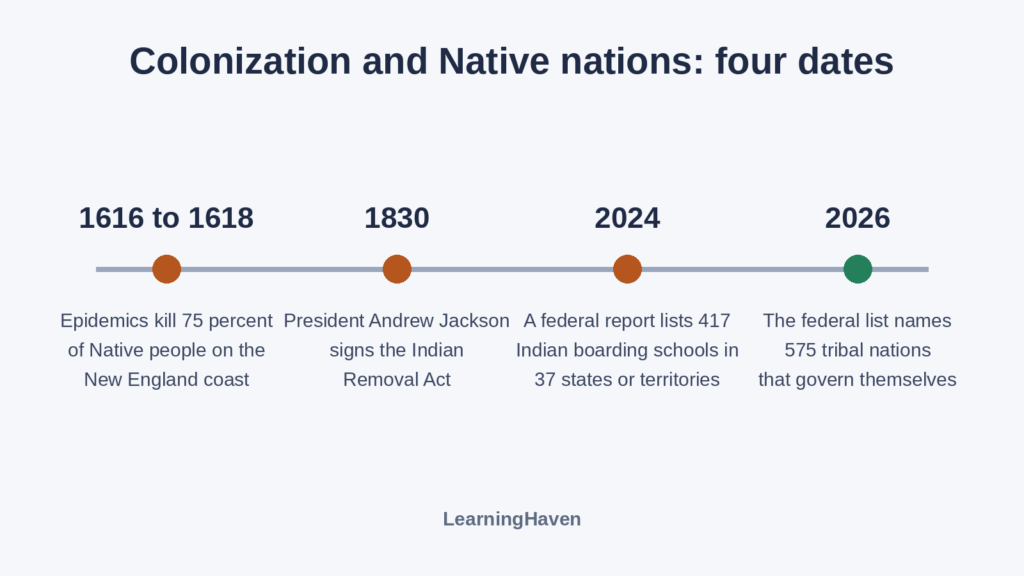
European colonization changed Native nations of North America through disease, war, lost land, forced removal and boarding schools. The effects were different for each nation, and Native nations survived them. Today the United States has a government-to-government relationship with 575 federally recognized tribes (Bureau of Indian Affairs).
Key facts
- Epidemics killed 75 percent of Native people on the New England coast between 1616 and 1618 (OpenStax).
- President Andrew Jackson signed the Indian Removal Act on May 28, 1830 (National Archives).
- A 2024 federal report lists 417 Indian boarding schools in 37 states or then-territories (Interior Department).
- The federal list published January 30, 2026, names 575 tribal nations (Federal Register).
Colonization means one country taking control of land where other people already live and sending its own settlers there. This page says “Native nations” for the peoples who have lived in North America since long before Europeans arrived. The Smithsonian notes that “whenever possible, Native people prefer to be called by their specific tribal name” (NMAI). Start at our Native American hub for an overview, and read about the European explorers who came first.
How did European diseases affect Native nations?
Diseases that Europeans carried, such as smallpox, killed huge numbers of Native people. Scholars estimate that 80 to 95 percent of the Native population of the Americas died within 100 to 150 years of European contact (UK National Archives). That estimate counts deaths from both disease and fighting. An epidemic is a disease that spreads to many people at once.
In 1837, a smallpox epidemic left the Mandan with as few as 125 people (National Park Service). The Mandan lived in permanent villages at the center of large trade networks. Today they are part of the Mandan, Hidatsa, and Arikara Nation (NPS).
Many older books say Native people died only because their bodies had no immunity. The scholars behind the book Beyond Germs say that is too simple. Their publisher writes, “Warfare, enslavement, land expropriation, removals, erasure of identity, and other factors undermined Native populations” (University of Arizona Press). So ask what war and land loss did too.
How did horses, guns and trade change Native life?
Horses, guns and European trade goods changed how many Native nations traveled, hunted and traded. Columbus’s voyages returned horses to the Americas. Native nations then traded horses across the Plains and Plateau regions (Smithsonian). Horses changed how nations such as the Apsáalooke (Crow), Lakota, Cheyenne and Nimiipuu (Nez Perce) traveled, hunted and fought (Smithsonian). See how horses changed Native life.
Europeans wanted beaver fur for hats. Native hunters traded more beaver pelts to get European goods, including weapons (OpenStax). Beavers were overhunted until they disappeared from New England and New York (OpenStax).
On the Plains, bison once numbered in the tens of millions. Only about 1,000 were left by the late 1800s (National Park Service).
How did Native nations lose their land?
Native nations lost land through wars, treaties and US laws that broke up reservations. A treaty is a formal agreement between nations. The Smithsonian’s National Museum of the American Indian counts about 374 treaties the United States ratified with Native nations. It adds, “Often broken, sometimes coerced, treaties still define mutual obligations between the United States and Indian Nations” (NMAI). Not every nation has a ratified treaty (NCAI).
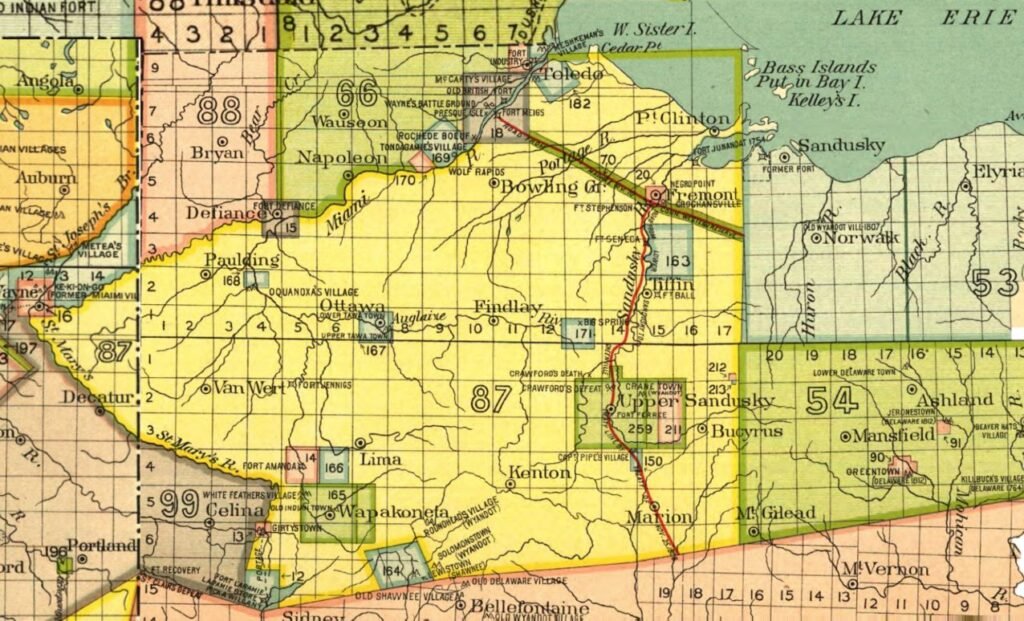
In 1887, Congress passed the General Allotment Act, also called the Dawes Act. It split shared tribal land into small plots for individual owners. More than 90 million acres, nearly two-thirds of reservation land, were taken from tribes and given to settlers (NCAI).
War took land and lives too. On December 29, 1890, the US Army’s Seventh Cavalry killed Lakota people at Wounded Knee Creek. One history counts 90 Lakota men and 200 women and children killed (DPLA). Some older books call Wounded Knee the end of the story. It was not. The Oglala Sioux Tribe and the Rosebud Sioux Tribe are on today’s federal list (Federal Register).
What was the Indian Removal Act of 1830?
The Indian Removal Act of 1830 was the US government’s first major step to force Native nations to move west. President Andrew Jackson signed it on May 28, 1830 (National Archives). It “authorized the President to negotiate removal treaties with Indian tribes living east of the Mississippi River” (National Archives).
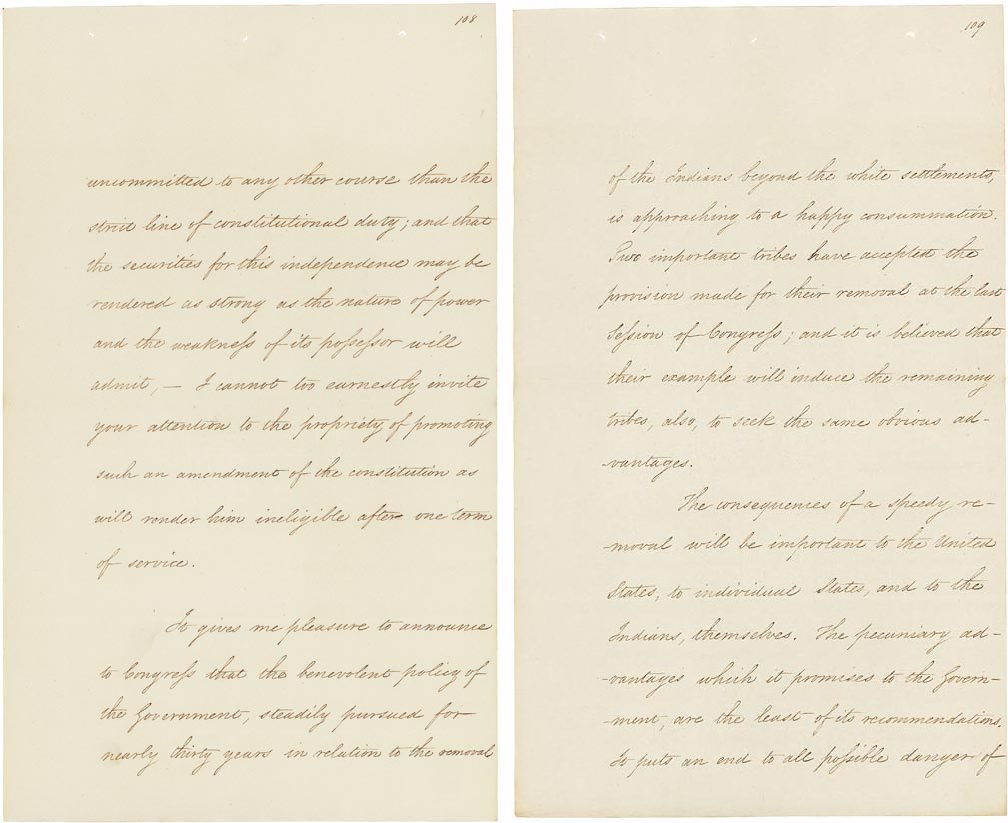
In the 1830s, the federal government forced these nations from the Southeast to Indian Territory, in present-day Oklahoma (National Park Service):
- About 16,000 Cherokee
- About 21,000 Muscogee (Creek)
- About 9,000 Choctaw
- About 6,000 Chickasaw
- About 4,000 Seminole
Many Cherokee opposed the 1836 Treaty of New Echota and refused to leave, so the government ordered General Winfield Scott to push them out with 3,000 troops (National Archives). About 4,000 of the 16,000 Cherokees died along the way (National Archives). These forced journeys are called the Trail of Tears (NPS). Removal reached nations in other regions too, such as the Potawatomi and Shawnee (NMAI).
The Cherokee Nation, The Muscogee (Creek) Nation, The Chickasaw Nation, The Choctaw Nation of Oklahoma and The Seminole Nation of Oklahoma are federally recognized today (Federal Register). Our US history section covers this era.
What were Indian boarding schools?
Federal Indian boarding schools were schools run or supported by the US government that tried to assimilate Native children (Interior Department). To assimilate means to make people give up their own culture and take on another. In 2024, the US Department of the Interior listed 417 of these schools in 37 states or then-territories. At least 973 American Indian, Alaska Native and Native Hawaiian children died while attending them (Interior Department). That is a minimum count, and it covers federal schools only.
Interior Secretary Deb Haaland said the government acted “to isolate children from their families, deny them their identities, and steal from them the languages, cultures and connections that are foundational to Native people” (Interior Department).
Canada had a similar system. At least 150,000 First Nations, Inuit and Métis children attended federally run residential schools in Canada (Government of Canada).
How did Native nations resist and survive?
Native nations resisted with uprisings, refusals to leave and the work of keeping their communities alive. On August 10, 1680, Pueblo people led by Po’Pay rose up against Spanish rule in New Mexico. Spain had forced them to convert to Christianity, suppressed their religious practices and made them work without pay (Library of Congress). It took 12 years before the Spanish could reoccupy Santa Fe (LOC).
A Smithsonian lesson compares how six nations, including the Cherokee and Seminole, tried to avoid removal (NMAI). Each nation has its own history of resistance.
How do Native nations govern themselves today?
Today 575 federally recognized tribes have a government-to-government relationship with the United States. The Bureau of Indian Affairs says these tribes have “inherent rights of self-government (i.e., tribal sovereignty)” (BIA). Sovereignty means a nation’s right to govern itself.
Some pages, even a Smithsonian one, still say 574 tribes (NMAI). That count is out of date. The list grew to 575 when the Lumbee Tribe of North Carolina was added after a law passed on December 18, 2025 (Federal Register). Always check the date on a tribe count.
In January 1975, President Gerald Ford signed the Self-Determination Act. He said, “Self-determination means that you can decide the nature of your tribe’s relationship with the federal government” (NCAI).
Try this: who lives here today?
- Find out which Native nations have homelands in your state.
- Visit one nation’s official website. Note the name it uses and how its government works.
- Put these dates on a timeline: 1616, 1680, 1830, 1837, 1887, 1890, 1975 and 2026.
- Which events came from disease, and which came from government decisions?
Next, compare nations by region on our page about the major groups of Native North Americans.
Sources
- U.S. National Archives. Jackson’s Message to Congress ‘On Indian Removal’
- National Park Service. What is the Trail of Tears?
- U.S. Department of the Interior. Boarding School Initiative (2024)
- Federal Register. Indian Entities Recognized (2026)
- Bureau of Indian Affairs. What is a federally recognized tribe?
- Smithsonian NMAI. Nation to Nation
- Smithsonian NMAI. Did You Know?
- Smithsonian NMAI. American Indian Removal
- Smithsonian. A Song for the Horse Nation
- National Park Service. Mandan
- National Park Service. History and Status of Bison Health
- Library of Congress. 1680: The Pueblo Revolt
- Government of Canada. Residential School System
- NCAI. Tribal Nations and the United States
- University of Arizona Press. Beyond Germs
- OpenStax. The Impact of Colonization
- The National Archives (UK). Native North Americans
- DPLA. The Wounded Knee Massacre