There are two types of right triangle: isosceles right triangles, where the two legs are equal, and scalene right triangles, where all three sides differ. Every right triangle is one or the other.
A right triangle is a triangle with one angle of exactly 90°. The side opposite that angle is the hypotenuse and is always the longest side. The other two sides are the legs.
The two types of right triangle
| Type | Sides | Angles |
|---|---|---|
| Isosceles right triangle | Two legs equal, hypotenuse longer | 90°, 45°, 45° |
| Scalene right triangle | All three sides different | 90° plus two unequal angles |
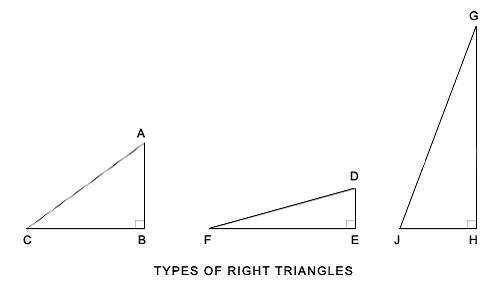
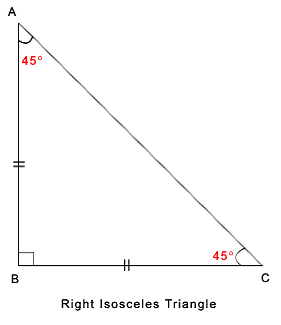
There is no such thing as an equilateral right triangle. An equilateral triangle has three 60° angles, so it cannot contain a 90° angle.
The two non-right angles always add to 90°, because all three angles of any triangle add to 180°. Knowing one of them gives you the other by subtraction.
Famous right triangles
Certain right triangles come up so often that their side ratios are worth memorizing. They fall into two groups.
Special angle triangles
| Angles | Side ratio | Where it comes from |
|---|---|---|
| 45°, 45°, 90° | 1 : 1 : √2 | A square cut along its diagonal |
| 30°, 60°, 90° | 1 : √3 : 2 | An equilateral triangle cut in half |
Both ratios follow from the Pythagorean theorem. For the 45-45-90, legs of 1 and 1 give a hypotenuse of √(1 + 1) = √2. For the 30-60-90, halving an equilateral triangle of side 2 leaves a base of 1 and a hypotenuse of 2, so the height is √(4 − 1) = √3.
Pythagorean triples
A Pythagorean triple is a set of three whole numbers that satisfy a² + b² = c². These give right triangles with no square roots in the answer, which is why textbooks use them constantly.
| Triple | Check |
|---|---|
| 3, 4, 5 | 9 + 16 = 25 |
| 5, 12, 13 | 25 + 144 = 169 |
| 8, 15, 17 | 64 + 225 = 289 |
| 7, 24, 25 | 49 + 576 = 625 |
Any multiple of a triple is also a triple. Doubling 3, 4, 5 gives 6, 8, 10, which works for the same reason.
One boundary worth stating: the 45-45-90 triangle is never a Pythagorean triple. Its hypotenuse is always an irrational multiple of its legs, so no set of whole numbers produces it.
The Pythagorean theorem
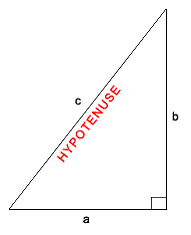
a² + b² = c²
c is the hypotenuse. a and b are the legs. The theorem is named for the Greek mathematician Pythagoras, who treated each side as a square and found that the two smaller squares together equal the largest.
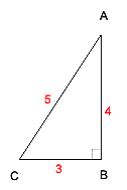
The theorem holds only for right triangles. Applying it to a triangle without a 90° angle gives a wrong answer, and that is the most common error students make with it.
Finding a missing side
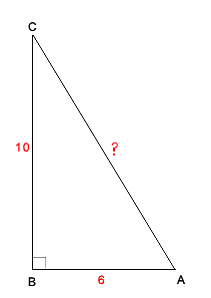
To find the hypotenuse when you know both legs: c = √(a² + b²)
Legs of 3 and 4 give c = √(9 + 16) = √25 = 5.
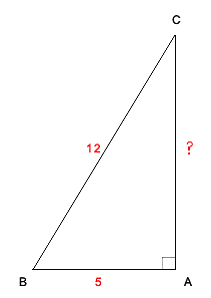
To find a leg when you know the hypotenuse and the other leg: a = √(c² − b²)
A hypotenuse of 12 and a leg of 5 give the other leg as √(144 − 25) = √119 = 10.9 to one decimal place.
Notice the subtraction. Finding a leg is not the same operation as finding the hypotenuse, and reaching for addition both times is the second most common error.
Where right triangles are used
Right triangles turn distance problems into arithmetic. A ladder against a wall, the diagonal of a rectangular room, the straight-line distance between two points on a map, and the rise of a roof are all right triangle problems.
They are also the foundation of trigonometry. Sine, cosine and tangent are defined as ratios of the sides of a right triangle.
What this page does not cover
This page covers right triangles only. Triangles classified by side length in general, and the law of sines and cosines for non-right triangles, are separate topics. Trigonometric ratios are introduced elsewhere.
Where to go next
For other triangle types and polygon classification, see polygon properties. For squares and roots, see squares and square roots. The section index is in geometry.