Native American pottery is clay vessels that Native potters shape by hand, traditionally without a potter’s wheel, using methods and designs that differ from nation to nation. This page covers how pots are built and fired, which nations are known for pottery, what pots were used for, potters known by name, and pottery today.
What is Native American pottery, and what is it not?
Native American pottery is not one style. It is the work of many nations, and each has its own clays, shapes, and designs. The Arizona State Museum says most Southwest Native pottery is still made by hand, although some contemporary Native potters use a potter’s wheel. (Arizona State Museum)
The Hopi Cultural Preservation Office says Hopi pottery is handmade by the coil and scrape technique and that Hopi potters do not use a pottery wheel. (Hopi Cultural Preservation Office)
This section covers what the tradition is. It doesn’t cover any one nation’s rules. For a map of nations, see our page on Native American cultural regions.
How do potters find and prepare clay?
Potters gather clay from natural sources, clean it, and mix in temper. Archaeology Southwest says clay can be found almost everywhere in the American Southwest, but not all clay works for pottery. The potter removes debris, grinds the clay to a powder, and mixes in temper. Temper is rock, sand, or crushed pieces of broken pottery (called sherds) that make the clay less likely to crack. (Archaeology Southwest)
Acoma potters have traditionally mixed their clay with finely ground shards of old pottery. (National Trust for Historic Preservation) The Illinois State Museum says Mississippian potters used crushed freshwater mussel shell, which let them make smoother and thinner pots. (Illinois State Museum) Many Pueblo potters offer thanks before they gather clay. (Vilcek Foundation)
This section covers clay and temper. It doesn’t cover any family’s clay sources.
How do potters build a pot by hand?
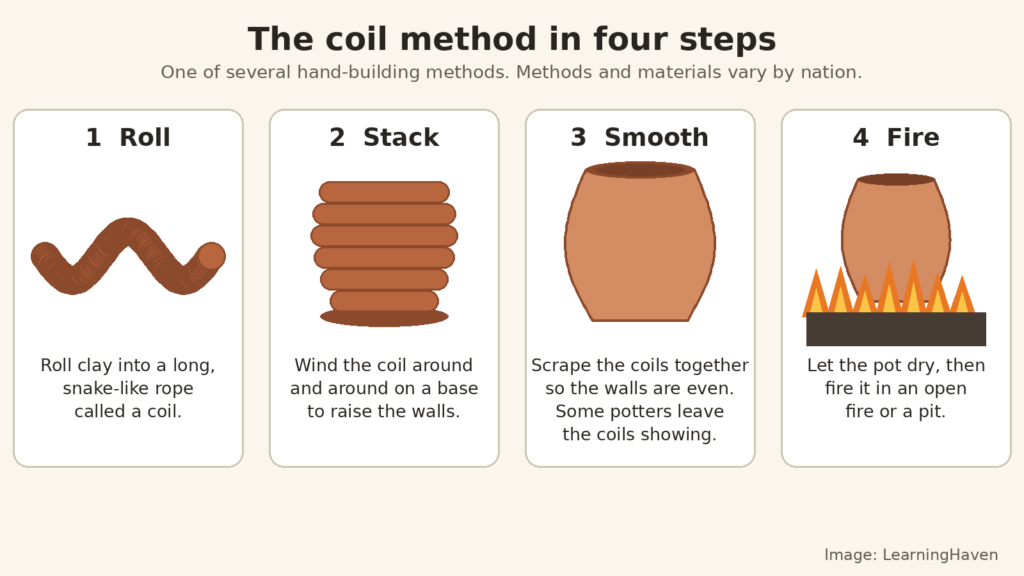
Potters build pots by hand with a few main methods. The Arizona State Museum says most Southwest Native pottery was made with one of two: coil-and-scrape or paddle-and-anvil. (Arizona State Museum)
- Coiling builds the walls from ropes of clay. The potter rolls long, snake-like pieces of clay and winds them around and around, usually on a shallow base mold. The coils can stay in place for a textured surface called corrugated. (Archaeology Southwest)
- Scraping smooths the coils into one even wall. The National Park Service says ancestral Pueblo potters probably used shaped pieces of wood or gourds as scrapers. (National Park Service)
- Pinching shapes a lump of clay with the fingers. You press a thumb into a ball of clay, then pinch the walls up and out. (Grounded in Clay) A Smithsonian library abstract says Pueblo pots are mostly coiled or pinched. (Smithsonian Museum Conservation Institute)
- Paddle and anvil builds the walls by pressing. The potter adds thick ropes of clay to a hand-formed or molded base, then hits the outside with a wooden paddle while holding a flat stone or a fist against the inside. Paddling thins the wall and shapes the pot. The method is used by Yuman-speaking and O’odham potters. (Arizona State Museum)
A base mold holds the pot’s rounded bottom while the walls rise. The National Park Service calls one a puki, a bowl-shaped object that supports the curved bottom of a pot. (National Park Service)
This section covers four hand-building methods. It doesn’t teach any nation’s designs.
How are pots smoothed, painted, and fired?
After shaping, potters let the pot dry, polish it, and often add a slip and paint. Archaeology Southwest says a smooth stone can polish the outside. A slip is an all-over coat of watered-down clay that forms a background color. (Archaeology Southwest)
Paint and tools come from nearby materials. The Hopi Cultural Preservation Office says Hopi potters boil beeweed into black paint, then paint designs freehand with a yucca leaf brush. (Hopi Cultural Preservation Office) Caddo potters cut fine lines into their pots, then rubbed red ochre or white kaolin clay into the lines. (Texas Beyond History) Catawba potters burnish the dry pot, which means rubbing it to a shine with a smooth river stone. (South Carolina Encyclopedia)
The Arizona State Museum says potters use fuel they can find locally, such as dried dung, wood, or coal, and some fire in pits. (Arizona State Museum) Firing is risky, and Archaeology Southwest says pots sometimes crack, break, or explode. At San Ildefonso Pueblo, Maria and Julian Martinez found that smothering the fire to cut the air turned pots black instead of the usual red. (Smithsonian)
This section covers finishing and firing in general terms. It doesn’t describe any family’s paints or firing practices.
Which nations are known for pottery?
Many nations make pottery. This table shows six examples from sources we read.
| Region | Nation or people | What sources say | Source |
|---|---|---|---|
| Southwest | Hopi | Ancestors made plain pottery as early as A.D. 700. Potters today coil and scrape | Hopi Cultural Preservation Office |
| Southwest | Acoma Pueblo | Thin, sturdy walls, ground-sherd temper, white slip. Large jars called ollas hauled and stored water | National Trust, NMAI |
| Southwest | San Ildefonso Pueblo | Black-on-black pottery made by Maria and Julian Martinez | Smithsonian |
| Southwest | Akimel O’odham | A Salt River Pima-Maricopa Indian Community artist showed paddle and anvil pottery in 2014 | National Park Service |
| Southeast | Catawba | Coiled, burnished, and pit fired. Methods nearly unchanged since the Woodland period (1000 B.C.E. to 600 C.E.), an unbroken chain of pottery making | South Carolina Encyclopedia |
| Caddo Homeland | Caddo | Coiled pots with brushed surfaces and engraved lines | Texas Beyond History |
Archaeologists also use the name Mississippian for people who built towns and mounds in places such as central Georgia, starting around 900 C.E. It is a name for a way of life, not one nation’s own name. The National Park Service says Mississippian women built pots by coiling and modeling local clays. (National Park Service)
This section covers a few examples. It doesn’t cover every nation that makes pottery.
What was pottery used for?
Pots were everyday tools. Archaeology Southwest says vessels stored food and seeds for next year’s crop, cooked and served meals, and carried items from place to place. Surfaces could carry painted messages about religion, clan, or history, and pots were bartered, gifted, or buried with a loved one. (Archaeology Southwest)
Shape followed use. Pueblo water jars are often made to reduce splashing and to fit the top of the head, because water was carried that way. (Vilcek Foundation) Texas Beyond History describes Caddo rattle bowls, whose hollow nodes hold pebbles that rattle when shaken. (Texas Beyond History) Our page on Native American music covers other rattles.
Some pottery is not for public view. The Hopi Cultural Preservation Office says some Hopi pottery is ceremonial and not intended for the public. (Hopi Cultural Preservation Office)
This section covers uses that sources describe. It doesn’t cover ceremonial pottery.
Which potters are known by name?
The Arizona State Museum says Southwest potters began to sign their work in the early twentieth century, prompted by traders, which took most of the guesswork out of identifying makers. (Arizona State Museum)
Maria and Julian Martinez of San Ildefonso Pueblo became known around the world for black-on-black pottery that mixes matte and glossy black designs. Maria formed the hand-coiled pots and polished them with a stone, and Julian painted the designs. Julian died in 1943, and Maria kept making pottery with family until 1970. (Smithsonian) As Maria simply put it, “Black goes with everything.” (Smithsonian American Art Museum)
Nampeyo (about 1858 to 1942) was a Hopi-Tewa potter born in Tewa Village on First Mesa. She visited the 1895 excavation of the ancient village of Sikyatki and drew inspiration from its pottery. She formed vessels, and relatives such as her daughters painted many of them. (Arizona State Museum)
This section covers two potters. It doesn’t rank potters or name a single leading artist.
Who makes pottery today?
Pottery is a living tradition. The Vilcek Foundation says the Pueblo pottery tradition is thriving, and that men and women of all ages make traditional and contemporary forms. (Vilcek Foundation) In 2021 Melvin Juanico of the Sky City Cultural Center & Haak’u Museum said he and his wife Marietta still make Acoma pottery with most of the same techniques. He also said, “We want to bring traditional pottery painting and making back.” (National Trust for Historic Preservation)
You can see current work too. Grounded in Clay: The Spirit of Pueblo Pottery is on view at the Indian Pueblo Cultural Center from March 20, 2026 to February 21, 2027. (Indian Pueblo Cultural Center)
This section covers three examples. It doesn’t cover every potter or where to buy pottery.
How can you look at and talk about pottery with respect?
- Name the nation. Say Hopi, Acoma, or Catawba, not just “Native American.”
- Don’t guess what a design means. The National Park Service says ancient designs may have carried meaning or may have been decoration, and that modern Pueblo people have helped explain some. Our page on Native American symbols explains why.
- Leave old pottery where it lies. Archaeology Southwest says it is illegal to remove pottery or sherds from public lands without permits. The Hopi Cultural Preservation Office says Hopi people find non-Hopi ownership of pots taken from burials offensive. (Hopi Cultural Preservation Office)
- Listen to potters. Nora Naranjo Morse of Santa Clara Pueblo says, “The clay offers herself, and we promise to make her proud.” (Vilcek Foundation)
This section covers basic respect. It doesn’t cover any one nation’s rules.
Check what you learned
- Name two ways potters build a pot by hand.
- What is temper, and why do potters add it?
- Do Hopi potters use a potter’s wheel?
- What turned San Ildefonso pots black?
- Why should you leave old sherds where you find them?
Show answers and reasoning
- Coiling, pinching, and paddle and anvil. Any two are right.
- Temper is rock, sand, or crushed old pottery mixed into clay. It makes the clay less likely to crack.
- No. They coil and scrape.
- Smothering the fire cut the air to the pots, so they turned black instead of red.
- Removing it from public lands without permits is illegal, and pots from burials can matter deeply to the nations they came from.
For more on Native nations, start at the Native Americans hub.
For another art tradition, see our page on totem poles. For what people wore, see Native American clothing.
See also National Native American Heritage Month and our social studies section.
Sources
- Archaeology Southwest. Art from Earth and Fire: Pottery in the American Southwest. Fact sheet, May 2014.
- Arizona State Museum. Southwest Native Pottery: Making Pottery, Paddle-and-Anvil Construction, Firing Pottery, and A Nampeyo Showcase.
- Grounded in Clay. Lesson Plan Three.
- Hopi Cultural Preservation Office. Pottery.
- Illinois State Museum. Mississippian containers.
- Indian Pueblo Cultural Center. Grounded in Clay: The Spirit of Pueblo Pottery.
- National Museum of the American Indian. Acoma polychrome jar.
- National Park Service. Pottery of the Ancestral Pueblo, Mississippian Culture, Ocmulgee Mounds, and a 2014 Tuzigoot news release.
- National Trust for Historic Preservation. The Ancient Art of Pottery at New Mexico’s Acoma Pueblo. Preservation Magazine, Fall 2021.
- Smithsonian American Art Museum. Julian Martinez.
- Smithsonian American Women’s History Museum. Fragments of Ancient Pottery Inspired Maria Martinez. November 24, 2025.
- Smithsonian Museum Conservation Institute. Pueblo potters of the North American Indian. Library abstract.
- South Carolina Encyclopedia. Catawba Pottery.
- Texas Beyond History. Making Caddo Pottery and The Caddo Pottery Tradition.
- Vilcek Foundation. Pottery-Making, Pueblo Pottery Stories in Clay.