Native nations made clothing from the materials of their homelands, including hides, plant fibers, cedar bark, cotton, wool, and fur. This page covers materials by region, climate, moccasins, Pueblo and Diné weaving, trade cloth and beads, regalia, and Native designers today.
What was traditional Native American clothing made from?
Clothing came from what each region offered, and the Hood Museum says it varied from people to people. (Hood Museum)
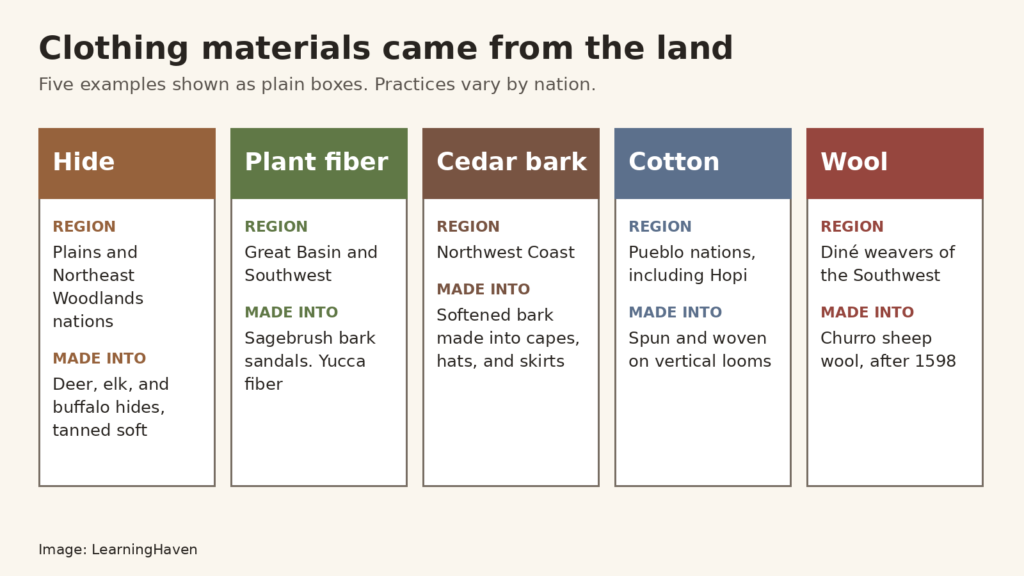
| Material | Where sources place it | What sources say | Source |
|---|---|---|---|
| Hide | Plains nations and the Haudenosaunee | Plains people used deer, elk, buffalo, bighorn sheep, and antelope hides. The Haudenosaunee tanned deer and elk hides into soft leather | Hood Museum, Haudenosaunee Confederacy |
| Plant fiber | Southeast Oregon, Nevada, and the Southwest | Sagebrush bark sandals found at sites in Oregon and Nevada are about 10,400 to 9,100 years old. Southwest clothing also used yucca | Oregon Encyclopedia, Hood Museum |
| Cedar bark | Northwest Coast, including Kwakwaka’wakw, Makah, and Nuu-chah-nulth makers | Cedar hats and capes were rain gear for more than 600 years. Bark is pulled in spring, dried, and pounded soft | Burke Museum, U’mista |
| Cotton | Pueblo nations, including Hopi | Grown, spun, and woven into cloth on vertical looms | National Park Service, Native Seeds/SEARCH |
| Wool | Diné weavers in the Southwest. Northwest Coast weavers used mountain goat wool | Churro sheep wool began to be woven after sheep arrived in 1598 | National Park Service, Burke Museum |
| Fur and skin | Inuit and the Haudenosaunee | Caribou hide for Inuit parkas. Bear skin for Haudenosaunee winter moccasins | The Canadian Encyclopedia, Haudenosaunee Confederacy |
This section covers six materials and the regions that sources tie to them. It doesn’t cover every nation. For the wider map, see Native American nations and cultural regions.
How did climate and season shape clothing?
Sources show climate shaping what people wore. Here are regional examples.
- Arctic. An Inuit parka protected the head, arms, and upper body from the arctic climate. Fur around the hood trapped air warmed by the body, and a full winter set took several caribou hides. (The Canadian Encyclopedia)
- Northeast Woodlands. The Haudenosaunee Confederacy says winter moccasins were often made of bear skin with the fur turned inside. (Haudenosaunee Confederacy)
- Northwest Coast. The Burke Museum says cedar hats and capes, woven like baskets, were standard rain gear for more than 600 years. (Burke Museum)
- Great Basin. The Oregon Encyclopedia says the Klamath and Paiute stuffed shoes of tule reeds and sagebrush bark with dry grass to keep feet warm in icy marsh water. (Oregon Encyclopedia)
For cedar carved into poles instead of cloth, see totem poles.
This section covers four regional examples. It doesn’t cover every region, and the sources here do not describe the climate of each one.
What are moccasins?
The Haudenosaunee Confederacy describes them as low, soft-soled coverings of tough buckskin. Some had decorated flaps sewn on afterward, so the flaps could move to new moccasins when old ones wore out. (Haudenosaunee Confederacy) The Onondaga Nation says nothing has replaced deerskin moccasins lined with rabbit fur. (Onondaga Nation)
The Hood Museum says moccasins were a Native American invention and are now a standard shoe or slipper around the world. (Hood Museum)
This section covers moccasins in two nations’ words. It doesn’t cover every moccasin style.
How did Pueblo weavers use cotton?
A loom is a device that holds the lengthwise threads, called the warp, so a crosswise thread, called the weft, can be woven through them. (Smithsonian Center for Education) Cotton came to the Southwest from Mexico. The Grand Canyon Conservancy says trade brought cotton to the Four Corners area around AD 600, and that vertical looms were making large fabrics by AD 900. (Grand Canyon Conservancy)
Native Seeds/SEARCH says the Hopi and other Pueblo peoples grew cotton for fabric from around AD 800. (Native Seeds/SEARCH) Sources give slightly different early dates, so treat each date as one source’s estimate. For many centuries, Ancestral Pueblo men grew the cotton, spun it, and wove everyday clothing, ceremonial dress, and trade goods. (Grand Canyon Conservancy)
Weaving did not stop. Hopi cotton farming declined from the late 1800s as wool and commercially grown cotton became common. In 2003, cotton and other culturally important crops were returned to the Hopi. (Native Seeds/SEARCH)
This section covers Pueblo cotton weaving in general terms. It doesn’t cover any ceremony or any one village’s designs.
How did Diné weaving change when sheep arrived?
The Grand Canyon Conservancy says it is uncertain when the Diné (Navajo) first took up weaving, and that Diné style had become distinct from Pueblo style by 1750. (Grand Canyon Conservancy) According to oral tradition, as the Hood Museum reports it, Spider Woman taught the Diné to build looms and weave. (Hood Museum)
In 1598, Juan de Oñate brought sheep called churra to the Southwest. The Diné adopted them and wove their wool. The Diné saying Dibé bé iiná means “sheep is life,” and Diné and Rio Grande shepherds still raise descendants of those sheep, called Navajo-Churro. (National Park Service)
The first Diné weaving palette was brown, white, and indigo. Trade from the east later brought colors such as red, black, green, yellow, and gray. (Grand Canyon Conservancy) Bayeta is the name for red wool flannel, or for the red yarn unwound from it. A Brooklyn Museum note says Diné weavers unwound the threads from commercial wool flannel and rewove them with their own dyed and spun yarns. (Brooklyn Museum, via the Reciprocal Research Network)
Weavers kept going. The Heard Museum names regional styles such as Two Grey Hills, Ganado, Crystal, and Wide Ruins that are still woven, and says Diné weavers keep developing new designs. (Heard Museum)
This section covers Diné weaving and sheep in brief. It doesn’t teach weaving or explain any rug’s design.
How did trade cloth and glass beads change clothing?
The Hood Museum says Native peoples long made beads of bone, shell, copper, and stone. Glass beads were among the first items traded with Europeans, first as large pony beads and later as tiny seed beads. (Hood Museum)
Quillwork is decoration made from porcupine quills. Makers softened the quills in water, flattened and dyed them, and stitched them down in rows. The Hood Museum says Plains women largely replaced quills with glass beads in the mid-19th century, and that from about 1885 to 1915 many Plains groups covered vests completely in beads. It adds that beadwork is a living tradition that both men and women practice today. (Hood Museum)
Cloth changed clothing too. Cloth began to replace hides on the Plains toward the end of the 19th century. (Hood Museum) The Haudenosaunee Confederacy says women began making clothing from broadcloth and swapped wooden beads for glass ones. In its words, “While the materials changed the styles remained the same.” (Haudenosaunee Confederacy) For Haudenosaunee beadwork today, see Haudenosaunee art. For the wider history, see effects of colonization.
This section covers beads, quills, and trade cloth. It doesn’t cover how beaded designs are made or what they mean.
What is regalia, and why is it not a costume?
Regalia is the clothing, accessories, and objects worn at sacred events. A school lesson by the Confederated Tribes of Siletz Indians defines it as “traditional or ceremonial clothing, accessories, and artifacts worn at sacred events.” (Siletz lesson, Oregon Department of Education) The Hood Museum says making and wearing regalia is “highly personal and sacred.” (Hood Museum)
Call dance clothing regalia. It is not a costume. The Utah Education Network’s American Indian Resources FAQ puts it this way: “A costume is something one puts on to become something else, whereas regalia represents who a Native American individual is.” (Utah Education Network) The Siletz lesson adds that dressing up in pretend regalia hurts most Native people. It says the Dee-ni regalia it shows uses materials such as beargrass and abalone shell, and that gathering the materials takes years of work.
The jingle dress is one example. Parks Canada calls it a sacred Anishinaabe women’s dress and dance tradition, with metal cone jingles that sound as the dancer moves with the drum. It named the dress a national historic event in 2023. (Parks Canada) For the music side, see Native American music. For why meanings belong to specific nations, see Native American symbols.
This section covers what regalia is and one example. It doesn’t describe any ceremony or dance, because nations decide what they share.
Who makes and wears this clothing today?
Many Native people wear everyday modern clothing. The Haudenosaunee Confederacy says most Haudenosaunee families wore the same clothing as settlers by the 1900s, and that most nations still wear traditional clothing to longhouse ceremonies and special events. (Haudenosaunee Confederacy)
Native designers work in fashion too. In 2017, the Smithsonian’s National Museum of the American Indian showed Native Fashion Now, with nearly 70 works from the last 50 years. (National Museum of the American Indian) The Smithsonian named designers in that show such as Lloyd “Kiva” New (Cherokee), Dorothy Grant (Haida), Virgil Ortiz (Cochiti Pueblo), Patricia Michaels (Taos Pueblo), D.Y. Begay (Diné), Bethany Yellowtail (Apsáalooke and Northern Cheyenne), and Jared Yazzie (Diné). (Smithsonian Institution)
Curator Karen Kramer said Native art and culture are often “perceived as phenomena of the past,” and that this “couldn’t be further from the truth.” The 2017 list is a snapshot of one exhibition. To learn more about living nations, see Native American Heritage Month or the social studies hub.
This section covers everyday dress and seven designers named by one museum. It doesn’t rank designers or name every maker.
How can you talk about Native clothing with respect?
- Name the nation. Say Hopi, Diné, Haudenosaunee, or Siletz, not just “Native American.”
- Say regalia. Use that word for dance and ceremonial clothing.
- Do not dress up in it. The Siletz lesson says pretend regalia hurts most Native people.
- Talk about living makers. Weavers, beaders, and designers are working today.
This section covers basic respect. It doesn’t cover any one nation’s rules.
Check what you learned
- What does regalia mean?
- Which fiber did Pueblo weavers use before wool arrived?
- What did Plains women largely use instead of porcupine quills by the mid-19th century?
- What did Diné weavers do with bayeta?
Show answers and reasoning
- Regalia is traditional or ceremonial clothing, accessories, and objects worn at sacred events.
- Cotton. Sheep came with the Spanish in 1598, so earlier Pueblo cloth was cotton and other plant fibers.
- Glass beads, according to the Hood Museum.
- They unwound the red threads and rewove the yarn into their own blankets.
Want more? Start at the Native American hub or see our Native American pottery page for another craft.
Sources
- Brooklyn Museum. Probably Bayeta-style Blanket with Terrace and Stepped Design, 50.67.54, via the Reciprocal Research Network.
- Burke Museum. Wearing Basketry, Native American Basketry Exhibit (archived by the museum in 2018).
- Confederated Tribes of Siletz Indians. Siletz Today, Grade 5, Not a Costume!, Oregon Department of Education.
- Connolly, Thomas J. Oregon Encyclopedia. Fort Rock Sandals.
- Abler, Thomas S. The Canadian Encyclopedia. Parka.
- Grand Canyon Conservancy. Weavers, Cultural Demonstration Series.
- Haudenosaunee Confederacy. Clothing.
- Heard Museum. Textiles.
- Hood Museum of Art, Dartmouth. Native American Art Teacher Resources: Plains, Clothing and Regalia.
- Hood Museum of Art, Dartmouth. Native American Art Teacher Resources: Northeast Woodlands, Clothing and Regalia.
- Hood Museum of Art, Dartmouth. Native American Art Teacher Resources: Southwest, Clothing.
- Hood Museum of Art, Dartmouth. Native American Art Teacher Resources: Arctic and Subarctic, Clothing.
- Hood Museum of Art, Dartmouth. Native American Art Teacher Resources: Crow vest and Dakota vest.
- Hood Museum of Art, Dartmouth. Native American Art Teacher Resources: Diné model loom.
- National Museum of the American Indian. Native Fashion Now.
- National Park Service. New Mexico Fiber Arts Traditions.
- Native Seeds/SEARCH. Hopi Short Staple Cotton.
- Onondaga Nation. Dress.
- Parks Canada. Shiibaashka’igan, The Jingle Dress National Historic Event.
- Smithsonian Center for Education and Museum Studies. Textiles of the North American Southwest, Glossary.
- Smithsonian Institution. Final Stop of “Native Fashion Now” Exhibition Arrives at the National Museum of the American Indian in New York.
- U’mista. Red Cedar Bark, Living Tradition: The Kwakwaka’wakw Potlatch on the Northwest Coast.
- Utah Education Network. American Indian Resources, Frequently Asked Questions: Dress Up.