Number words are the names of numbers written in letters, such as seven for 7 and forty-two for 42. This page covers spelling zero to 20, the tens words, hyphens, hundreds and thousands, place value, comparing numbers, even and odd, and two free worksheets with answer keys.
How do you spell the number words from 0 to 20?
Zero to twenty is 21 words, and kids learn them one by one. Every larger number word is built from them.
A number word is a number written in letters. A numeral is the written symbol, such as 7. A digit is one of the symbols 0 to 9, so 42 has two digits. Standard K.CC.A.3 asks Kindergartners to “Write numbers from 0 to 20.” (Common Core, Kindergarten Counting & Cardinality)
| Numeral | Word | Numeral | Word | Numeral | Word |
|---|---|---|---|---|---|
| 0 | zero | 7 | seven | 14 | fourteen |
| 1 | one | 8 | eight | 15 | fifteen |
| 2 | two | 9 | nine | 16 | sixteen |
| 3 | three | 10 | ten | 17 | seventeen |
| 4 | four | 11 | eleven | 18 | eighteen |
| 5 | five | 12 | twelve | 19 | nineteen |
| 6 | six | 13 | thirteen | 20 | twenty |
Spellings follow the table in English numerals, Wikipedia. Watch four traps.
- Eleven and twelve do not end in teen.
- Thirteen and fifteen start thir and fif, not three and five.
- Eighteen has one t after the h.
- Four keeps its u in fourteen.
Worked example. Write 14 in words.
- 14 is a ten and 4 ones. Say “four” and “teen.”
- Join the parts: four + teen = fourteen.
- Check: the u from four is still there.
This section covers the 21 words from zero to twenty. It doesn’t cover ordinal words such as first and second.
How do you write the tens words and the numbers 21 to 99?
The tens words are ten, twenty, thirty, forty, fifty, sixty, seventy, eighty, and ninety. Each one names a number of tens.
Standard 1.NBT.B.2.c says the numbers 10, 20, 30, 40, 50, 60, 70, 80, and 90 “refer to one, two, three, four, five, six, seven, eight, or nine tens (and 0 ones).” (Common Core, Grade 1 Number & Operations in Base Ten)
| Numeral | Tens word | Number of tens |
|---|---|---|
| 10 | ten | 1 ten |
| 20 | twenty | 2 tens |
| 30 | thirty | 3 tens |
| 40 | forty | 4 tens |
| 50 | fifty | 5 tens |
| 60 | sixty | 6 tens |
| 70 | seventy | 7 tens |
| 80 | eighty | 8 tens |
| 90 | ninety | 9 tens |
Watch forty. It has no u, unlike four and fourteen.
The numbers between the tens take a hyphen. The Blue Book of Grammar and Punctuation says: “Hyphenate all compound numbers from twenty-one through ninety-nine.” (Grammar Book, Rules for Writing Numbers) The hyphen applies when “the second digit is not zero.” (English numerals, Wikipedia) So 30 is thirty and 31 is thirty-one.
Of the 80 numbers from 20 to 99, 72 need a hyphen and 8 do not. Only 28 different words build every number from 0 to 99: 20 words from zero to nineteen, plus 8 tens words.
Worked example. Write 68 in words.
- 68 is 6 tens and 8 ones.
- 6 tens is sixty. 8 ones is eight.
- Join them with a hyphen: sixty-eight.
Check: 60 + 8 = 68.
This section covers 10 to 99. It doesn’t cover fractions written in words, such as two-thirds. The same guide says to hyphenate those too (rule 2b). Fractions themselves are on our fractions page.
How do you write hundreds and thousands in words?
Say how many hundreds, then the word hundred, then the rest of the number. Skip any place that holds a zero.
Hundred stays singular, because “the word hundred remains in its singular form regardless of the number preceding it.” (English numerals, Wikipedia) So 600 is six hundred. Standard 2.NBT.A.3 asks Grade 2 students to “Read and write numbers to 1000 using base-ten numerals, number names, and expanded form.” (Common Core, Grade 2 Number & Operations in Base Ten)
| Numeral | Words |
|---|---|
| 100 | one hundred |
| 342 | three hundred forty-two |
| 805 | eight hundred five |
| 910 | nine hundred ten |
| 1,000 | one thousand |
| 2,060 | two thousand sixty |
Worked example. Write 805 in words.
- The 8 is in the hundreds place. Write eight hundred.
- The tens place holds 0. Write no tens word.
- The 5 is in the ones place. Write five.
So 805 is eight hundred five. Check: 800 + 0 + 5 = 805.
For four digits, say the thousands first, so 2,060 is two thousand sixty. The same guide says: “With figures of four or more digits, use commas.” (Grammar Book, Rules for Writing Numbers) This page writes numbers without the word and. If your curriculum uses and, follow it.
This section covers numbers up to 1,000 and one four-digit example. It doesn’t cover millions.
What is place value?
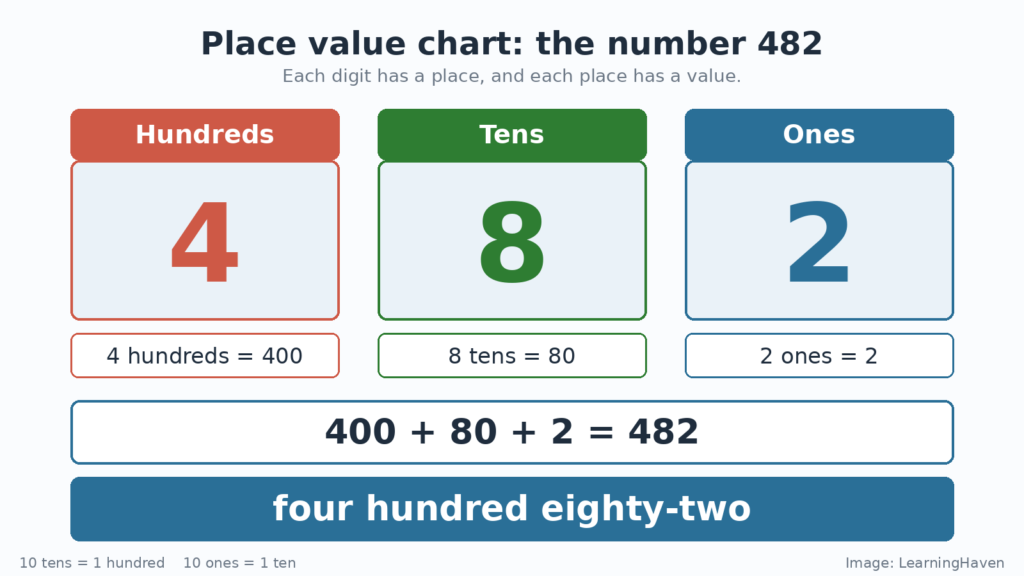
Place value means a digit’s position tells you its value. In 482, the 4 means 4 hundreds, which is 400.
Standard 2.NBT.A.1 says the digits of a three-digit number stand for hundreds, tens, and ones. It gives this example: “706 equals 7 hundreds, 0 tens, and 6 ones.” (Common Core, Grade 2 Number & Operations in Base Ten)
| Place | Digit in 482 | Value |
|---|---|---|
| Hundreds | 4 | 400 |
| Tens | 8 | 80 |
| Ones | 2 | 2 |
Writing a number as a sum of its place values is called expanded form. For 482, it is 400 + 80 + 2. The words follow the same places: four hundred eighty-two.
Ten ones make 1 ten, and ten tens make 1 hundred. Standard 1.NBT.B.2.a calls 10 “a bundle of ten ones.” (Common Core, Grade 1 Number & Operations in Base Ten)
Worked example. Find the value of each digit in 376.
- The 3 is in the hundreds place. Its value is 300.
- The 7 is in the tens place. Its value is 70.
- The 6 is in the ones place. Its value is 6.
In words, 376 is three hundred seventy-six. Check: 300 + 70 + 6 = 376.
Place value also makes carrying work, as our addition page shows. This section covers places up to hundreds. It doesn’t cover decimal places, which are on our decimals page.
How do you compare numbers and find the greatest value?
Compare the places from left to right. The first place with different digits decides which number is greater.
First count the digits. A number with more digits is greater, so 101 is greater than 99. With the same number of digits, start at the left. Standard 2.NBT.A.4 asks students to “Compare two three-digit numbers based on meanings of the hundreds, tens, and ones digits, using >, =, and < symbols to record the results of comparisons.” (Common Core, Grade 2 Number & Operations in Base Ten)
The skill starts in Kindergarten. Standard K.CC.C.7 asks children to “Compare two numbers between 1 and 10 presented as written numerals.” (Common Core, Kindergarten Counting & Cardinality)
Worked example. Circle the number with the greatest value: 47, 59, 51, 60.
- All four numbers have two digits, so compare the tens.
- The tens digits are 4, 5, 5, and 6. The 6 is the greatest.
- Only 60 has 6 tens. The greatest value is 60.
Worked example. Compare 412 and 421.
- The hundreds match: 4 and 4.
- Compare the tens: 1 is less than 2.
- So 412 < 421, which reads “412 is less than 421.”
To order numbers from least to greatest, find the least one first, then the next. The numbers 305, 290, 287, and 310 go in the order 287, 290, 305, 310.
This section covers comparing whole numbers up to three digits. It doesn’t cover comparing decimals or fractions, which have their own pages for decimals and fractions.
Is zero even or odd?
Zero is an even number. Even numbers have a ones digit of 0, 2, 4, 6, or 8, and odd numbers have 1, 3, 5, 7, or 9.
Standard 2.OA.C.3 asks students to determine whether a group of objects “has an odd or even number of members, e.g., by pairing objects or counting them by 2s.” (Common Core, Grade 2 Operations & Algebraic Thinking) The same standard asks them to “write an equation to express an even number as a sum of two equal addends.” For zero, that equation is 0 + 0 = 0.
Wolfram MathWorld lists 0 among the even numbers. It adds: “An integer which is not even is called an odd number.” (Wolfram MathWorld, Even Number)
| Kind | First numbers | Ones digit |
|---|---|---|
| Even | 0, 2, 4, 6, 8, 10, 12 | 0, 2, 4, 6, or 8 |
| Odd | 1, 3, 5, 7, 9, 11, 13 | 1, 3, 5, 7, or 9 |
Worked example. Is 17 odd or even?
- Look at the ones digit. It is 7, so 17 should be odd.
- Test it. Pair up 17 objects. You get 8 pairs and 1 left over.
- A number with one left over is odd.
Check: 8 pairs is 16, and 16 + 1 = 17. Skip counting by 2s lands only on even numbers, as our counting page shows.
This section covers even and odd whole numbers. It doesn’t cover negative numbers or other kinds of numbers, which come much later.
Where can you get free number words worksheets?
LearningHaven made two free worksheets with answer keys. Both print on US Letter paper at 100% scale. You don’t need an account.
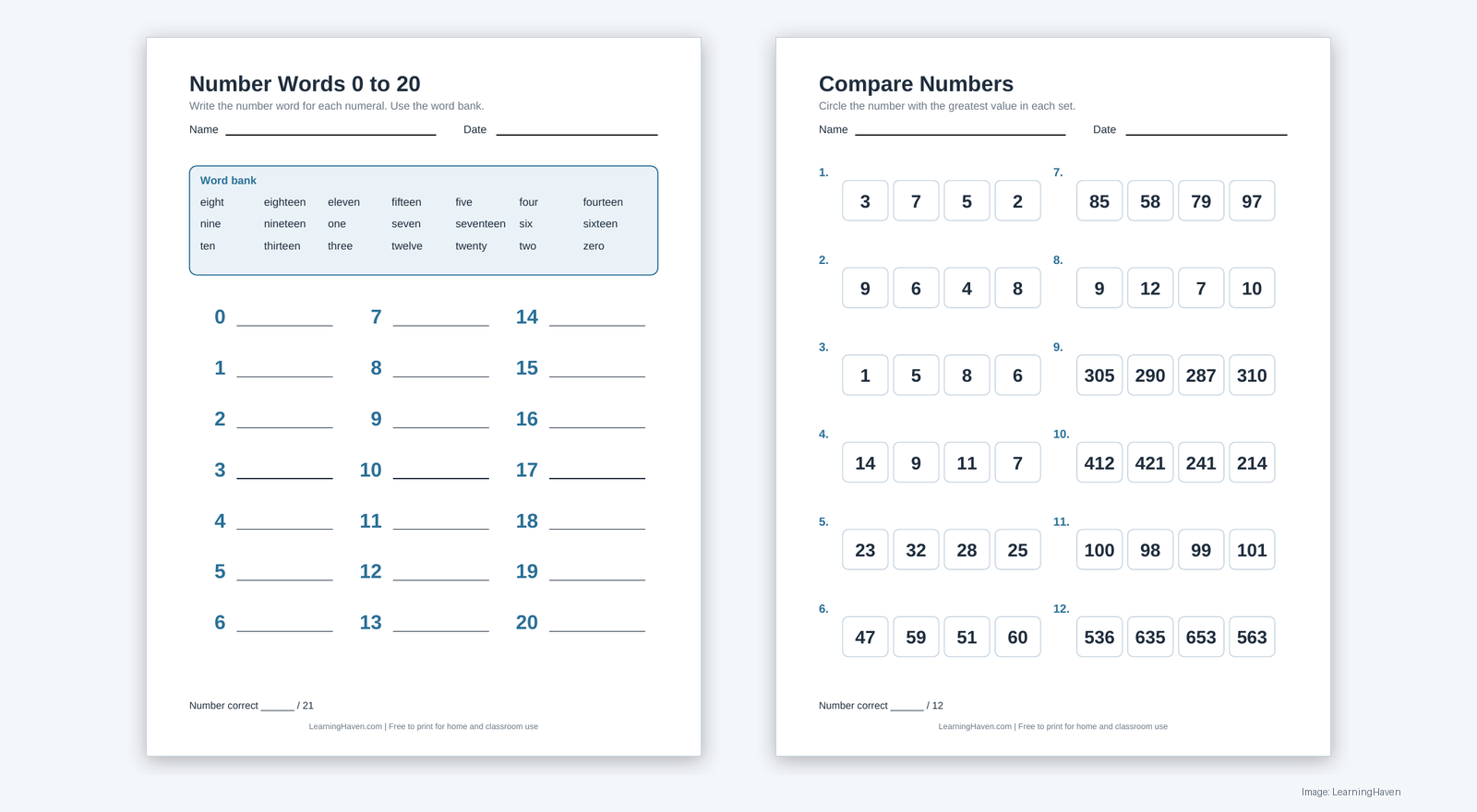
Number words 0 to 20. It lists the 21 numerals from 0 to 20. A word bank gives the 21 words in alphabetical order. The child writes the matching word on each line.
- Download the number words 0 to 20 worksheet (PDF)
- Download the number words 0 to 20 answer key (PDF)
Compare numbers. It has 12 sets of 4 numbers, 48 numbers in all, from one digit to three digits. The child circles the greatest number in each set.
Have the child say each number aloud before writing. Check with the key, then redo any miss. For more printables, see our math worksheets page and homeschool worksheets page.
This section covers the two worksheets made for this page. It doesn’t cover worksheets for the numbers above 100 in words or for even and odd.
How can parents help at home?
Keep sessions short and tie each number word to a real amount.
- Pair the word with a quantity. Say “seven,” show 7 objects, and point to the numeral 7.
- Use Look, Say, Cover, Write, Check. Devon County Council says the “Look Say Cover Write Check” approach “is a good method to teach your child.” It adds a caution: “Be aware that this method does not work for everyone.” (Devon County Council, How can I help my child with spelling?)
- Bundle tens. Tie 10 craft sticks together, then count bundles and loose sticks and read the total in words.
- Play a greater-number game. Each player turns over a number card, and the greater number wins. Our math games page has a similar card game, Math War, that compares totals.
This section covers home practice ideas. It doesn’t cover how to tell whether a child needs extra help with spelling, which a teacher can help you judge.
Practice set
Work through these on paper, then check your answers.
- Write 17 in words.
- Write 64 in words.
- Write 308 in words.
- Write fifty-eight as a numeral. What is the value of the 5?
- Circle the greatest number: 72, 207, 270, 702.
- Is 0 even or odd? Explain how you know.
Show answers and reasoning
- Seventeen. It is seven + teen. Check: 10 + 7 = 17.
- Sixty-four. 6 tens is sixty, 4 ones is four, and the hyphen joins them. Check: 60 + 4 = 64.
- Three hundred eight. The number has 3 hundreds, 0 tens, and 8 ones. Write no tens word. Check: 300 + 0 + 8 = 308.
- 58. The 5 is in the tens place, so its value is 50. Check: 50 + 8 = 58.
- 702. It has 7 hundreds. 207 and 270 have 2 hundreds, and 72 has none. Check: 72 < 207 < 270 < 702.
- Even. Its ones digit is 0, and 0 + 0 = 0 is a sum of two equal addends.
Number words build on counting, so the counting page is a good place to start or review. For more topics, visit our math hub.
Place value carries into adding and subtracting, so try the subtraction page next. For a full-year view, see the K to 3 homeschool plan.
Sources
- Common Core State Standards Initiative. Kindergarten Counting & Cardinality.
- Common Core State Standards Initiative. Grade 1 Number & Operations in Base Ten.
- Common Core State Standards Initiative. Grade 2 Number & Operations in Base Ten.
- Common Core State Standards Initiative. Grade 2 Operations & Algebraic Thinking.
- The Blue Book of Grammar and Punctuation. Rules for Writing Numbers.
- Wikipedia. English numerals.
- Wolfram MathWorld. Even Number.
- Devon County Council. How can I help my child with spelling?