A totem pole is a tall carved monument, usually made of red cedar, that Indigenous nations of the Northwest Coast raise to show family lineage, record history, and honor people and events. This page covers which nations carve poles, what the carvings mean, pole types, carving and raising, formline, the potlatch ban, returned poles, and respectful viewing.
What is a totem pole, and what is it not?
A totem pole is a family and community record carved in wood. The University of British Columbia’s Indigenous Foundations site says poles represent and commemorate “ancestry, histories, people, or events.” (UBC Indigenous Foundations) The Canadian Encyclopedia adds that a pole can show rights to territories, songs, and dances. (The Canadian Encyclopedia)
A pole is not a god and not an idol. UBC calls the idea that First Nations worshipped poles a misconception, and says missionaries may have started it. (UBC Indigenous Foundations) Art historian Aaron Glass says poles express parts of First Nations spirituality, especially ties to ancestors, but “they are not religious icons.” He also says “totem” carries inaccurate ideas and suggests “crest poles.” (The Tyee)
This section covers what a pole is and a common mistake about it. It doesn’t cover any one family’s pole.
Which nations carve totem poles?
Poles come from the Northwest Coast, a narrow strip of coast that includes British Columbia and Southeast Alaska. Glass says only a handful of coastal First Nations carved poles before the 1900s. (The Tyee) Styles differ by nation.
| Nation | What sources say | Source |
|---|---|---|
| Haida | Closely intertwined designs in shallow relief. Creatures with bold eyes | UBC, Canadian Encyclopedia |
| Tsimshian | Horizontal line breaks between figures. Memorial poles tend to be the tallest | UBC |
| Kwakwaka’wakw | Deeply etched surfaces, jutting wings and beaks, narrow eyes | UBC, Canadian Encyclopedia |
| Tlingit | Sitka National Historical Park shows Tlingit and Haida house posts, frontal poles, and detached poles | National Park Service |
| Nuxalk | Among the nations credited with some of the earliest poles | Canadian Encyclopedia |
| Coast Salish | House posts and planks for ceremonial houses, not usually stand-alone poles | UBC, Burke Museum |
Seattle has many poles, but the Burke Museum says Washington’s Coast Salish peoples did not traditionally carve them. The city’s poles trace to a late-1800s plan by civic leaders to market Seattle as the “Gateway to Alaska.” (Burke Museum)
This section covers five nations and one contrast. It doesn’t cover every nation. For the wider map, see our page on Native American cultural regions.
What do the carvings mean?
Most poles show crests, which are animals or other beings that mark a family’s lineage. UBC says crests validate the rights and privileges a family holds. Common crests along the coast include wolf, eagle, grizzly bear, thunderbird, killer whale, frog, raven, and salmon. (UBC Indigenous Foundations) The Canadian Encyclopedia says crests are “considered the property of specific family lineages.” (The Canadian Encyclopedia)
A raven on one pole is the crest of one family, so a figure has no single fixed meaning. UBC says a pole documents stories that community members already know, more than it tells a story to strangers. At Sitka, the National Park Service says “many stories will forever remain locked in the towering poles.” (National Park Service) This page does not retell any family’s crest story. Those belong to the families.
Many people think the most important figure sits at the top. The Canadian Encyclopedia calls this a “false idea” and says the most important figure is sometimes at the bottom. (The Canadian Encyclopedia) For more on how meanings belong to specific nations, see Native American symbols.
This section covers crests in general terms. It doesn’t explain what any one figure means.
What types of poles are there?
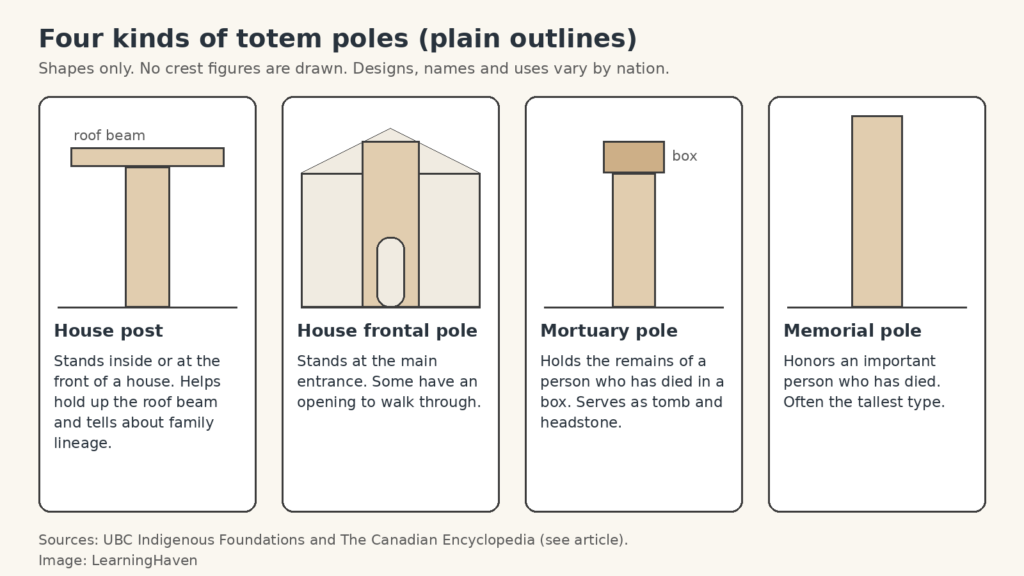
Poles have different jobs. UBC and The Canadian Encyclopedia describe these types:
- House posts hold up roof beams and tell about family lineage.
- House frontal poles stand at the main entrance. Some have an opening to walk through.
- Mortuary poles hold the remains of a person who has died in a box. Haida examples have the box at the top.
- Memorial poles honor an important person who has died.
- Welcome poles greet guests, such as the welcome figures of the Hupacasath First Nation.
- Legacy poles mark important events. The Haida raised one in 2013 for the 20th anniversary of the Gwaii Haanas Agreement.
- Shame poles criticized neighbors who did not pay debts. They are less common.
(UBC Indigenous Foundations, The Canadian Encyclopedia)
Most poles stand 3 to 18 meters tall, which is about 10 to 59 feet. Some pass 20 meters. (UBC Indigenous Foundations)
This section covers seven types. It doesn’t cover every name a nation uses for its own poles.
How is a pole carved and raised?
Most poles are carved from Western red cedar. UBC says many communities hold a ceremony of gratitude and respect for the tree before it is cut. (UBC Indigenous Foundations)
Carvers remove the bark and shape the wood with adzes, axes, and chisels. The Canadian Encyclopedia says they work from the bottom of the log upward over lightly drawn designs. (UBC Indigenous Foundations, The Canadian Encyclopedia)
A raising is a community event. UBC says it is often held with a feast or potlatch, and the pole’s meaning is shared and witnessed there. Parks Canada says more than 400 people took part in raising the 42-foot Gwaii Haanas Legacy Pole on August 15, 2013. In Haida tradition, monumental poles become “living members of the community that tell stories and history” once they are carved, danced, and raised. (Parks Canada)
Most poles last about a hundred years, and UBC calls the decay “a natural part of a pole’s life cycle.” (UBC Indigenous Foundations)
This section covers the steps in general terms. It doesn’t describe any ceremony, because families and nations decide what is shared.
What is formline, the Northwest Coast art style?
Formline is the curving line that outlines the subject in northern Northwest Coast two-dimensional design. The Burke Museum says the primary formline is often black and the secondary often red, and formlines build shapes such as U-shapes, ovoids, and S-shapes. (Burke Museum)
Sealaska Heritage Institute says formline design dates back more than two thousand years. Many formline designs show clan crests, which a clan owns as property. (Sealaska Heritage Institute)
This section covers formline in brief. It doesn’t teach how to draw it. For art from another region, see Haudenosaunee art.
What was the potlatch ban, and what happened to poles?
A potlatch is a ceremony of Northwest Coast nations that includes feasting, dancing, singing, and gift giving. Nations and clans practice it differently. (The Canadian Encyclopedia)
Canada amended its Indian Act in 1884, and the ban on the potlatch took effect on January 1, 1885. It ended with the 1951 revision of the Act, about 66 years later. The government saw the potlatch as a barrier to its policy of assimilation. After a large potlatch in 1921, officials arrested 45 people and took about 600 ceremonial objects. (The Canadian Encyclopedia)
Poles were hit too. Christian missionaries encouraged cutting poles down, and many poles were taken to museums and parks around the world. (The Canadian Encyclopedia)
Carving came back. Kwakwaka’wakw carver Mungo Martin arrived at the Royal BC Museum in 1952 to restore poles. He later held a public potlatch to open the house he built in Thunderbird Park. Carver Richard Hunt called the park “where our culture was revived.” (Royal BC Museum) For more on this history, see Effects of Colonization on Native Americans.
This section covers the ban in Canada. It doesn’t cover Alaska or U.S. law.
Which poles have come home, and who carves today?
The G’psgolox pole is a Haisla mortuary pole carved in 1872. It was taken from the village of Misk’usa in the late 1920s and shipped to Sweden. The Haisla learned where it was in 1991. Sweden agreed in 1994 to return it, and it came home to Kitimat on July 1, 2006. The Haisla carved a new pole that now stands outside the museum in Stockholm. The chief’s descendants later decided to let the original return to the earth and decay in the forest where it grew. (UBC Indigenous Foundations, Museum of Ethnography, Stockholm)
In 2023, the Nisga’a Nation brought home the House of Ni’isjoohl memorial pole, carved in 1860, from a museum in Scotland. National Museums Scotland calls it the first pole rematriated from the United Kingdom. Chief Earl Stephens says the pole is “alive with the spirit of our ancestors.” (National Museums Scotland)
Carvers work today. Jaalen Edenshaw (Haida) led the Legacy Pole project. (Parks Canada) Robert Davidson (Haida) carved the Bear Mother pole, which The Canadian Encyclopedia calls the first pole carved and raised on Haida Gwaii in living memory of Haida Elders. (The Canadian Encyclopedia) No one carver speaks for all nations.
This section covers two returns and two carvers. It doesn’t rank carvers or list every pole.
How can you look at and talk about poles with respect?
- Name the nation. Say Haida, Tlingit, or Kwakwaka’wakw, not just “Native American.”
- Don’t guess what a figure means. Crests belong to families, so read what the nation publishes.
- Don’t call poles idols. UBC calls that idea a misconception, and Glass calls it a stereotype.
- Listen to the nation’s own voice. The Haida Heritage Centre says it exists to celebrate “the living culture of the Haida.” (Haida Heritage Centre)
This section covers basic respect. It doesn’t cover any one nation’s rules.
Check what you learned
- What is a crest?
- Why is the idea “the top figure is most important” wrong?
- What years did the potlatch ban cover in Canada?
- What happened to the original G’psgolox pole after it came home?
Show answers and reasoning
- A crest is an animal or other being that marks a family’s lineage.
- Poles do not rank figures from top to bottom. Sometimes the most important figure is at the bottom.
- The ban took effect on January 1, 1885, and ended in 1951.
- The chief’s descendants let it return to the earth and decay in the forest where it grew.
For more on Native nations, start at the Native Americans hub.
For another coastal animal topic, see the spirit bear. Potlatches include singing, and our page on Native American music covers songs from many nations.
See also National Native American Heritage Month and our social studies section.
Sources
- Burke Museum. How did totem poles become a symbol of Seattle?.
- Burke Museum. Formline.
- Gadacz, René R. The Canadian Encyclopedia. Totem Pole.
- Gadacz, René R. The Canadian Encyclopedia. Potlatch.
- Noakes, Taylor C. The Canadian Encyclopedia. Potlatch Ban.
- Sheenan, Carol. The Canadian Encyclopedia. Robert Davidson.
- Haida Heritage Centre at Ḵay Llnagaay. About.
- Huang, Alice. UBC Indigenous Foundations. Totem Poles.
- Museum of Ethnography, Stockholm. G’psgolox Totem Pole.
- National Museums Scotland. Nisg̱a’a pole returns to the Nass Valley after 94 years.
- National Park Service. Totem Poles, Sitka National Historical Park.
- National Park Service. Totem Pole Walking Tour.
- Parks Canada. Legacy Pole, Gwaii Haanas.
- Royal BC Museum. An Artist’s Legacy, Stories Carved in Cedar.
- Sealaska Heritage Institute. Northwest Coast Formline Design, art kit textbook.
- The Tyee. Totem Poles: Myth and Fact.