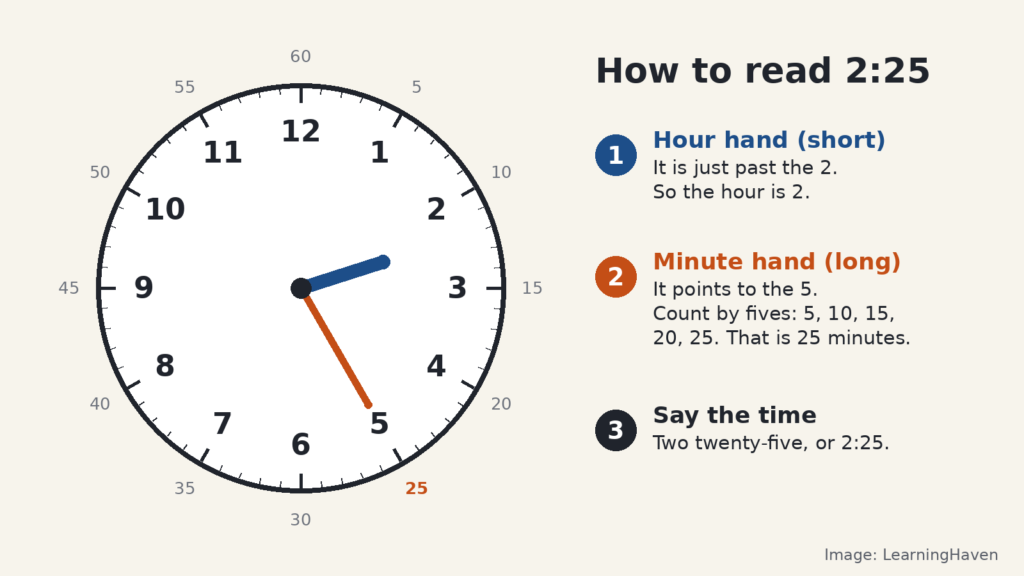
Telling time on an analog clock means reading the short hour hand and the long minute hand together. This page covers the parts of a clock, o’clock, half past, quarter past and quarter to, counting by fives, a.m. and p.m., elapsed time, and free clock worksheets with an answer key.
What are the parts of an analog clock?
An analog clock shows the time with hands that move around a numbered face.
Encyclopaedia Britannica Kids describes it this way: “Moving hands on the face of a clock point to the current hour, minute, and second.” (Britannica Kids) The face has the numbers 1 through 12 and, on many clocks, 60 small marks around the edge (Wikipedia, Clock face). Each number sits 5 marks from the next, because 60 ÷ 12 = 5.
The hour hand is the short, thick hand. The minute hand is the long, thin hand. Merriam-Webster defines the minute hand as “the long hand that marks the minutes on the face of a watch or clock.” (Merriam-Webster) Some clocks also have a thin second hand.
Teach the hour hand first, then the minute hand, and the second hand last or not at all. The three Common Core time standards used on this page never mention seconds. They go in steps: hours and half-hours in Grade 1, the nearest five minutes in Grade 2, and the nearest minute plus elapsed time in Grade 3. This page follows the same steps.
This section covers the parts of a 12-hour analog clock. It doesn’t cover 24-hour dials or digital clocks.
How do the hour hand and minute hand work together?
The minute hand circles the face once an hour, while the hour hand moves from one number to the next.
The hour hand takes 12 hours to go around once (Wikipedia, Clock face). It creeps forward all hour long, so it is rarely right on a number. Read the hour from the last number it has passed. At 4:30, the hour hand sits halfway between the 4 and the 5, and the hour is still 4.
Angles show why. Measure each turn clockwise from the 12. The minute hand turns 6 degrees each minute (360 ÷ 60). The hour hand turns 30 degrees each hour (360 ÷ 12), or 0.5 degrees each minute (30 ÷ 60).
| Time | Minute hand angle | Hour hand angle |
|---|---|---|
| 3:00 | 0 degrees | 90 degrees |
| 4:30 | 180 degrees | 135 degrees |
| 2:25 | 150 degrees | 72.5 degrees |
| 8:45 | 270 degrees | 262.5 degrees |
At 4:30 the hour hand has turned 4 × 30 + 30 × 0.5 = 135 degrees, halfway between the 4 (120 degrees) and the 5 (150 degrees). Our worksheets use these exact angles.
This section covers how the two hands move. It doesn’t cover the second hand.
How do you read o’clock and half past?
A time is o’clock when the minute hand points straight up at the 12.
Standard 1.MD.B.3 sets the Grade 1 goal: “Tell and write time in hours and half-hours using analog and digital clocks.” (Common Core, Grade 1 Measurement & Data) The minute hand on the 12 means 0 minutes. The minute hand on the 6 means 30 minutes (6 × 5 = 30), which is half past, because 30 is half of 60.
Worked example. The hour hand is halfway between the 2 and the 3. The minute hand is on the 6.
- The minute hand is on the 6, so 6 × 5 = 30 minutes. This is half past.
- The hour hand has passed the 2 but not reached the 3, so the hour is 2.
- Say “half past 2.” Write 2:30.
With the minute hand on the 12 and the hour hand on the 3, the time is 3 o’clock, written 3:00.
This section covers o’clock and half past. It doesn’t cover quarter hours, which come next.
What do quarter past and quarter to mean?
A quarter of an hour is 15 minutes, because 60 ÷ 4 = 15.
The minute hand on the 3 means 15 minutes (3 × 5 = 15), so the time is quarter past the hour. The minute hand on the 9 means 45 minutes (9 × 5 = 45), so the time is quarter to the next hour. That is 15 minutes before the next hour begins (60 − 45 = 15). Use “past” when the minute hand is on the right side of the clock and “to” when it is on the left side. A quarter is one of four equal parts, as our fractions page explains.
Worked example. The hour hand is just before the 9. The minute hand is on the 9.
- The minute hand is on the 9, so 9 × 5 = 45 minutes. That is quarter to the next hour.
- The hour hand has not reached the 9, so the hour is 8 and the next hour is 9.
- Say “quarter to 9.” Write 8:45.
This section covers quarter past and quarter to. It doesn’t cover other spoken forms, such as “twenty to nine.”
How do you read time to the nearest five minutes?
Count by fives from the 12 to the number the minute hand points to.
Standard 2.MD.C.7 asks Grade 2 students to “tell and write time from analog and digital clocks to the nearest five minutes.” (Common Core, Grade 2 Measurement & Data) Each number on the face stands for a multiple of 5 minutes.
| Minute hand points to | 1 | 2 | 3 | 4 | 5 | 6 | 7 | 8 | 9 | 10 | 11 | 12 |
|---|---|---|---|---|---|---|---|---|---|---|---|---|
| Minutes after the hour | 5 | 10 | 15 | 20 | 25 | 30 | 35 | 40 | 45 | 50 | 55 | 0 |
Counting by fives is skip counting, covered on our counting page, and it is the 5 times table from our multiplication page. For a time between two fives, count single marks after the last five. At 3:17, count 5, 10, 15 and then 16, 17.
Worked example. The hour hand is almost at the 5. The minute hand is on the 11.
- Count by fives to the 11: 5, 10, 15 and on to 55. Check: 11 × 5 = 55 minutes.
- The hour hand has not reached the 5. The last number it passed is the 4, so the hour is 4.
- Say “5 to 5.” Write 4:55.
This section covers five-minute times. It doesn’t cover seconds or stopwatches.
What do a.m. and p.m. mean?
The abbreviation a.m. means before noon, and p.m. means after noon.
The National Institute of Standards and Technology explains that “a.m.” and “p.m.” stand for “ante meridiem” and “post meridiem,” which mean “before noon” and “after noon.” (NIST, Times of Day FAQs) A 12-hour clock shows each hour twice a day, once before noon and once after (24 ÷ 12 = 2). So 7:30 a.m. is a morning time and 7:30 p.m. is an evening time. Standard 2.MD.C.7 includes this skill with the words “using a.m. and p.m.”
Noon and midnight need care. NIST says 12 a.m. and 12 p.m. “are ambiguous and should not be used.” Write “noon” or “midnight” instead.
Worked example. Write a.m. or p.m. for breakfast at 6:30 and dinner at 6:30.
- Breakfast is in the morning, before noon. Write 6:30 a.m.
- Dinner is in the evening, after noon. Write 6:30 p.m.
This section covers a.m. and p.m. on a 12-hour clock. It doesn’t cover 24-hour time or time zones.
How do you find elapsed time?
Elapsed time is how much time passes from a start time to an end time.
Standard 3.MD.A.1 names the skill: “Tell and write time to the nearest minute and measure time intervals in minutes.” It adds that students “solve word problems involving addition and subtraction of time intervals in minutes, e.g., by representing the problem on a number line diagram.” (Common Core, Grade 3 Measurement & Data) A simple plan is to jump to the next hour first and then add what is left.
Worked example. A game starts at 3:15 p.m. and ends at 4:05 p.m. How long is it?
- Jump from 3:15 to 4:00. That is 45 minutes (15 + 45 = 60).
- Jump from 4:00 to 4:05. That is 5 minutes.
- Add the jumps: 45 + 5 = 50.
The game lasts 50 minutes. Finding an end time works the same way, using addition from our addition page.
Worked example. A show starts at 2:50 and lasts 25 minutes. When does it end?
- Jump from 2:50 to 3:00. That is 10 minutes.
- Find the minutes left: 25 − 10 = 15.
- Jump from 3:00 forward 15 minutes to 3:15.
The show ends at 3:15. Subtraction like 25 − 10 is covered on our subtraction page.
This section covers elapsed time inside one a.m. or p.m. period. It doesn’t cover crossing noon or midnight.
Where can you get free clock worksheets?
LearningHaven made two free clock worksheets. Both print on US Letter paper at 100% scale. You don’t need an account.
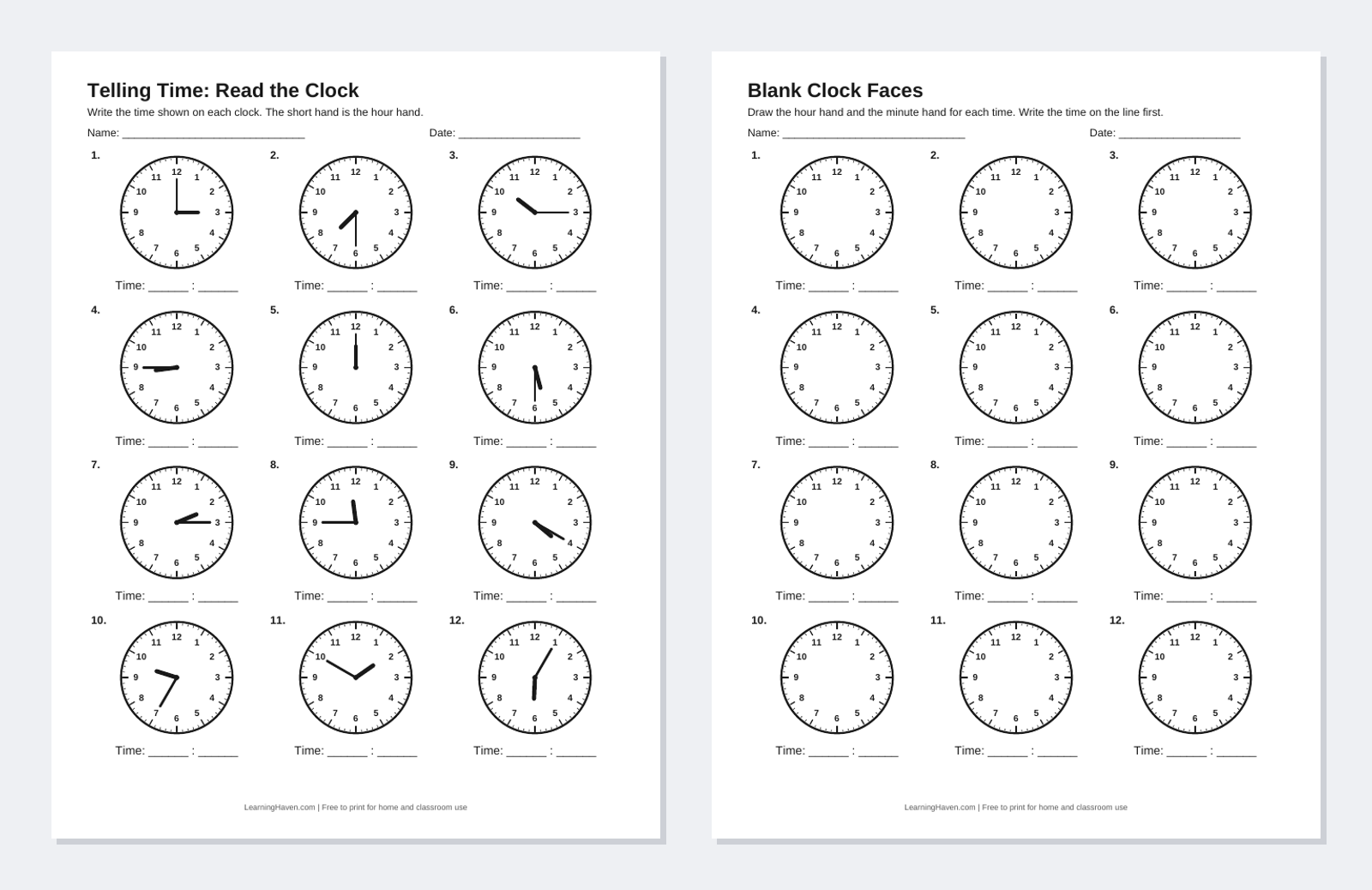
Clock-reading worksheet. It has 12 clocks. Two show o’clock times, two show half past, two show quarter past, two show quarter to, and four show other five-minute times. Every hand is drawn at the exact angle for its time, so the hour hand sits between numbers when it should.
Blank clock faces. It has 12 faces with numbers and minute marks but no hands. Call out a time, write it on the line, and let your child draw both hands.
Ask your child to say each time out loud before writing it, then check with the answer key. For more printables, see our math worksheets page.
This section covers the two worksheets made for this page. It doesn’t cover worksheets on digital clocks or the nearest minute.
Practice set
Work through these on paper, then check your answers.
- The hour hand is halfway between the 9 and the 10. The minute hand is on the 6. What time is it?
- The hour hand is just past the 11. The minute hand is on the 3. What time is it?
- The hour hand is almost at the 5. The minute hand is on the 9. What time is it?
- The hour hand is just past the 1. The minute hand is on the 7. What time is it?
- School starts at 8:30 in the morning and ends at 3:15 in the afternoon. Write each time with a.m. or p.m.
- Soccer practice starts at 4:20 p.m. and ends at 5:05 p.m. How many minutes is practice?
Show answers and reasoning
- 9:30, or half past 9. The minute hand on the 6 means 6 × 5 = 30 minutes. The hour hand has passed the 9. Check: 30 is half of 60.
- 11:15, or quarter past 11. The minute hand on the 3 means 3 × 5 = 15 minutes. The hour hand has passed the 11. Check: 60 ÷ 4 = 15.
- 4:45, or quarter to 5. The minute hand on the 9 means 9 × 5 = 45 minutes. The hour hand has not reached the 5, so the hour is 4. Check: 60 − 45 = 15 minutes to 5:00.
- 1:35, or 25 minutes to 2. The minute hand on the 7 means 7 × 5 = 35 minutes. The hour hand has passed the 1. Check: 60 − 35 = 25 minutes to 2:00.
- 8:30 a.m. and 3:15 p.m. Morning times are before noon, so they get a.m. Afternoon times are after noon, so they get p.m.
- 45 minutes. Jump from 4:20 to 5:00, which is 40 minutes (20 + 40 = 60). Then jump 5 minutes to 5:05. Add: 40 + 5 = 45. Check: 4:20 plus 45 minutes is 5:05.
Elapsed time is addition and subtraction on a clock, so our addition page and subtraction page are natural next stops.
Schedules turn into story problems, which you can practice on our word problems page. For a break from paper, try our math games page.
Homeschool families can fit clock practice into our K to 3 learning plan. For more topics, visit our math hub.
Sources
- Common Core State Standards Initiative. Grade 1 Measurement & Data.
- Common Core State Standards Initiative. Grade 2 Measurement & Data.
- Common Core State Standards Initiative. Grade 3 Measurement & Data.
- Encyclopaedia Britannica Kids. Clock.
- Merriam-Webster. Minute hand.
- National Institute of Standards and Technology. Times of Day FAQs.
- Wikipedia. Clock face.