Bartering is trading goods or services directly for other goods or services, usually with no cash changing hands. It works only when each person wants what the other has. Scholars debate whether barter came before money, so treat that old story as an idea and not a fact.
Key facts
- Bartering is the exchange of goods or services, and usually no cash changes hands (IRS).
- Barter needs a “double coincidence of wants,” which means each person wants what the other has (Stanford Encyclopedia of Philosophy).
- People used metal as money in Babylon before 2000 BCE (Britannica).
- Archaeologists found 93 electrum coins at Ephesus that date to the late 600s BCE (Sardis Expedition).
- China produced the world’s first government-issued paper money in the 1020s CE (Columbia University).
This page is part of our economics section. BCE means “Before Common Era” and covers the same years as BC. CE means “Common Era” and covers the same years as AD.
What is bartering?
Bartering means trading something you have for something you need. Imagine a potter who makes bowls and a farmer who grows beans. The potter gives the farmer three bowls. The farmer gives the potter a sack of beans.
You can barter services too. The IRS gives this example: a plumber trades plumbing work for the services of a dentist (IRS). Plumbers and dentists are both community helpers. The English word “barter” was first recorded in the 15th century (Merriam-Webster).
Why is bartering hard?
Bartering is hard because both people must want what the other person has. The Stanford Encyclopedia of Philosophy says, “Barter only works when there is a double coincidence of wants” (Stanford Encyclopedia of Philosophy).
Matches like this are rare. Barter does work when the wants match, as the potter and farmer show. In the game at the end of this page, three people form three possible pairs. None of the three pairs can make a swap that pleases both people.
Size is a second problem. The Federal Reserve Bank of Philadelphia calls barter “an inefficient means of trading” and names divisibility as a main problem (Federal Reserve Bank of Philadelphia). Divisibility means splitting value into small parts. You cannot pay for a loaf of bread with half a cow.
Price is a third problem. How many beans equal one bowl? Economists call a shared measure of value a unit of account (Stanford Encyclopedia of Philosophy). Without one, every trade needs a long talk. Our percentage lessons help you compare values.
Did barter come before money?
Scholars disagree, and the popular story that barter always came first is now questioned. The debate is about whether barter led step by step to money.
The story. People bartered, found it clumsy, and then chose one item to use as money. Economists Adam Smith in 1776 and Carl Menger in 1892 told it this way (Stanford Encyclopedia of Philosophy). The Federal Reserve Bank of Philadelphia lesson still says, “Initially, trading was carried out through barter, the direct exchange of goods and services” (Federal Reserve Bank of Philadelphia).
The correction. The Stanford entry, revised on March 10, 2023, reports that “recent anthropological studies question the idea that early societies went from a barter economy to money” (Stanford Encyclopedia of Philosophy). Money seems to have arisen to keep track of credit that people already owed each other. Credit means one person gives something now and is paid back later.
What to take from it. Britannica says barter is considered the oldest form of commerce (Britannica). People turn to barter when money fails. After World War II, German money lost its value, and people used barter and money substitutes such as cigarettes (Britannica).
How did money change from shells to paper?
Money changed from everyday goods to metal coins and then to paper.
What did people use as money before coins?
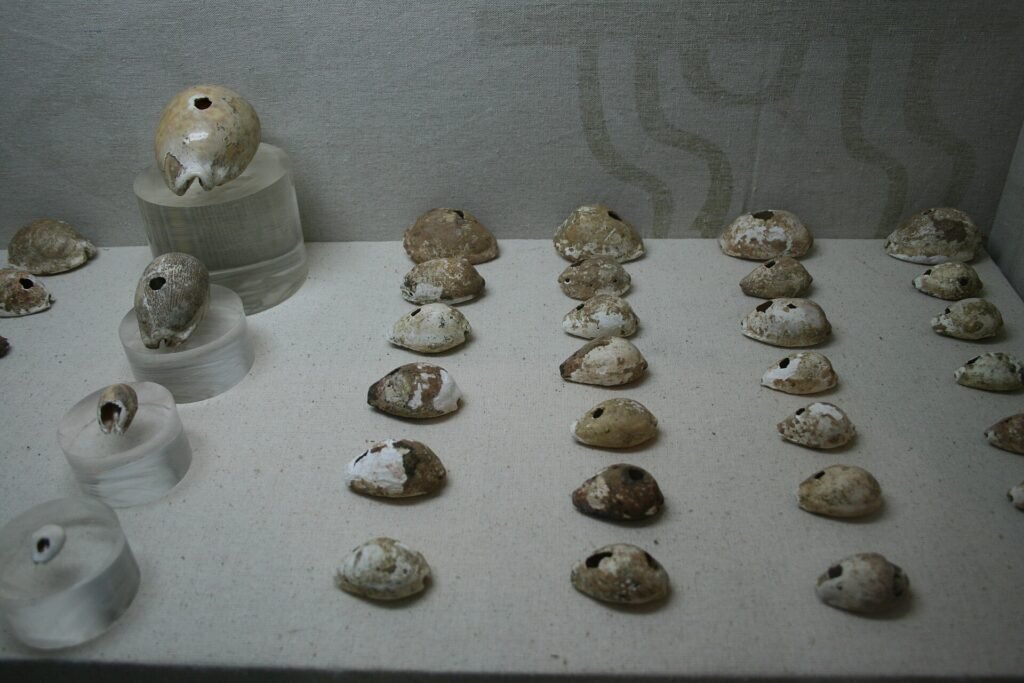
Many societies used goods that had value in themselves. Economists call this commodity money (Federal Reserve Bank of Philadelphia). Cowries, which are brightly colored shells, served as money in India. Cattle were widely used as money too. The English word “pecuniary” comes from the Latin word “pecus,” which means cattle (Britannica).
The Smithsonian says small seashells make good money because they are durable, portable and hard to imitate (National Museum of American History). The same Federal Reserve lesson notes that commodity money was not a perfect medium of exchange (Federal Reserve Bank of Philadelphia). Metal was used as money too. People in Babylon, a city in ancient Mesopotamia, used metal as money before 2000 BCE (Britannica).
When were coins invented?
The first coins appeared in the 600s BCE. They were made of electrum, a natural mix of gold and silver. The British Museum finds most of the earliest coins in parts of modern Turkey that formed the ancient kingdom of Lydia (British Museum).
In 1904 and 1905, archaeologists found 93 electrum coins under the Temple of Artemis at Ephesus. Someone had left them as offerings in the late 600s BCE. The Greek historian Herodotus wrote that “the Lydians were the first to mint and use a coinage of gold and silver” (Sardis Expedition). The Smithsonian adds that coins were made at about the same time in China, and in India in the 5th century BCE (National Museum of American History).
When did paper money begin?
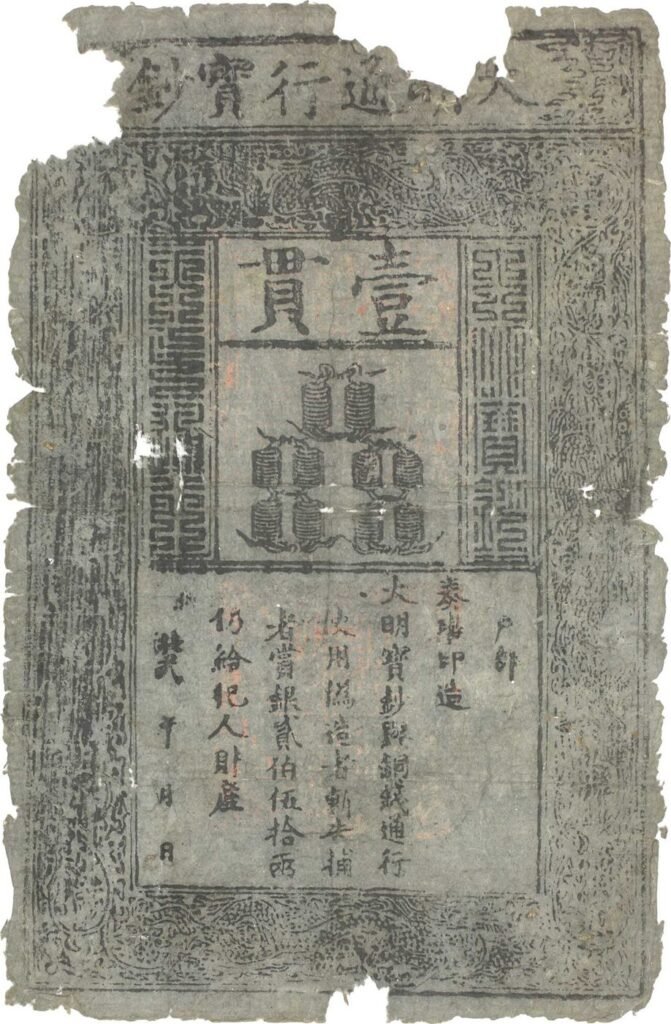
Paper money began in China, and merchants started it. Carrying thousands of strings of coins over long distances was a burden. Around 900 CE, merchants began trading receipts from shops where they had left money or goods. In the 1020s the Song government took over and produced “the world’s first government-issued paper money” (Columbia University, Asia for Educators). That is more than 1,500 years after the first coins.
What makes money easier to use than barter?
Good money has six traits. The Federal Reserve Bank of Philadelphia lists them as portable, durable, divisible, stable in value, relatively scarce, and acceptable (Federal Reserve Bank of Philadelphia).
Economists also name three jobs for money. It is a medium of exchange, a unit of account and a store of value (Stanford Encyclopedia of Philosophy). A medium of exchange is what you hand over in a trade.
A coin that everyone accepts lets the potter sell bowls to one person and buy beans from another. To practice planning with money, try our event budget page.
Do people still barter today?
Yes, and some people barter through a barter exchange, which is an organization whose members contract with each other to exchange property or services. A babysitting group run by neighborhood parents does not count as one (IRS).
In the United States, bartering has tax rules. The IRS says, “You must include in gross income in the year of receipt the fair market value of goods or services received from bartering” (IRS). The IRS page was reviewed on October 8, 2026. Ask an adult to check the current rules before you trade.
Try this: a paper-card exchange
You need three players and three cards. Use imaginary goods only.
| Player | Holds | Wants |
|---|---|---|
| A | kite | book |
| B | book | hat |
| C | hat | kite |
Can any two players swap and both be happy? Draw an arrow from each player to the one who holds the thing they want. Then look for a trade that works for all three.
Think about it
- What changes if Player B no longer wants a hat?
- What must the players tell each other before they trade?
- How would a coin that everyone accepts make the trade easier?
Discussion guide
No pair can swap and satisfy both players. A three-way trade works. A gives the kite to C, C gives the hat to B, and B gives the book to A. All three must agree to it. A coin lets each person sell to one player and buy from another. A classroom game like this is a simple model and does not describe every real economy in history.
Teachers can find more activities in our social studies lesson plans. For more stories of the past, browse the world history section.
Sources
- Internal Revenue Service. Topic no. 420, Bartering income
- Stanford Encyclopedia of Philosophy. Philosophy of Money and Finance
- Federal Reserve Bank of Philadelphia. What Is Money? Grades 3-5 lesson
- Encyclopaedia Britannica. Money and Barter
- Merriam-Webster. Barter
- Smithsonian National Museum of American History. Forms of Money
- British Museum. The origins of coinage
- The Archaeological Exploration of Sardis. The Coins of Sardis (John H. Kroll)
- Columbia University, Asia for Educators. Song Dynasty China: Money