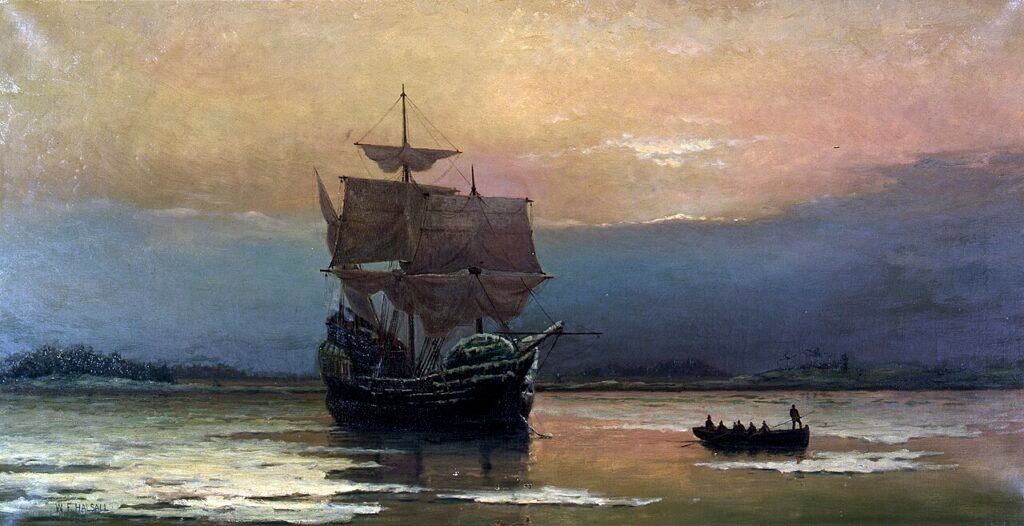
The Pilgrims were English Separatists who sailed on the Mayflower in 1620 and founded Plymouth Colony in present-day Massachusetts (HISTORY). Not every passenger shared their faith, because investors recruited other settlers (Pilgrim Hall). About half of the Pilgrims died during the first winter (Smithsonian). Their 1621 harvest feast with the Wampanoag is remembered as the first Thanksgiving (Pilgrim Hall).
Key facts
- The Mayflower left England in September 1620 with 102 passengers and sighted Cape Cod after 66 days (Pilgrim Hall).
- Sailors in 1620 could measure latitude but not longitude (The Conversation).
- 41 men signed the Mayflower Compact, dated November 11, 1620 (HISTORY, Avalon Project).
- About half of the Pilgrims died during the first winter (Smithsonian).
- 53 Pilgrims and at least 90 Wampanoag people attended the 1621 harvest event (Pilgrim Hall).
Who were the Pilgrims?
The Pilgrims were English Christians called Separatists, who wanted a church fully separate from the Church of England (NPS). English law banned every other church, so some Separatists were fined or jailed and fled to the Netherlands (Plimoth). Puritans were different. They wanted to reform the Church of England, not leave it (Plimoth).
People did not generally call the Plymouth colonists “Pilgrims” until the early 1800s. Governor William Bradford did write that “They knew they were pilgrims,” meaning travelers on a spiritual journey (Pilgrim Hall). See more in our US history section.
Why did the Pilgrims leave Holland for America?
The Pilgrims left Holland because of poverty, hard work, fears for their children and the threat of war (Pilgrim Hall). They had lived in Leiden for 11 or 12 years (Plimoth). Some hoped to spread their faith. They were not escaping persecution there. The Dutch were unusually tolerant (Pilgrim Hall), and the Pilgrims had religious freedom (Plimoth).
They planned to settle in the northern part of the Virginia Colony, which then reached the Hudson River (Plimoth). English investors paid for the trip and hired the Mayflower (Pilgrim Hall). A second ship, the Speedwell, leaked so badly that both ships turned back. The Mayflower sailed alone in September 1620 (Pilgrim Hall).
How did the Mayflower cross the Atlantic?
The Mayflower crossed the Atlantic in 66 days with 102 passengers. It was a cargo ship about 100 feet long, and the voyage was often stormy (Pilgrim Hall). One baby was born at sea and another off Cape Cod, which made 104 settlers (Pilgrim Hall).
The ship reached Cape Cod, not Virginia. The season was late and food and water were low, so the passengers could go no farther (Pilgrim Hall). Jonathan Ridley of Southampton Solent University writes that sailors used “a combination of the compass, hourglasses and a log” to record direction, time and speed (The Conversation). Both England and Cape Cod lie in the Northern Hemisphere.
How did sailors find their way in 1620?
Sailors steered by compass, tracked speed with a knotted line and found latitude from the sky, but they could not find longitude (The Conversation).
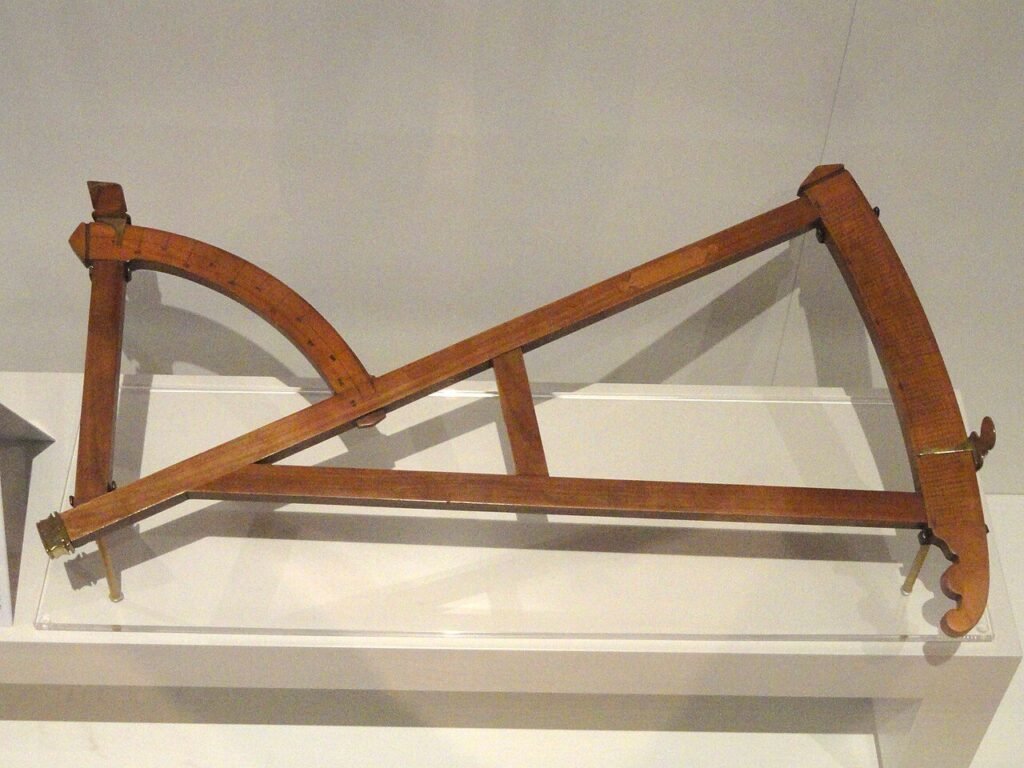
How did sailors find latitude?
Latitude is how far north or south of the equator you are (The Conversation). In the Northern Hemisphere, the height of the North Star in degrees roughly equals your latitude (Mayflower Descendants).
Robert Harper, who taught celestial navigation, wrote that Captain Christopher Jones probably measured the sun at noon with a Davis backstaff (Mayflower Descendants). A backstaff read the sun’s height from its shadow (Mariners’ Museum).
Harper wrote that the captain “would do well to get within a degree.” NOAA defines one nautical mile as one minute of latitude. A degree has 60 minutes, so one degree equals 60 nautical miles (NOAA).
Why could sailors not find longitude?
Longitude is how far east or west you are. Sailors could not measure it at sea because clocks were nowhere near accurate enough (The Conversation). Local noon comes four minutes later for each degree you travel west, so sailors needed a clock set to home time (The Conversation).
How did dead reckoning work?
Dead reckoning means working out your position from your direction, speed and travel time (The Conversation). Learn about direction on our page on reading a compass.
To measure speed, a sailor dropped a piece of wood on a knotted rope into the sea and counted the knots that ran out in a set time. One knot equals one nautical mile per hour, and a nautical mile equals 1.1508 land miles (NOAA).
Every half hour, the crew pegged the heading and speed on a traverse board. A four-hour watch filled eight records (Mariners’ Museum). Ridley notes that dead reckoning “would become more inaccurate as the voyage progressed” (The Conversation).
Try this: steer a pretend watch
Draw a grid. Let each square equal half a nautical mile. Start in the middle. Every half hour, move as many squares as the speed in knots, so 3 knots is 3 squares. Follow these eight records:
- West at 3 knots
- West at 3 knots
- West at 2 knots
- North at 2 knots
- West at 3 knots
- West at 3 knots
- South at 1 knot
- West at 2 knots
Where does your ship end up, in nautical miles?
Answer: You end 16 squares west and 1 square north. Sixteen squares at half a nautical mile each is 8 nautical miles west. That equals about 9.2 land miles.
What was the Mayflower Compact?
The Mayflower Compact was a written agreement to govern the new colony together. It is dated November 11, 1620, and was signed at Cape Cod (Avalon Project). Forty-one men signed it aboard the ship (HISTORY). They wrote it because Cape Cod lay outside the area where they had permission to settle (NPS).
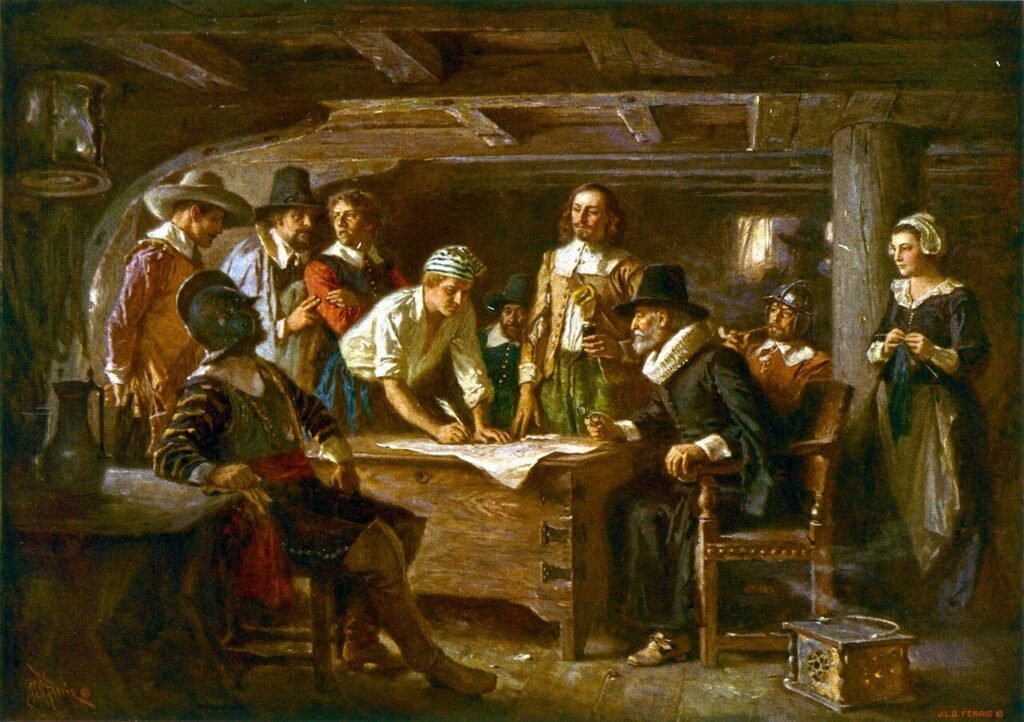
The signers promised to “covenant and combine ourselves together into a civil Body Politick.” The text promised “just and equal Laws” to come later (Avalon Project).
What happened during the first winter?
About half of the Pilgrims died during the first winter, weakened by scurvy, cold weather and pneumonia (Smithsonian). The Mayflower reached Plymouth Harbor on December 16, 1620 (Plimoth).
These numbers count Mayflower passengers only. The next ship, the Fortune, arrived in November 1621 (Pilgrim Hall).
In March 1621, the colonists made a treaty of mutual protection with the Wampanoag leader Ousamequin, also called Massasoit. A Wampanoag man named Squanto, who had been captured by English sailors, lived with the colonists and taught them to grow corn (Plimoth). Our page on the Wampanoag tells their story.
What was the harvest feast of 1621?
In autumn 1621, the surviving Pilgrims held a week-long harvest celebration. A large group of Wampanoag men joined them for three days (Pilgrim Hall). Pilgrim Hall counts 53 Pilgrims and at least 90 Wampanoag people at the event (Pilgrim Hall).
Edward Winslow, a colonist, wrote that Massasoit came “with some ninety men, whom for three days we entertained and feasted” (spelling modernized by Pilgrim Hall). Only two written accounts survive, and both come from English writers.
The story of the “First Thanksgiving” took shape in the 1800s (Plimoth). To see how English settlement spread, read about the Thirteen Colonies. To place Plymouth on a map, try our geography section.
Sources
- Pilgrim Hall Museum. The Voyage of the Mayflower & Speedwell
- Pilgrim Hall Museum. Mayflower Pilgrims
- Pilgrim Hall Museum. Exile in Holland
- Pilgrim Hall Museum. The “First Thanksgiving”
- Pilgrim Hall Museum. Who was at the “First Thanksgiving” at Plymouth?
- Plimoth Patuxet Museums. Who Were the Pilgrims?
- National Park Service, Cape Cod National Seashore. Pilgrims
- Yale Law School, Avalon Project. Mayflower Compact: 1620
- Smithsonian Magazine. This Thanksgiving, Step Back in Time and into 17th-Century Plymouth Colony
- HISTORY. The Pilgrims
- The Conversation. Mayflower 400: the science of sailing across the ocean in 1620
- General Society of Mayflower Descendants. The Mayflower Voyage
- The Mariners’ Museum. Traverse Board
- The Mariners’ Museum. Backstaff
- NOAA National Ocean Service. What is the difference between a nautical mile and a knot?