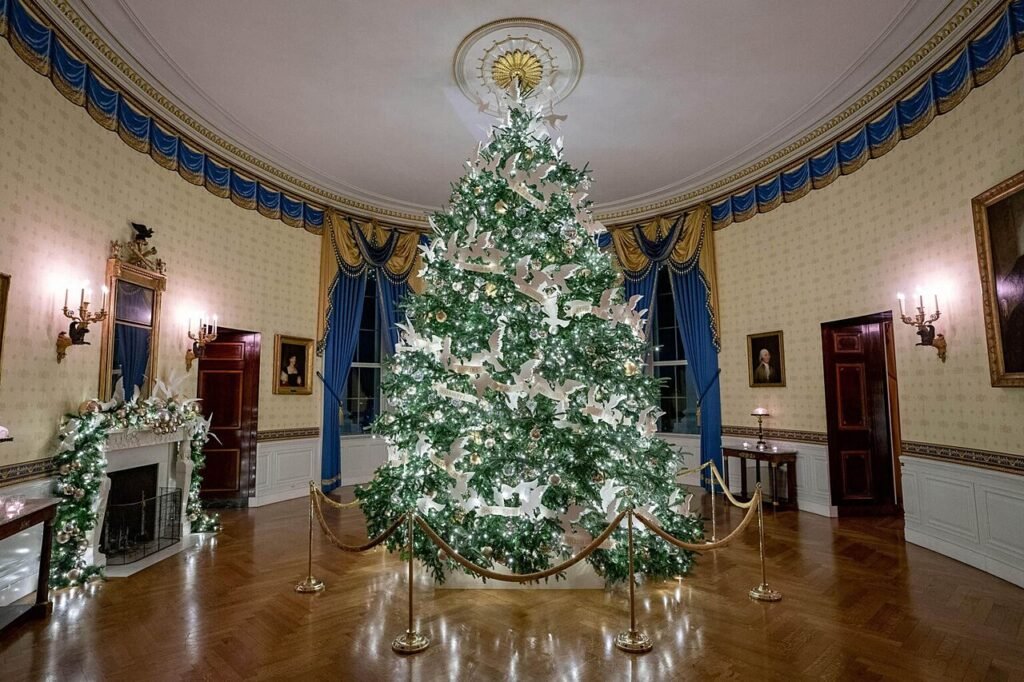
Christmas traditions have different origins: the tree most likely began in Germany, Santa Claus took shape in America, and the first card appeared in England. Some popular stories are myths, including the claim that Coca-Cola invented Santa’s red suit. Other countries add customs of their own.
Key facts
- Many Western churches celebrate Christmas on December 25. Many Eastern churches celebrate it on January 6 or 7 (Encyclopaedia Britannica).
- Records show a Christmas tree raised in Strasbourg Cathedral in 1539 (National Geographic).
- Cartoonist Thomas Nast drew Santa visiting an army camp in Harper’s Weekly dated January 3, 1863 (New York State Library).
- Haddon Sundblom painted his first Coca-Cola Santa in 1931. Santa wore a red coat before then (Atlanta History Center).
- Henry Cole sent the first Christmas card in 1843 (Victoria and Albert Museum).
Where did the Christmas tree come from?
The Christmas tree as we know it most likely began in Alsace in the 1500s (National Geographic). Alsace was German territory then. Records show a tree raised in Strasbourg Cathedral in 1539. The city of Freiburg banned cutting trees for Christmas in 1554, after the custom grew popular.
Evergreens are older than the tree. “Evergreens at midwinter festivals were traditional since the ancient world, signifying the victory of life and light over death and darkness,” wrote Carole Cusack, a religious studies professor at the University of Sydney, in an email to National Geographic.
German emigrants took the custom abroad. Queen Charlotte, a German princess who married King George III, is thought to have introduced a tree to the British royal household. In 1848 the Illustrated London News printed an engraving of Queen Victoria and Prince Albert with their children around a tree. It helped make the custom popular in Britain (Victoria and Albert Museum).
Latvia and Estonia claim the first tree, in 1510 and 1441. A historian at the National Library of Latvia says those guild festivities were likely unrelated to Christmas (National Geographic).
Myth check. A popular story says Martin Luther added the first candles to a tree after he saw stars through a forest. Texas A&M AgriLife Extension calls this 16th century folklore. It adds that some historians place the first evidence of a lighted tree more than a century after Luther died in 1546 (Texas A&M AgriLife Extension). Call the Luther story a legend when you retell it.
Explore more holiday histories in our holidays section.
Where did Santa Claus come from?
Santa Claus grew from stories about Saint Nicholas, who is remembered as a 4th-century bishop of Myra (Encyclopaedia Britannica). The Dutch call him Sinterklaas. The American Santa began taking shape in the 1820s, and poems and artists kept changing him (CNN).
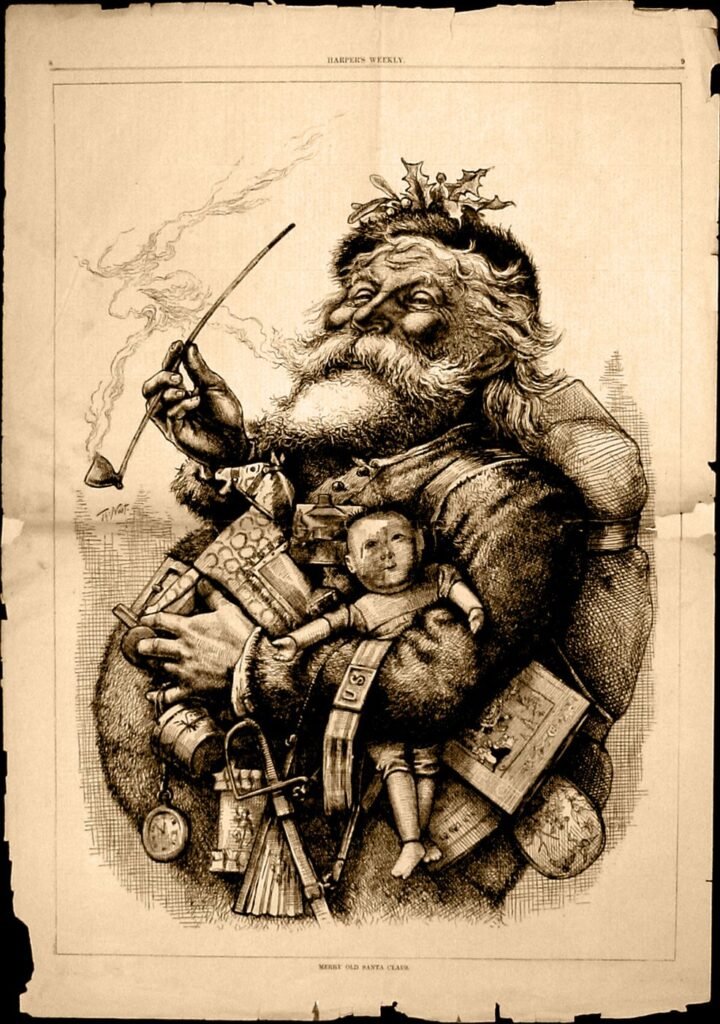
Artists shaped his look. Thomas Nast drew Santa visiting a military camp during the Civil War in Harper’s Weekly dated January 3, 1863. It was the first of many Santa drawings he made for the magazine (New York State Library). Historian Gerry Bowler told CNN, “It took about 80 years for American artists to settle on Santa’s outfit” (CNN).
Myth check. Many people think Coca-Cola invented Santa’s red suit. Artist Haddon Sundblom painted his first Coca-Cola Santa in 1931. Caitlin Smith Bowron, Archives Manager at The Coca-Cola Company, wrote that “Santa appeared in a red coat well before Sundblom painted him” (Atlanta History Center). CNN reports that Norman Rockwell and J.C. Leyendecker drew Santa in his now iconic suit for The Saturday Evening Post in the early 20th century (CNN). Coca-Cola made one version of Santa famous.
Who sent the first Christmas card?
Henry Cole sent the first Christmas card in 1843, using a design by the artist John Callcott Horsley. His diary entry for December 17, 1843 says, “In the Evg Horsley came & brought his design for Christmas Cards” (Victoria and Albert Museum).
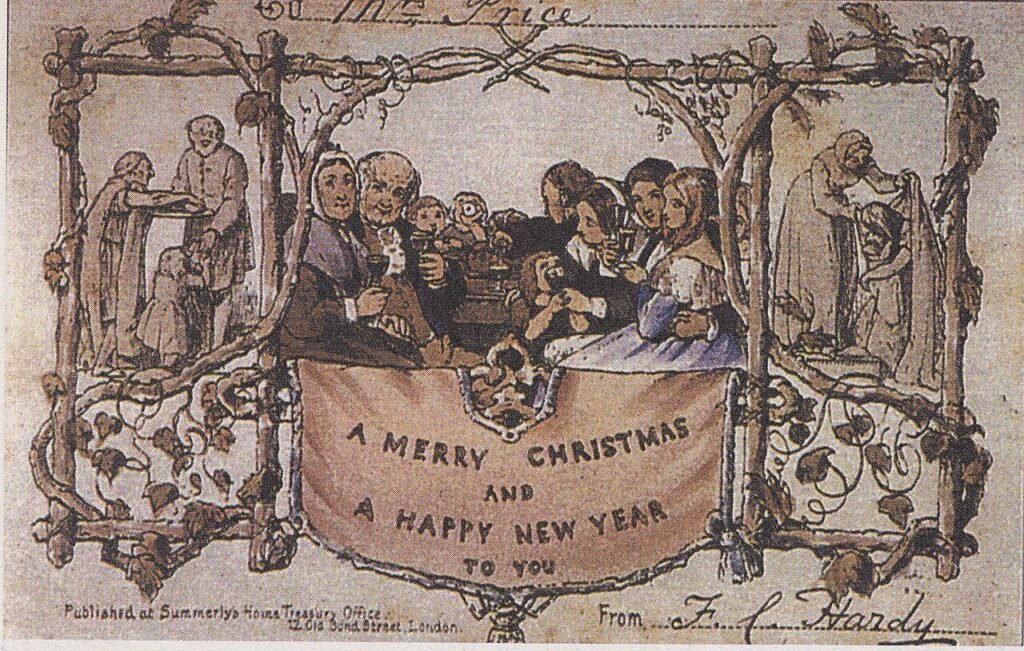
Cole had 1,000 copies printed and sold them for a shilling each. That price was high for the time, and the venture was judged a commercial flop. By the 1870s the Christmas card trend was firmly established (Victoria and Albert Museum).
Cole helped set up the Uniform Penny Post. It began in 1840, three years before the card. It let you send a letter anywhere in Britain for one penny (London Museum).
The first card did not show a religious scene. It showed three generations of the Cole family raising a toast. A second card by William Maw Egley came in 1848. People once thought it was older because its date was misread as 1842 (Victoria and Albert Museum).
Why is Christmas on December 25?
Historians have no record of the day Jesus was born. “There is simply no historical record,” said Lynn Ross-Bryant, a religious studies professor at the University of Colorado Boulder (CU Boulder Today).
Many Western churches celebrate Christmas on December 25, and many Eastern churches celebrate it on January 6 or 7. Scholars still debate why the December date was chosen. Ross-Bryant points to a Roman celebration of the unconquered sun god at the winter solstice. A 2012 review in Church History says researchers should weigh both outside religious influence and early Christian calculations of dates (Church History).
Many Orthodox churches still use the Julian calendar. It runs 13 days behind the Gregorian calendar used by Western churches. December 25 on the Julian calendar falls on January 7 (University of Maine). This page describes customs. It does not say which date is correct.
How do people celebrate Christmas around the world?
Customs differ by country, and some seasons start in September or fall in January. Here are six examples. You can find each country in our geography section.
- Germany. Families traditionally put up and decorate the tree on Christmas Eve, December 24. Real candles are still common. The Christ Child brings presents in the south and Father Christmas in the north (Germany Travel).
- Sweden. People celebrate Lucia on December 13 with processions in white gowns. Lucia traditionally wears light in her hair, which today is usually a crown of electric candles (Sweden.se).
- Mexico. Las Posadas runs from December 16 to 24. “Posada” means inn. A procession re-enacts Mary and Joseph looking for lodging, and children break star-shaped piñatas afterward (University of Wisconsin-Milwaukee Libraries).
- The Philippines. The Christmas season starts as early as September. Homes display the parol, a star-shaped lantern. Simbang Gabi is a nine-day series of early morning masses. It began in the Spanish colonial period as a practical choice for farmers who started work before sunrise (National Irrigation Administration, Philippines).
- Ethiopia. Ethiopian Orthodox Christians celebrate Genna on January 7. The main decoration is a manger scene, not a tree. Children play a hockey-like game that is also called Genna (REOnline).
- Australia. Christmas falls in summer, so beaches and barbecues are common. The Boxing Day cricket Test at the Melbourne Cricket Ground, held the day after Christmas, has been a tradition since 1980 (State Library Victoria).
Other holidays have food and customs tied to a calendar too. Read about Pancake Day, or see how another tradition marks a holiday on our Eid page.
Try this: trace a tradition
Pick one custom from this page and find its country on a map. Then answer three questions. Which date does it use? What do people do? Which parts do you also see in another country on this page? Write a short paragraph and ask a parent or teacher to check your facts.
If you like making things, try our candy cane reindeer craft. Teachers can find classroom ideas in our social studies lesson plans.
Sources
- Encyclopaedia Britannica. Christmas
- Encyclopaedia Britannica. St. Nicholas Day
- University of Colorado Boulder. Origins of Christmas Traditions Explained by CU-Boulder Professor
- Nothaft, C. P. E. Church History. The Origins of the Christmas Date: Some Recent Trends in Historical Research
- University of Maine, Religious Studies. Christmas (Orthodox Christian)
- National Geographic. Why do we have Christmas trees?
- Texas A&M AgriLife Extension. A Little Bit of History About Christmas Trees
- Victoria and Albert Museum. The magic of the tree
- New York State Education Department. Santa Claus in Camp
- CNN. Dress Codes: Why Santa Claus wears a red and white suit
- Atlanta History Center. A Look Inside Coca-Cola at Christmastime
- Victoria and Albert Museum. The first Christmas card
- London Museum. The Penny Post sparked a letter-writing revolution
- Germany Travel. Christmas Eve: Christmas tree, Christ Child and Father Christmas
- Sweden.se. Lucia in Sweden
- University of Wisconsin-Milwaukee Libraries. Las Posadas
- National Irrigation Administration, Philippines. The Filipino Christmas
- REOnline. Christmas Eve and Day: Orthodox and Rastafarian
- State Library Victoria. Holiday traditions we love