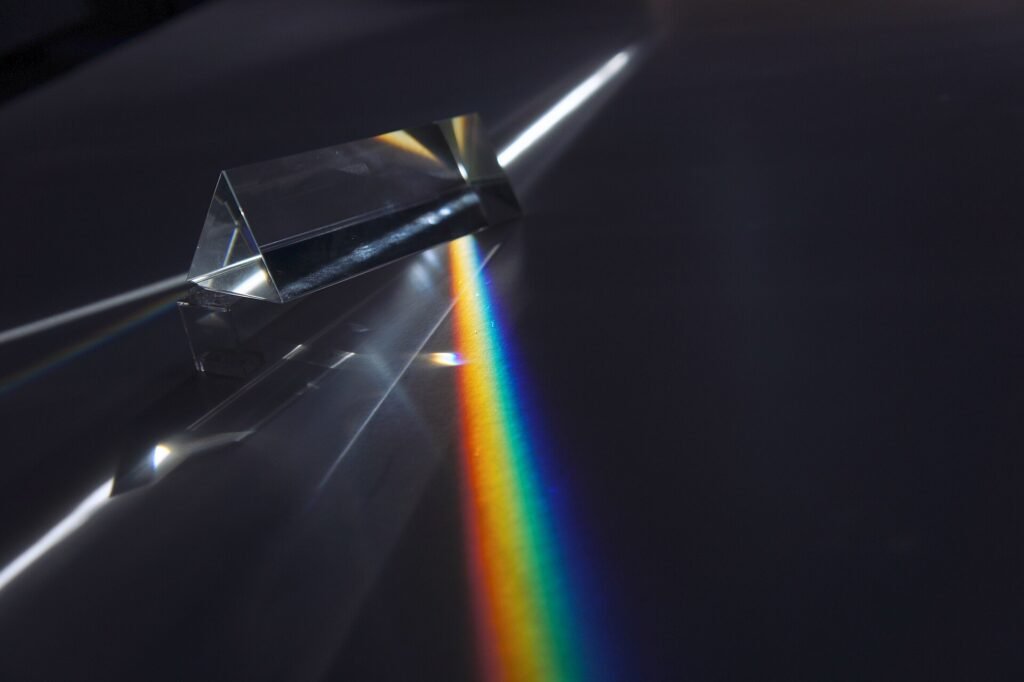
Color is what your eyes and brain make from the wavelengths of light that reach them. Your eyes detect only a narrow band, about 380 to 700 nanometers, called visible light. Objects look colored because they absorb some wavelengths and reflect the others.
Key facts
- Typical human eyes detect wavelengths from 380 nanometers (violet) to 700 nanometers (red) (NASA).
- Scientists estimate that people can tell apart up to 10 million colors (American Academy of Ophthalmology).
- William Herschel discovered infrared light in 1800 (NASA). Johann Ritter discovered ultraviolet light in 1801 (Caltech Cool Cosmos).
- The primary colors of light are red, green and blue (Smithsonian Libraries).
- Sunlight looks white because it is a mix of all the visible colors (Stanford Solar Center).
What is light?
Light is a form of energy, and your eyes can detect only a small part of it. NASA says electromagnetic energy “travels in waves and spans a broad spectrum from very long radio waves to very short gamma rays” (NASA).
The distance from one wave peak to the next is the wavelength (Stanford Solar Center). Scientists measure visible wavelengths in nanometers, and a nanometer is one billionth of a meter (NIST). Typical human eyes detect wavelengths from about 380 to 700 nanometers (NASA). Violet has the shortest visible wavelength and red has the longest (NASA).
Britannica gives 400 to 700 nanometers because the limits vary from person to person (Britannica).
Plants, algae and some microorganisms use light to make sugar and oxygen (Smithsonian Science Education Center). Light is one of many topics in our science section.
How do we see color?
You see color because cone cells in your eyes respond to different wavelengths of visible light. NASA describes cones as “receivers tuned to the wavelengths in this narrow band of the spectrum” (NASA).
Humans typically have three types of cones, sensitive to red, green and blue wavelengths (American Academy of Ophthalmology). The types overlap a little (West Texas A&M University). Light reflected from a lemon activates both red and green cones, and your brain reports yellow (American Academy of Ophthalmology).
Objects do not make color on their own. The American Academy of Ophthalmology says objects “reflect wavelengths of light that are seen as color by the human brain.” A yellow pigment absorbs blue and violet light and reflects yellow, green and red light (Britannica).
Scientists estimate that people can tell apart up to 10 million colors (American Academy of Ophthalmology).
These facts describe typical color vision. The National Eye Institute says about 1 in 12 men have color vision deficiency, and red and green are the colors most often confused.
Animals show color too. Our page on palomino horses explains one coat color.
What color is sunlight?
Sunlight is white light, a mix of all the visible colors. The Stanford Solar Center says the Sun is “essentially all spectral colors mixed together, which appear to human eyes as white.”
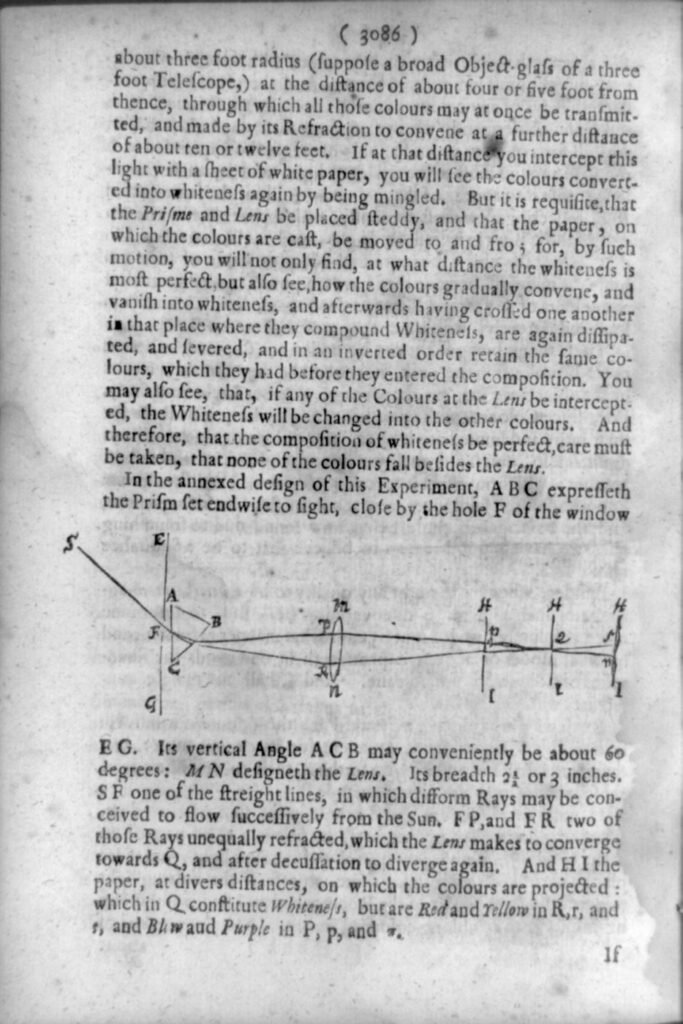
Isaac Newton showed this in the 1660s. He passed sunlight through prisms and found that white light is made of seven visible colors (Smithsonian Libraries).
A prism is a clear piece of glass that bends each color by a different amount (Britannica).
In his book Opticks (1704), Newton wrote that “if the Sun’s Light consisted of but one sort of Rays, there would be but one Colour in the whole World” (Smithsonian Libraries).
Many people think the Sun is yellow. It only looks yellow, orange or red when it is low in the sky. At midday its light crosses about 30 kilometers of air. At sunrise or sunset it crosses about 320 kilometers. Air scatters blue and violet light away on that long path, so mostly red, orange and yellow reach you (Stanford Solar Center). To check, look at a white cloud in midday sunlight.
Space photos of a neon green or pink Sun are false-color images that show light your eyes cannot see (Stanford Solar Center).
What colors are in a rainbow?
A rainbow shows red, orange, yellow, green, blue, indigo and violet, but the real spectrum is one smooth band.

Newton chose seven names for segments of that band, by analogy with the seven notes of the musical scale (Britannica). Many students remember the order as Roy G. Biv. Where one named color ends and the next begins is “a matter of culture and history,” says the Stanford Solar Center.
A rainbow works like a prism made of raindrops. Sunlight bends as it enters a raindrop. Each color bends at a slightly different angle because each has a different wavelength. The light reflects inside the drop and bends again as it leaves. You see the rainbow when you look away from the Sun (Britannica).
What are the primary colors of light?
The primary colors of light are red, green and blue, and equal amounts of all three make white. Mixing colored light adds colors together, which is called additive mixing (Smithsonian Libraries and Britannica).
Paint, dye and ink mix differently. They are subtractive, which means they start with white light and absorb some of its colors (West Texas A&M University).
| Kind of mixing | Light (additive) | Paint, dye and ink (subtractive) |
|---|---|---|
| Primary colors | Red, green, blue | Cyan, magenta, yellow (printing) |
| What happens | Colors add together. Equal amounts of all three make white. | Pigments absorb colors from white light. |
| Everyday examples | TVs, computer screens, phone screens | Paints, inks, printed pages |
School art classes often teach red, yellow and blue as the paint primaries (Smithsonian Libraries). Printers use cyan, magenta and yellow (West Texas A&M University and Britannica). Physics professor Christopher Baird explains that cyan, magenta and yellow can make more colors than red, yellow and blue (West Texas A&M University).
You can try mixing paint colors with our homemade watercolor paints craft.
What colors can’t we see?
Infrared and ultraviolet light lie just beyond red and violet, and your eyes cannot see either. Scientists found them in 1800 and 1801.
Infrared
In 1800, William Herschel split sunlight with a prism and put thermometers in each color. The readings rose from blue to red. A thermometer just past the red end read even warmer, and Herschel had discovered infrared light (NASA).
People give off infrared waves but not visible light. Night-vision goggles and infrared cameras detect it (NASA).
Pit vipers have heat-sensing pit organs between each eye and nostril that detect the heat of warm-blooded prey (Britannica). Learn more about how animals adapt in our animal adaptations page.
Ultraviolet
In 1801, Johann Ritter put silver chloride in each color of a prism’s spectrum. It darkened more toward violet and reacted strongly beyond the violet end, where no visible light fell. That showed ultraviolet light exists (Caltech Cool Cosmos).
UV-B rays cause sunburn, and about 95 percent of them are absorbed by ozone in Earth’s atmosphere. Bumblebees can see ultraviolet light (NASA).
Try this: make a rainbow, mix colored light and find infrared
- Make a rainbow. Hold a glass prism in a sunbeam so the light lands on white paper. Never look straight at the Sun.
- Mix colored light. Cover three flashlights with red, green and blue cellophane. In a dim room, shine them on white paper so the circles overlap. Where all three overlap, the light should look close to white. Results vary with your cellophane and flashlights.
- Find infrared. Point a TV remote at a phone camera and press a button. A remote uses infrared light near 940 nanometers, and some cell phone cameras can detect it (NASA). Some cameras show a faint glow and others do not.
Turn these tests into a project with our science fair project ideas. Teachers can find more activities in our science lesson plans.
Sources
- NASA Science. Introduction to the Electromagnetic Spectrum
- NASA Science. Visible Light
- NASA Science. Infrared Waves
- NASA Science. Ultraviolet Waves
- Caltech IPAC Cool Cosmos. The Ritter Experiment
- Smithsonian Libraries and Archives. The Science of Color
- Smithsonian Science Education Center. What is Photosynthesis
- American Academy of Ophthalmology. How Humans See In Color
- National Eye Institute. Color Blindness
- Stanford Solar Center. What Color is the Sun? and other mysteries
- West Texas A&M University. Why are red, yellow, and blue the primary colors in painting but computer screens use red, green, and blue?
- NIST. Metric (SI) Prefixes
- Britannica. Color: The Visible Spectrum
- Britannica. White Light
- Britannica. What Causes a Rainbow?
- Britannica. Pit Organ