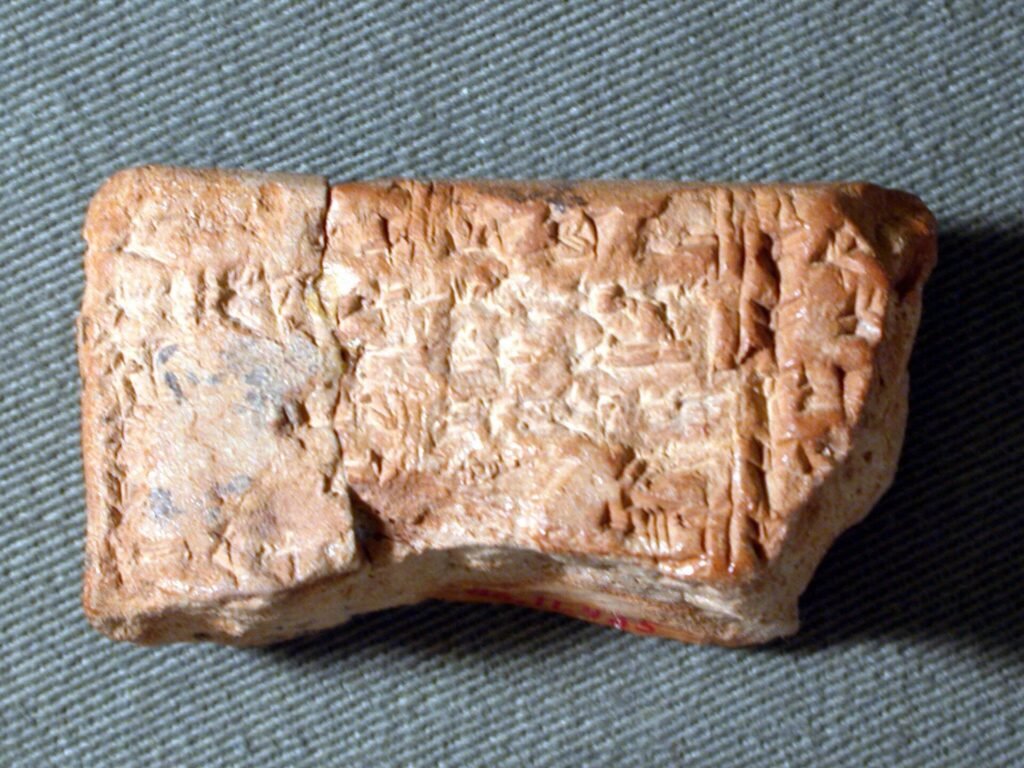
People first used writing more than 5,000 years ago, in Mesopotamia and Egypt, to keep records. Their dates overlap, and scholars still debate whether the two systems arose separately. Mesopotamians pressed wedge-shaped cuneiform into clay, Egyptians carved picture signs called hieroglyphs, and later people invented alphabets in which each letter stands for a sound.
You use writing every time you read a message or type on a keyboard. This page, part of our world history section, follows writing from clay tablets through Egyptian hieroglyphs, also called hieroglyphics, to the alphabet you use today.
Key facts
- Cuneiform and hieroglyphs both appeared between about 3400 and 3100 BCE. (BCE means “before the common era,” the same years as BC. CE means “common era,” the same years as AD.)
- Writing in Egypt appeared around 3250 BCE.
- The Rosetta Stone carries a decree from 196 BCE. French soldiers found it in July 1799.
- A letter read in public on 27 September 1822 marks the moment scholars deciphered hieroglyphs.
- The alphabet may be as old as 1800 BCE.
Who invented writing?
No single person invented writing, and it appeared in more than one place. The Penn Museum places the start of both cuneiform and hieroglyphs between 3400 and 3100 BCE (Penn Museum). Egyptian writing dates to around 3250 BCE (British Museum). The oldest dated tablets from Uruk are about 3100 to 2900 BCE (Met Museum).
Myth: the Egyptians were the first people to write. The dates overlap, and some scholars call cuneiform the earliest (Schmandt-Besserat). Others debate whether hieroglyphs were an independent invention or were inspired by cuneiform (Ingrid Piller, University of Hamburg). It is safer to say that writing appeared in both places within a few centuries.
The first writing was for counting, not for stories. Denise Schmandt-Besserat explains that “writing emerged from counting and accounting” (Schmandt-Besserat, 2014). Before tablets, people counted goods with clay tokens. A cone stood for a small measure of grain and a sphere for a large one. Tokens come from sites dated 8000 to 3000 BCE (Schmandt-Besserat).
How did cuneiform writing work?
Cuneiform is a script of wedge-shaped marks pressed into soft clay with a reed or wooden stylus. Later scholars named it after the Latin word for wedge (Met Museum).
A script is not a language. Scribes used cuneiform to write Akkadian, for example (Penn Museum). Pictures could not show sounds, so signs began to stand for sounds too. This is the rebus principle. A picture of an eye could stand for both “eye” and the word “I.” Such signs were rare from 3200 to 3000 BCE and became consistent only after 2600 BCE (Met Museum).
About 6,000 early tablets with more than 38,000 lines of text were known in 2004 (Met Museum). Meet the people who used them on our ancient Mesopotamia page.
What were Egyptian hieroglyphs?
Hieroglyphs, also spelled hieroglyphics, are the picture signs of ancient Egyptian writing, carved mostly in stone for temples, tombs and monuments (British Museum). The signs were becoming standardized in the Early Dynastic Period, about 3100 to 2686 BCE. Egyptians thought their beauty showed they were the “words of the gods” (UCL Museums).
Are hieroglyphs an alphabet?
No, hieroglyphs mix sound signs, word signs and picture clues. A foot stands for the sound b and an owl for m. Some signs stand for a longer sound, and word signs stand for whole words. A determinative is a picture that tells you a word is abstract or hard to draw (Penn Museum).
Hieroglyphs had very few symbols for vowels. That is why you see Ramesses, Ramses and Rameses for one pharaoh (Penn Museum).
What were hieratic and demotic?
Hieratic and demotic were faster handwritten scripts for the same Egyptian language. Hieratic is a joined-up shorthand of hieroglyphs. Demotic grew from hieratic and spread widely after Psamtek I conquered Upper Egypt in the 7th century BCE (UCL Museums).
Few people could read any of them. The British Museum says that in ancient Egypt “only about 1% of the population were literate.” Many scribes never mastered hieroglyphs and learned hieratic and demotic for daily work (British Museum).
What was papyrus?
Papyrus was a writing sheet made from the stems of the papyrus plant. Workers laid strips in two crossing layers, beat the damp sheet flat and smoothed it with a pebble. The strips stuck together without glue. Nobody knows when papyrus was first used for writing (Global Egyptian Museum).
How did people learn to read hieroglyphs again?
The Rosetta Stone, found in 1799, gave scholars a Greek text they could read beside hieroglyphs they could not. The last known hieroglyphic inscription is a graffito by a priest at Philae temple, dated to 394 CE. After that, the ability to read hieroglyphs was lost (British Museum).
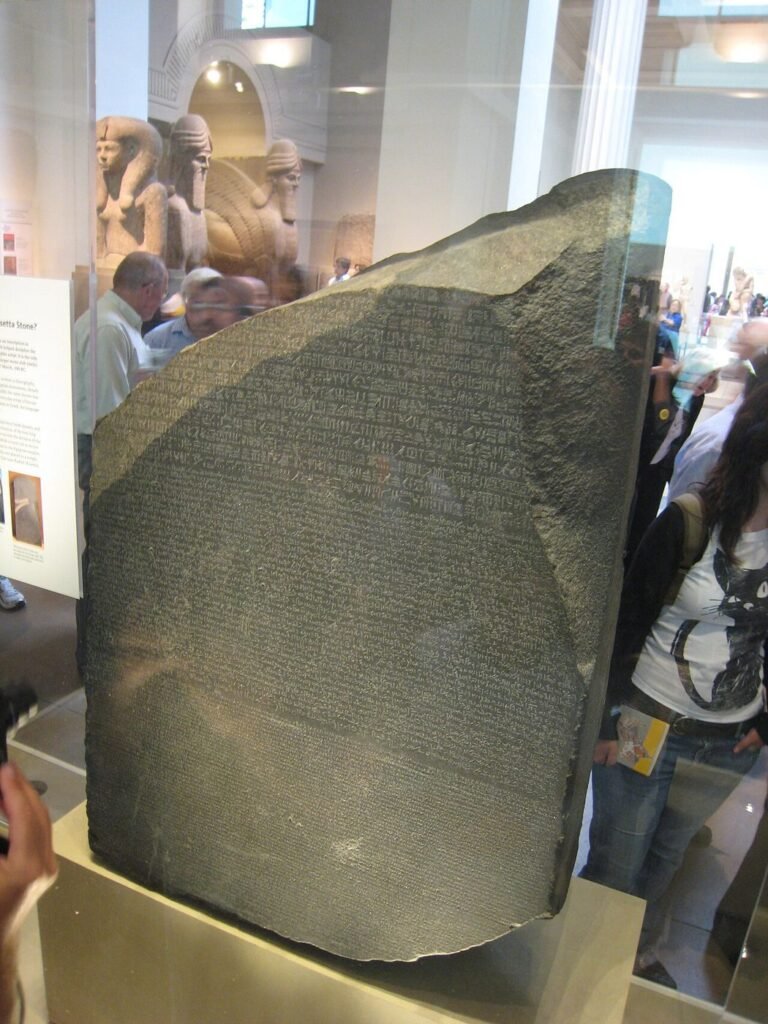
In July 1799, French soldiers working on a fort at Rashid found a large broken stone. Priests drew up its decree on 27 March 196 BCE (British Museum). The same text appears three times, in 14 lines of hieroglyphs, 32 lines of demotic and 54 lines of Greek (British Museum). The stone is not a dictionary. It is one decree written three ways.
Thomas Young showed that some hieroglyphs spelled the sounds of the name Ptolemy. Jean-François Champollion then realized that hieroglyphs recorded the sounds of the Egyptian language (British Museum). A letter about his findings, read in public on 27 September 1822, marks the moment of decipherment (British Museum timeline).
Did writing start anywhere else?
Yes, scholars think writing may have been invented independently in the Near East, China and Mesoamerica. The earliest Chinese inscriptions come from the Shang Dynasty, about 1400 to 1200 BCE. They are oracle texts engraved on animal bones and turtle shells (Schmandt-Besserat).
Where did the alphabet come from?
Many scholars think Canaanite people in the Levant, on the Eastern Mediterranean coast, invented the alphabet, possibly as early as 1800 BCE. In an alphabet, each letter stands for a sound. Penn Museum scholars write that “students of alphabetic writing only need to learn twenty to thirty letters to spell out the basic sounds of their spoken language” (Penn Museum).
In 1905, archaeologists Flinders and Hilda Petrie recorded unusual picture carvings at Serabit el-Khadim in the Sinai Peninsula. Alan Gardiner later realized these were early forms of the Phoenician alphabet. Each letter took its sound from the first consonant of the West Semitic word for the pictured object. The ox-head sign became aleph and the house sign became bet. Finds in Egypt and Syria keep the debate over its birthplace open (Penn Museum).
The alphabet took about a thousand years to come into widespread use. The earliest Greek alphabetic inscriptions date to the 700s BCE. The Latin alphabet used for English grew from the Greek alphabet, and our a-b-c-d order comes from the order used by the Phoenician alphabet (Penn Museum). Practice letter sounds with our phonics guide.
How did printing change writing?
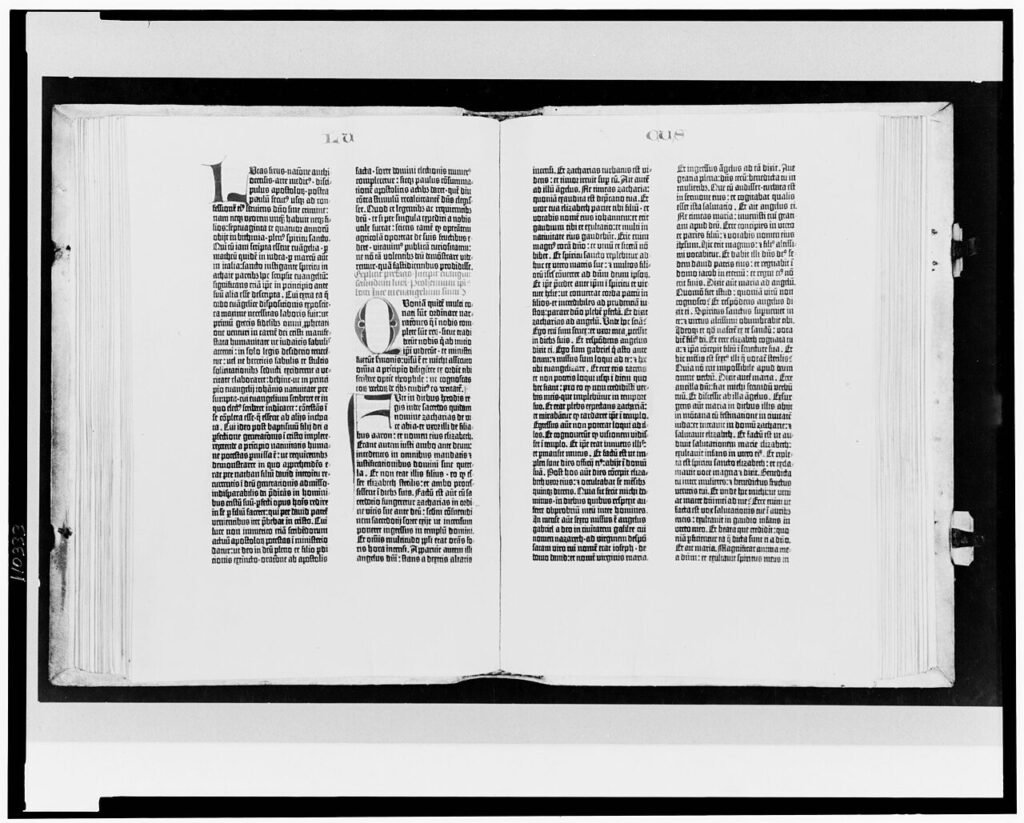
Johann Gutenberg printed a Bible in Mainz in about 1455, and printing made texts far easier to produce. The Library of Congress calls it “The first book printed with moveable metal type in Western Europe.” It was not the first printed book, because Korea used moveable metal type nearly a century earlier. About 180 copies were printed, and 49 survived into the twentieth century (Library of Congress). Read about Europe in that era on our medieval Europe page.
Try this: write like an ancient scribe
- Count with tokens. Roll a clay cone for a small measure and a ball for a large measure. Use them to record a trade with a friend.
- Write a rebus message. Draw an eye for “I” and a bee and a leaf for “belief.” Trade messages and read them.
- Write your name without vowels, as hieroglyphs mostly did. Can a friend read it?
- Think about it. Why did the first writers count things before they told stories? Why is it easier to learn twenty to thirty letters than hundreds of picture signs?
Find Egypt and the Eastern Mediterranean on a map in our geography section or in our world maps guide.
Teachers can plan this topic with our social studies lesson plans.
Sources
- The Metropolitan Museum of Art. The Origins of Writing
- British Museum. Egyptian Hieroglyphs Decipherment Timeline
- British Museum. The Rosetta Stone (Collection Online)
- British Museum. Hieroglyphs: Unlocking Ancient Egypt, large print guide
- UCL Museums and Collections. Egyptian Languages Explained
- Global Egyptian Museum. Papyrus (Glossary)
- Penn Museum, Expedition Magazine. The Alphabet
- Penn Museum. Write Like An Egyptian!
- Schmandt-Besserat, Denise. The Evolution of Writing (2014)
- Piller, Ingrid. Who Invented Writing? Language on the Move (2020)
- Library of Congress. The Gutenberg Bible