Two figures are similar when they have the same shape but not necessarily the same size. Their corresponding angles are equal and their corresponding sides are in the same ratio.
Enlarging a photograph is the everyday version. The shape stays the same and only the size changes. That is similarity.
The two conditions
Two polygons with the same number of sides are similar when both of these hold:
- Corresponding angles are equal. Every angle in one figure matches an angle in the other.
- Corresponding sides are in the same ratio. Divide each side by its match and you get the same number every time.
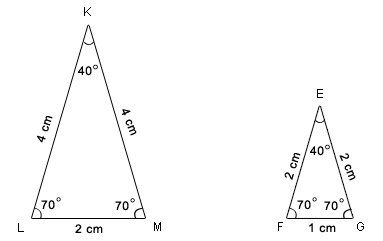
Both conditions are required for a general polygon. One on its own is not enough, and that is where most errors start.
The symbol for similarity is ∼. Writing △ABC ∼ △DEF says the two triangles are similar, and the order of the letters tells you which vertices correspond.
Similar quadrilaterals need both checks
A square and a rectangle have four equal angles each, all 90°, but they are not similar. The sides are not in a constant ratio.
A square and a rhombus that is not a square both have four equal sides, so the side ratio is constant. Their angles differ, so they are still not similar.
Two rectangles are similar only when the ratio of their sides matches. A 2 by 4 rectangle is similar to a 3 by 6, because 2 ÷ 4 and 3 ÷ 6 both give 0.5. It is not similar to a 3 by 5, because 3 ÷ 5 gives 0.6.
Triangles are the exception. For triangles alone, equal angles guarantee proportional sides, so three matching angles is enough. That shortcut does not extend to quadrilaterals or any other polygon.
Similar or congruent?
| Same shape | Same size | Symbol | |
|---|---|---|---|
| Similar | Yes | Not necessarily | ∼ |
| Congruent | Yes | Yes | ≅ |
Congruent figures can be superimposed to cover each other exactly. Similar figures cannot, unless the scale factor happens to be 1.
Every pair of congruent figures is also similar. The reverse is not true.
Scale factor
The scale factor k is the ratio between corresponding sides. If a side of 6 corresponds to a side of 3, the scale factor is 2.
Scale factor governs more than side length, and the pattern catches people out:
| Measurement | Ratio between similar figures | Example, k = 2 |
|---|---|---|
| Length (sides, perimeter) | k | 2 times |
| Area | k² | 4 times |
| Volume | k³ | 8 times |
A correction worth making
The claim: Doubling the size of a shape doubles its area.
Why it persists: Scale factor is introduced through side lengths, where doubling does mean doubling, and the rule gets carried across to area without being re-examined.
The correction: Area scales by the square of the scale factor. A shape enlarged by a factor of 2 has 4 times the area. Enlarged by 3, it has 9 times the area.
Why it works that way: Area is two dimensions multiplied together, and both of them get multiplied by k. A 2 by 3 rectangle has an area of 6. Doubled to 4 by 6, its area is 24, which is 4 times, not 2.
Finding a missing side
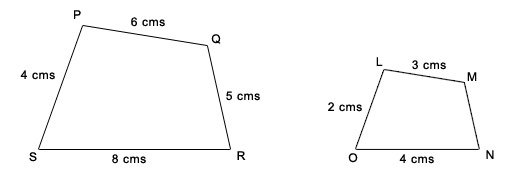
This is the main thing similarity is used for. Because corresponding sides are proportional, three known lengths give you the fourth.
- Identify which sides correspond. Matching the angles first makes this reliable.
- Write the proportion, keeping both figures on consistent sides of the equation.
- Cross-multiply and solve.
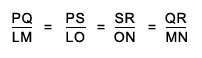
Worked example. If SR corresponds to ON and OR corresponds to MN, then SR divided by ON equals OR divided by MN.


Substituting the lengths and cross-multiplying gives 8n = 20, so n = 2.5.
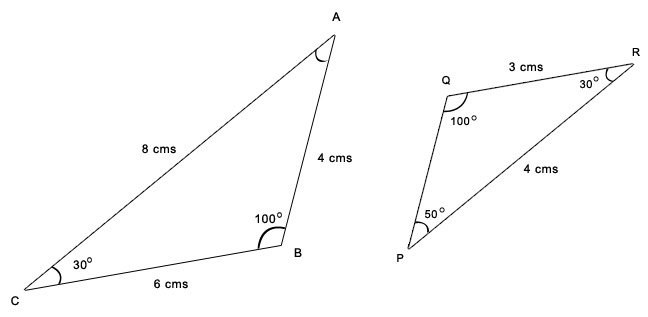
The most common mistake is pairing the wrong sides. Check the angles before you write the proportion, not after you get an answer that looks wrong.
More worked examples
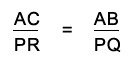
When all three angles of one triangle equal all three of another, the triangles are similar and the sides can be set in proportion.
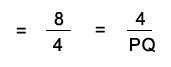
You only need two pairs of sides to solve for one unknown. The third pair is a useful check on your answer.
What this page does not cover
This page covers similarity of plane figures. Similar solids follow the same rules with volume scaling by k³, and are covered separately. Trigonometric ratios, which depend on the similarity of right triangles, are a separate topic.
Where to go next
For figures that match in size as well as shape, see congruent figures. For the proportional reasoning underneath this, see ratios and proportions. The section index is in geometry.