Two figures are congruent when they have exactly the same size and the same shape. Turning, flipping or sliding a figure does not change whether it is congruent.
The symbol for congruent is ≅. Writing △ABC ≅ △DEF says that triangle ABC is congruent to triangle DEF.
The test for congruence
Two figures are congruent if one can be placed exactly on top of the other with nothing left over and nothing sticking out.
Three moves are allowed while you do it, and none of them changes congruence:
- Slide the figure to a new position, also called a translation.
- Turn the figure, also called a rotation.
- Flip the figure over, also called a reflection.
Resizing is not on the list. Enlarging or shrinking a figure breaks congruence, and produces a similar figure instead.
Congruent, equal and similar
| Term | What it means |
|---|---|
| Congruent | Same shape and same size. Used for figures |
| Equal | The same value. Used for numbers and measurements |
| Similar | Same shape, any size. Angles match, sides are in proportion |
The distinction is worth keeping. Two triangles are congruent, but their areas are equal. Every pair of congruent figures is also similar, with a scale factor of 1. The reverse is not true.
Examples of congruent figures
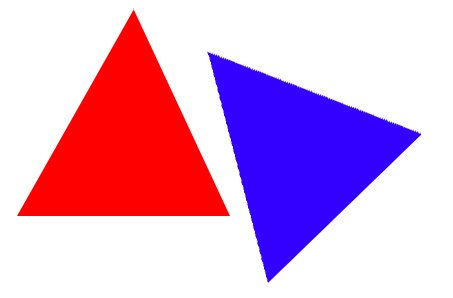
These two triangles are congruent. One has been rotated, which is why they look different at a glance, but every side and every angle matches.
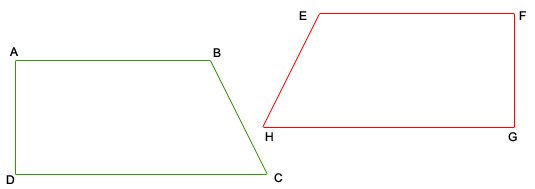
Quadrilateral ABCD and quadrilateral EFGH are congruent. Here one is a mirror image of the other, which is the flip. Flipping is allowed, so they are still congruent.
This is the point that most often surprises students. Orientation does not matter. Only size and shape do.
Reading congruence marks
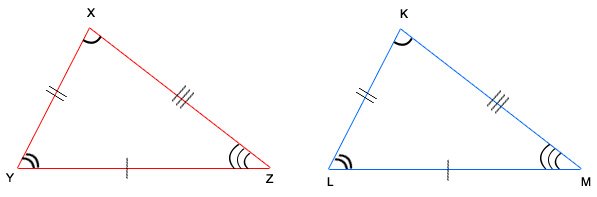
Diagrams use marks rather than numbers to show which parts match.
- Tick marks on sides. Sides with the same number of ticks are equal in length.
- Arcs on angles. Angles with the same number of arcs are equal in measure.
In this figure, the side with one tick in triangle XYZ matches the side with one tick in triangle KLM, and so on through two ticks and three ticks. The same holds for the angle arcs.
Reading the marks tells you the correspondence, which is the order the vertices pair up in.
Corresponding parts
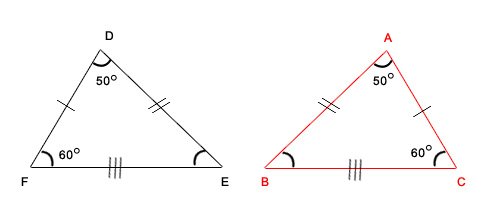
When two figures are congruent, each part of one has a partner in the other. Those partners are the corresponding parts.
In this figure the 50° angle in one triangle matches the 50° angle in the other, the 60° angles match each other, and the sides with matching ticks match in the same way.
Order matters when you write it. △ABC ≅ △DEF states that A matches D, B matches E and C matches F. Writing the letters in a different order states a different claim, and it may be false even when the figures really are congruent.
Five examples in real life
- Tiles on a floor. Cut from the same mold, so each is the same size and shape.
- Coins of the same denomination. Two quarters are congruent circles.
- Pages in a book. Every page is the same rectangle.
- Keys cut from the same blank. A spare key is congruent to the original, which is why it works.
- Stamps in a sheet. Identical rectangles repeated across the sheet.
The pattern behind all five is manufacturing. Anything made repeatedly from one mold, one die or one template comes out congruent.
Figures that are not congruent
Two figures fail the test if either size or shape differs.
- A large square and a small square have the same shape but different sizes. Similar, not congruent.
- A square and a rectangle of the same area have the same size in one sense but different shapes. Not congruent.
- Two rectangles measuring 4 by 6 and 3 by 8 both have an area of 24, and they are still not congruent.
That last case is the one to remember. Equal area does not mean congruent.
What this page does not cover
This page covers what congruence means and how to spot it. The shortcuts for proving two triangles congruent without checking all six parts, known as SSS, SAS, ASA, AAS and HL, are a separate topic. Congruence proofs and transformations in coordinate form are also covered separately.
Where to go next
For figures with the same shape but different sizes, see similar figures. For the shapes congruence is usually tested on, see polygon basics. The section index is in geometry.